
Catalogue Search | MBRL


Are you sure you want to remove the book from the shelf?

{{itemTitle}}
124
result(s) for
"German Americans -- History -- 19th century"
Sort by:


We Are the Revolutionists
AChoiceMagazine Outstanding Academic TitleWidely remembered as a time of heated debate over the westward expansion of slavery, the 1850s in the United States was also a period of mass immigration. As the sectional conflict escalated, discontented Europeans came in record numbers, further dividing the young republic over issues of race, nationality, and citizenship. The arrival of German-speaking \"Forty-Eighters,\" refugees of the failed European revolutions of 1848-49, fueled apprehensions about the nation's future. Reaching America did not end the foreign revolutionaries' pursuit of freedom; it merely transplanted it.
InWe Are the Revolutionists, Mischa Honeck offers a fresh appraisal of these exiled democrats by probing their relationship to another group of beleaguered agitators: America's abolitionists. Honeck details how individuals from both camps joined forces in the long, dangerous battle to overthrow slavery. In Texas and in cities like Milwaukee, Cincinnati, and Boston this cooperation helped them find new sources of belonging in an Atlantic world unsettled by massive migration and revolutionary unrest.
Employing previously untapped sources to write the experience of radical German émigrés into the abolitionist struggle, Honeck elucidates how these interethnic encounters affected conversations over slavery and emancipation in the United States and abroad. Forty-Eighters and abolitionists, Honeck argues, made creative use not only of their partnerships but also of their disagreements to redefine notions of freedom, equality, and humanity in a transatlantic age of racial construction and nation making.
eBook


Nassau Plantation
In the 1840s an organization of German noblemen, the Mainzner Adelsverein, attempted to settle thousands of German emigrants on the Texas frontier. Nassau Plantation, located near modern-day Round Top, Texas, in northern Fayette County, was a significant part of this story. James C. Kearney has studied a wealth of original source material (much of it in German) to illuminate the history of the plantation and the larger goals and motivation of the Adelsverein. This new study highlights the problematic relationship of German emigrants to slavery. Few today realize that the society’s original colonization plan included ownership and operation of slave plantations. Ironically, the German settlements the society later established became hotbeds of anti-slavery and anti-secessionist sentiment. Several notable personalities graced the plantation, including Carl Prince of Solms-Braunfels, Johann Otto Freiherr von Meusebach, botanist F. Lindheimer, and the renowned naturalist Dr. Ferdinand Roemer. Dramatic events also occurred at the plantation, including a deadly shootout, a successful escape by two slaves (documented in an unprecedented way), and litigation over ownership that wound its way to both the Texas Supreme Court and the U.S. Supreme Court.
eBook

A house of tailors
When thirteen-year-old Dina emigrates from Germany to America in 1871, her only wish is to return home as soon as she can, but as the months pass and she survives a multitude of hardships living with her uncle and his young wife and baby, she finds herself thinking of Brooklyn as her home.
Book

Women of Two Countries
German-American women played many roles in the US women's rights movement from 1848 to 1890. This book focuses on three figures-Mathilde Wendt, Mathilde Franziska Anneke, and Clara Neymann-who were simultaneously included and excluded from the nativist women's rights movement. Accordingly, their roles and arguments differed from those of their American colleagues, such as Susan B. Anthony, Elizabeth Cady Stanton, or Lucy Stone. Moreover, German-American feminists were confronted with the opposition to the women's rights movement in their ethnic community of German-Americans. As outsiders in the women's rights movement they became critics; as \"women of two countries\" they became translators of feminist and ethnic concerns between German- Americans and the US women's rights movement; and as messengers they could bridge the gap between American and German women in a transatlantic space. This book explores the relationship between ethnicity and gender and deepens our understanding of nineteenth-century transatlantic relationships.
eBook

Chancellorsville and the Germans
Often called Lee's greatest triumph, the battle of Chancellorsville decimated the Union Eleventh Corps, composed of large numbers of German-speaking volunteers. Poorly deployed, the unit was routed by StonewallJackson and became the scapegoat for the Northern defeat, blamed by many on the flightof German immigrant troops. The impact on America's large German community was devastating. But there is much more to the story than that. Drawing for the first time on German-language newspapers, soldiers' letters, memoirs, and regimental records, Christian Keller reconstructs the battle and its aftermath from the German-American perspective, military and civilian. He offers a fascinating window into a misunderstood past, one where the German soldiers' valor has been either minimized or dismissed as cowardly. He critically analyzes the performance of the German regiments and documents the impact of nativism on Anglo-American and German-American reactions-and on German self-perceptions as patriots and Americans. For German-Americans, the ghost of Chancellorsville lingered long, and Keller traces its effects not only on ethnic identity, but also on the dynamics of inclusion andassimilation in American life.
eBook

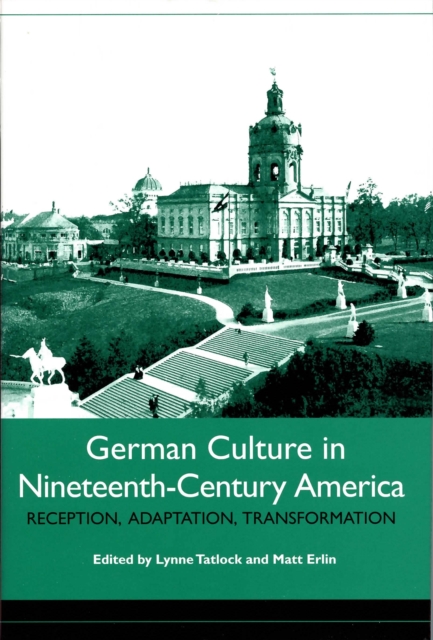
German Culture in Nineteenth-Century America
Building on recent trends in the humanities and especially on scholarship done under the rubric of cultural transfer, this volume emphasizes the processes by which Americans took up, responded to, and transformed German cultural material for their own purposes. The fourteen essays by scholars from the US and Germany treat such topics as translation, the reading of German literature in America, the adaptation of German ideas and educational ideals, the reception and transformation of European genres of writing, and the status of the \"German\" and the \"European\" in celebrations of American culture and criticisms of American racism. The volume contributes to the ongoing re-conception of American culture as significantly informed by non-English-speaking European cultures. It also participates in the efforts of historians and literary scholars to re-theorize the construction of national cultures. Questions regarding hybridity, cultural agency, and strategies of acculturation have long been at the center of postcolonial studies, but as this volume demonstrates, these phenomena are not merely operative in encounters between colonizers and colonized: they are also fundamental to the early American reception and appropriation of German cultural materials. Contributors: Hinrich C. Seeba, Eric Ames, Claudia Liebrand, Paul Michael Lützeler, Kirsten Belgum, Robert C. Holub, Jeffrey Grossman, Jeffrey L. Sammons, Linda Rugg, Gerhild Scholz Williams, Gerhard Weiss, Lorie Vanchena. Lynne Tatlock is Hortense and Tobias Lewin Distinguished Professor in the Humanities and Matt Erlin is Assistant Professor in the Department of Germanic Languages and Literatures, both at Washington University in St. Louis.
eBook

Traveling between worlds : German-American encounters
In Traveling between Worlds, six authors explore the connectedness between Germans and Americans in the nineteenth century and their mutual impact on transatlantic history. Despite the ocean between them, these two groups of people were linked not only by the emigration from one to the other but also by ongoing interactions, especially among their intellectuals.
Christof Mauch’s introduction examines the history of the German-American exchange and of cultural exchanges in general. Focusing on various aspects of the German-American relationship, Eberhard Bruning, John T. Walker, Thomas Adam, Gabriele Lingelbach, Andrew P. Yox, and Christiane Harzig examine the cultural and communicative exchanges that occurred both between the two countries and within them. Topics such as travel, cultural interpretation, ideological and intellectual transfer, the immigrant experience, and German-American poetry are all considered.
Traveling between Worlds demonstrates that exchange was facilitated and maintained by ordinary individuals such as teachers and scholars, immigrants and natives, and held implications that last to this day.
eBook