Catalogue Search | MBRL


Are you sure you want to remove the book from the shelf?

{{itemTitle}}
1,764
result(s) for
"German language Acquisition."
Sort by:

Learning the meaning of change-of-state verbs : a case study of German child language
Language acquisition is a human endeavor par excellence. As children, all human beings learn to understand and speak at least one language: their mother tongue. It is a process that seems to take place without any obvious effort. Second language learning, particularly among adults, causes more difficulty. The purpose of this series is to compile a collection of high-quality monographs on language acquisition. The series serves the needs of everyone who wants to know more about the problem of language acquisition in general and/or about language acquisition in specific contexts.
eBook

The Acquisition of German
The Acquisition of German: Introducing Organic Grammar brings together work on the acquisition of German from over four decades of child L1 and immigrant L2 learner studies. The book's major feature is new longitudinal data from three secondary school students who began an exchange year in Germany with no German knowledge and attained fluency. Their naturalistic acquisition process — with a succession of stages described for the first time in L2 acquisition — is highly similar to that of younger learners. This has important implications for German teaching and for the theory of Universal Grammar and acquisition. Organic Grammar, a variant of generative syntax, is offered as a practical alternative to Chomsky's Minimalism. The analysis focuses on extensive monthly samples of the three students' German development in an input-rich environment. Similar to previous studies, the teenagers build syntactic structure from the bottom up. Two acquired correct word order by the end of the year, the third, who had greater conscious awareness of German grammar, had a divergent route of development, suggesting that language awareness can alter a natural developmental path. The results are addressed in light of recent debates in child-adult differences.
eBook
The Acquisition of Intensifiers
Insa Gülzow analyzes the acquisition of intensifiers by children acquiring German or English as their first language. Based on a comparative analysis of intensifiers and related expressions in the two languages, she examines the longitudinal production data of six German-speaking and six English-speaking children with regard to when and in which contexts the intensifiers German selbst/selber and English x-self (myself, yourself, himself, etc.) appear. As intensifiers evoke alternatives to the referent of their focus and relate a central referent to more peripheral alternative referents, they are an important linguistic means to structure the participants of a child's early discourse. By integrating intensifiers into their utterances, children can identify themselves as central. The notion of being included or excluded in a certain state of affairs is relevant for children when interacting with their parents and/or other children. In the course of development, children acquire a number of both linguistic and non-linguistic skills that characterize them as increasingly independent and competent agents. In this process, intensifiers are an important linguistic device with which children can negotiate and comment on their participation in a given event. The three parts of the volume consist first, of a detailed analysis of the intensifiers selbst/selber and x-self and related expressions such as allein and by x-self in the two languages. Special attention is given to the fact that in English, intensifiers and reflexive pronouns are identical expressions while in German they are distinct. Second, previous results of comprehension studies are carefully reviewed in order to relate them to the findings in longitudinal production data. Third, a detailed analysis of the children's early use of intensifiers and related expressions is presented.
eBook

Bilingual first language acquisition : French and German grammatical development
The contributions in this volume are based on an analysis of data from bilingual children acquiring French and German simultaneously. The longitudinal studies started at approximately age one year and six months and continued till age six. The papers focus on the development of specific grammatical phenomena; explanations are given within the framework of the Principle and Parameter approach. The study is primarily concerned with the acquisition of so-called 'functional categories' and the consequences of their acquisition for the development of grammar. Specific points dealt with in these papers include: gender, number and case and their internal structure (DP vs NP); inflection and its consequences for agreement marking; and word order phenomena (subject-raising constructions (incl. passives), word order in subordinate clauses). The basic hypothesis underlying this study is that early child grammars consist only of lexical categories and that functional categories are implemented later in the child's grammar. How this happens exactly is the central issue explored in this book.
eBook
TELEVISION CHILDREN AT THE UNIVERSITY OF BELGRADE
The majority of those who decide to study German at the Department of German Studies in Belgrade learned German at school, but there is also a percentage of students that should not be underestimated, who, especially in preschool age, acquired their language skills independently and without guidance – the so-called “Fernsehkinder” (television children). The aim of the study presented in this article was to single out these students and analyze their language competencies and skills, their specific deficits – e.g. in written expression –, but also their advantage in oral expression over other students. Additionally, the extent to which students identify with the term “Fernsehkind” (television child) is examined. The classification of this type of language acquisition according to established categories and the issues that arise therefrom have been a further focus of our research.
Paper

Child language and developmental dysphasia : linguistic studies of the acquisition of German
The subject of this two part work is the acquisition of language structure in which the development of syntax and morphology is examined by investigations on children without language problems and on children with developmental dysphasia. The author uses a comparative acquisition study to provide insights into the structure and development of the language acquisition device, which cannot be obtained by isolated analysis of only one type of learning. The theoretical framework used for the investigations is the learnability theory, in which acquisition models are proposed which are heavily influenced by theoretical linguistics. Part I shows how child grammar acquisition can be explained in the framework of learnability theory and Part II deals with deficiencies in normal grammar acquisition using the learnability theory.
eBook
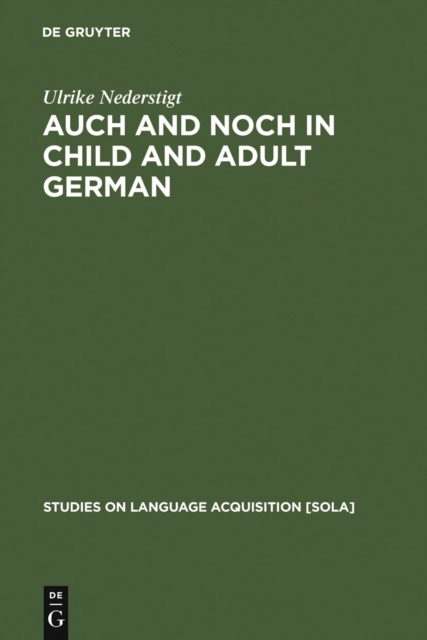
Auch and noch in child and adult German
Language acquisition is a human endeavor par excellence. As children, all human beings learn to understand and speak at least one language: their mother tongue. It is a process that seems to take place without any obvious effort. Second language learning, particularly among adults, causes more difficulty. The purpose of this series is to compile a collection of high-quality monographs on language acquisition. The series serves the needs of everyone who wants to know more about the problem of language acquisition in general and/or about language acquisition in specific contexts.
eBook