
Catalogue Search | MBRL


Are you sure you want to remove the book from the shelf?

{{itemTitle}}
281
result(s) for
"German language Pronunciation."
Sort by:

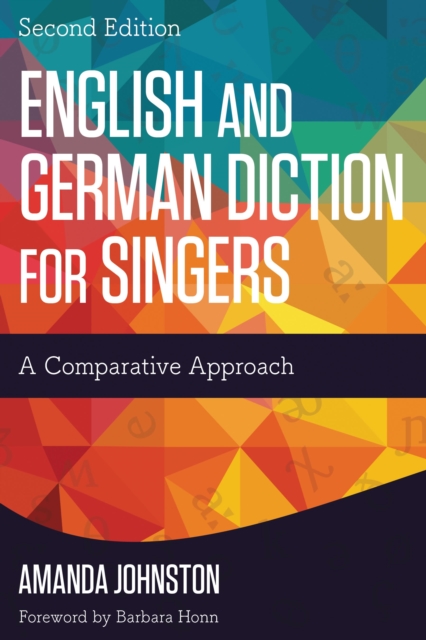
English and German Diction for Singers
Lyric diction is a portal to powerful and meaningful vocal performance because diction enables singers to communicate the vision of both the poet and the composer. The study of diction involves learning to perceive speech patterns in different languages, practicing their precise articulation, recognizing this in speech and singing, and developing an awareness of the refined movements of the articulators and their effects on singing tone.
In the second edition of English and German Diction for Singers, Amanda Johnston continues her comparative, modernized approach to lyric diction. This comprehensive resource offers a thorough analysis of the German and English languages and includes extensive oral drills, word lists, tables, charts, musical examples, and even tongue twisters. Unique to this publication is the illustration of the rhythmic timing and release of consonants within the International Phonetic Alphabet transcriptions in all musical examples.
This book is designed for both undergraduate and graduate courses in German and English lyric diction and is an invaluable resource for classical singers, vocal coaches, and voice teachers alike.
Improvements to the second edition include:
An online workbook that includes extensive written exercises suitable for classroom or independent useChapter-by-chapter video clips that demonstrate the concepts addressed in the text Expanded chapters address the schwa, the treatment of monosyllabic incidental words, the use of R, and the correct formation of the elusive upsilon and extended epsilonConsideration of loan words and stressed vs. unstressed closed German vowelsIntegrated practice drills for mastering challenging and unfamiliar phonemesEnlarged musical examples show the rhythmic timing and release of voiced and voiceless consonantsAn expanded appendix on suggested repertoire for diction studyInclusion of specific diction choices suitable for musical theatre repertoireExpanded discussion of healthy glottal onsets, including the concept of junctureUse of the latest resources, namely Deutsche Rechtschreibung (2014) and Cambridge Pronouncing Dictionary, 18th edition (2011)For all users, there is a WORKBOOK. Access the workbook here.The ANSWER KEY is available for instructors. Contact textbooks@rowman.com for details.
eBook
Whose German? : the ach/ich alternation and related phenomena in \standard\ and \colloquial\
In this title, the author addresses a number of issues in German and general phonology, using a specific problem in German phonology (the ach/ich alternation) as a springboard. These issues include the naturalness of the prescriptive standard in German.
eBook
German phonetics and phonology : theory and practice
The first course book designed to engage students in the pronunciation of modern German by grounding practice in theory An essential introduction to the pronunciation of modern German, this unique classroom text is designed to help mid- to upper-level undergraduate students of German produce more accurate and comprehensible German speech. Written in English in a clear and engaging style and employing a minimum of technical jargon, it is the first German phonetics and phonology text to focus on theory and practice, covering topics ranging from the analysis of one's own speech to historical developments and regional variation. This work includes a wealth of exercises supported by an ancillary website audio program designed to help students perceive and produce sounds and prosodic features more accurately. Addressing topics such as word stress, sentence stress, and intonation as well as the pronunciation of individual sounds, this one-of-a-kind primer provides its users with a solid basis in German phonetics and phonology in order to improve their pronunciation of German.
eBook
Die Worterkennung in einem Dialogsystem für kontinuierlich gesprochene Sprache
Die Buchreihe Linguistische Arbeiten hat mit über 500 Bänden zur linguistischen Theoriebildung der letzten Jahrzehnte in Deutschland und international wesentlich beigetragen. Die Reihe wird auch weiterhin neue Impulse für die Forschung setzen und die zentrale Einsicht der Sprachwissenschaft präsentieren, dass Fortschritt in der Erforschung der menschlichen Sprachen nur durch die enge Verbindung von empirischen und theoretischen Analysen sowohl diachron wie synchron möglich ist. Daher laden wir hochwertige linguistische Arbeiten aus allen zentralen Teilgebieten der allgemeinen und einzelsprachlichen Linguistik ein, die aktuelle Fragestellungen bearbeiten, neue Daten diskutieren und die Theorieentwicklung vorantreiben.
eBook
\Umlaut\ in optimality theory : a comparative analysis of German and Chamorro
In this first book-length study of synchronicumlaut, a comprehensive comparative analysis of the phonology and morphology of theumlautalternation in present-day German and the Austronesian language Chamorro is presented in the framework of Optimality Theory. A fresh perspective of the phonology-morphology interface and the interaction between segmental and metrical structure with wider cross-linguistic implications is developed, including a new conception of morphological conditioning based on morphological faithfulness and Representation as Pure Markedness. The Chamorro data collected for this study contribute significantly to the documentation of this endangered language.
eBook

On the role of orthography in L2 vowel production: The case of Polish learners of German
This study investigates the role of orthography in German vowel production by Polish native speakers (L1) with German as a second language (L2). Eighteen intermediate to advanced Polish L2 German learners and 20 German native speakers were recorded during a picture-naming task in which half of the experimental items were explicitly marked in their orthographic representation for their vowel length (short or long). Duration measurements revealed that explicit orthographic marking helped the Polish L2 German learners produce the short-long contrast more native-like. Regarding vowel quality, group differences were interpreted to have been caused by (in)congruencies between L1 and L2 grapheme-to-phoneme correspondences. These findings have important implications for models of L2 speech learning and pronunciation training.
Journal Article

Pronunciation Can Be Acquired Outside the Classroom: Design and Assessment of Homework-Based Training
Even though there is ample evidence that pronunciation plays a crucial role in effective second language (L2) communication, pronunciation training is frequently neglected in L2 classrooms due to time constraints or because instructors do not feel adequately prepared to teach pronunciation. To address this discrepancy, the present study investigates the effectiveness of a novel, homework-based method of pronunciation instruction. Novice German learners' (N = 122) perception and oral production skills on the word and sentence level were assessed at the beginning and the end of the semester. Learners were assigned to 1 of 3 groups: a homework-based pronunciation training group, an in-class training group, and a control group. The results showed that the learners in the homework training group significantly outperformed learners in the control group on some (but not all) measures of phonological perception skills and on comprehensibility measures of productions of individual words. Results further revealed no significant difference between learners who received homework-based or in-class pronunciation training and responses on a debriefing questionnaire showed that learners were equally satisfied with both training modalities. Taken together, these results suggest that homework-based pronunciation training is similarly effective as in-class practice. (Verlag).
Journal Article

Pronunciation trainer for second language learning using generative AI
Generative AI models have demonstrated great promise in a variety of fields, including language learning and translation tasks. This research aims to develop a web-based pronunciation training system using Generative AI techniques to provide real-time feedback and multilingual support. The system leverages advanced AI models including pre-trained Automatic Speech Recognition (ASR) and Text-To-Speech (TTS) models, to analyse and synthesize speech. Machine learning algorithms are additionally used for real-time evaluation. The key features of the system include diverse sample texts for pronunciation, immediate pronunciation feedback, audio of the sample text using the TTS model, audio playback of the user input, support for both English and German languages and finally, an interactive user-interface. To assess the system’s effectiveness, evaluation techniques such as Mean Opinion Score (MOS), response time evaluation and Task Completion Rate (TCR) are employed. The Mean Opinion Score obtained was 3.72 and the Task Completion Rate was 80% showing that this novel system can significantly enhance language learning by providing users with pronunciation training, making it a valuable tool for both educators and learners. Even though AI tools help learners reduce their speaking anxiety, they may have difficulties with interpreting feedback and detecting small pronunciation differences. By creating a comprehensive system that uses generative AI to improve pronunciation training, this novel research aims to overcome existing issues in second-language learning.
Journal Article

New Perspectives on Language Variety in the South
The third installment in the landmark LAVIS (Language
Variety in the South) series,
New Perspectives on Language Variety in the South: Historical
and Contemporary Approaches brings together essays devoted
to the careful examination and elucidation of the rich linguistic
diversity of the American South, updating and broadening the work
of the earlier volumes by more fully capturing the multifaceted
configuration of languages and dialects in the South. Beginning
with an introduction to American Indian languages of the
Southeast, five fascinating essays discuss indigenous languages,
including Caddo, Ofo, and Timucua, and evidence for the
connection between the Pre-Columbian Southeast and the Caribbean.
Five essays explore the earlier Englishes of the South, covering
topics such as the eighteenth century as the key period in the
differentiation of Southern American English and the use of new
quantitative methods to trace the transfer of linguistic features
from England to America. They examine a range of linguistic
resources, such as plantation overseers’ writings, modern
blues lyrics, linguistic databases, and lexical and locutional
compilations that reveal the region’s distinctive dialectal
traditions.
New Perspectives on Language Variety in the South: Historical
and Contemporary Approaches widens the scope of inquiry into
the linguistic influences of the African diaspora as evidenced in
primary sources and records. A comprehensive essay redefines the
varieties of French in Louisiana, tracing the pathway from
Colonial Louisiana to the emergence of Plantation Society French
in a diglossic relationship with Louisiana Creole. A further
essay maps the shift from French to English in family documents.
An assortment of essays on English in the contemporary South
touch on an array of compelling topics from discourse strategies
to dialectal emblems of identity to stereotypes in popular
perception. Essays about recent Latino immigrants to the South
bring the collection into the twenty-first century, taking into
account the dramatic increase in the population of Spanish
speakers and illuminating the purported role of
“Spanglish,” the bilingual lives of Spanish-speaking
Latinos in Mississippi, and the existence of regional Spanish
dialectal diversity.
eBook