
Catalogue Search | MBRL


Are you sure you want to remove the book from the shelf?

{{itemTitle}}
3,454
result(s) for
"German literature History and criticism"
Sort by:

Anglo-German theatrical exchange : \a sea-change into something rich and strange?\
Through the great diversity of topics and methodologies the essays in this volume make a seminal contribution to an under-researched field at the intersection of literary and cultural criticism, comparative literature, and theatre as well as translation studies. The essays cover a wide range of texts from the eighteenth to the twenty-first century. From a broad variety of perspectives the exchange between drama and theatre of the Anglophone and the Germanophone worlds and their mutual influence are explored. While there is a focus on the successful or unsuccessful bridging of the cultural gaps, due consideration is given to the nexus between intercultural translation and mise en scلene as well as the intricacies of intermedial reshaping. Always placing the analyses within the political and socio-historical contexts the essays make an innovative contribution to the aesthetics of Anglo-German theatrical exchange as well as to European cultural history.
Book

Translating the World
In Translating the World, Birgit Tautz provides a new narrative of German literary history in the late eighteenth and early nineteenth centuries. Departing from dominant modes of thought regarding the nexus of literary and national imagination, she examines this intersection through the lens of Germany's emerging global networks and how they were rendered in two very different German cities: Hamburg and Weimar.
German literary history has tended to employ a conceptual framework that emphasizes the nation or idealized citizenry, yet the experiences of readers in eighteenth-century German cities existed within the context of their local environments, in which daily life occurred and writers such as Lessing, Schiller, and Goethe worked. Hamburg, a flourishing literary city in the late eighteenth century, was eventually relegated to the margins of German historiography, while Weimar, then a small town with an insular worldview, would become mythologized for not only its literary history but its centrality in national German culture. By interrogating the histories of and texts associated with these cities, Tautz shows how literary styles and genres are born of local, rather than national, interaction with the world. Her examination of how texts intersect and interact reveals how they shape and transform the urban cultural landscape as they are translated and move throughout the world.
A fresh, elegant exploration of literary translation, discursive shifts, and global cultural changes, Translating the World is an exciting new story of eighteenth-century German culture and its relationship to expanding global networks that will especially interest scholars of comparative literature, German studies, and literary history.
eBook

The science of literature : essays on an incalculable difference
Do literary texts provide distinctive access to the history of science? Is the study of literature based on scientific procedures? Is there a connection between scientific processes and literary forms? The essays in this collection show how literary and scientific texts from the late 18th to the late 19th centuries revolve around these questions. What emerges is a picture of the mutual dependence and the incalculable difference between literature and science in the period of their modern formation. -- Provided by publisher
Book

Gender, Canon and Literary History
It has been shown that the total number of women who published in German in the 18th and 19th centuries was approximately 3, 500, but even by 1918 only a few of them were known. The reason for this lies in the selection processes to which the authors have been subjected, and it is this selection process that is the focus of the research here presented.
The selection criteria have not simply been gender-based but have had much to do with the urgent quest for establishing a German Nation State in 1848 and beyond. Prutz, Gottschall, Kreyßig and others found it necessary to use literary historiography, which had been established by 1835, in order to construct an ideal of 'Germanness' at a time when a political unity remained absent, and they wove women writers into this plot. After unification in 1872, this kind of weaving seemed to have become less pressing, and other discourses came to the fore, especially those revolving round femininity vs. masculinity, and races.
The study of the processes at work here will enhance current debates about the literary canon by tracing its evolution and identifying the factors which came to determine the visibility or obscurity of particular authors and texts. The focus will be on a number of case studies, but, instead of isolating questions of gender, Gender, Canon and Literary History will discuss the broader cultural context.
eBook

Anglo-German dramatic and poetic encounters : perspectives on exchange in the Sattelzeit
\"Anglo-German Dramatic and Poetic Encounters contains essays focusing on the roles of drama and poetry in Anglo-German exchange in the Sattelzeit. It offers new perspectives on the movement of texts and ideas across genres and cultures, the formation and reception of poetic personae, and the place of illustration in cross-cultural, textual exchange\"-- Provided by publisher.
Book

Peripheral Desires
InPeripheral Desires, Robert Deam Tobin charts the emergence, from the 1830s through the early twentieth century, of a new vocabulary and science of human sexuality in the writings of literary authors, politicians, and members of the medical establishment in German-speaking central Europe-and observes how consistently these writers, thinkers, and scientists associated the new nonnormative sexualities with places away from the German metropoles of Berlin and Vienna.
In the writings of Aimée Duc and Lou Andreas-Salomé, Switzerland figured as a place for women in particular to escape the sexual confines of Germany. The sexual ethnologies of Ferdinand Karsch-Haack and the popular novels of Karl May linked nonnormative sexualities with the colonies and, in particular, with German Samoa. Same-sex desire was perhaps the most centrifugal sexuality of all, as so-called Greek love migrated to numerous places and peoples: a curious connection between homosexuality and Hungarian nationalism emerged in the writings of Adalbert Stifter and Karl Maria Kerbeny; Arnold Zweig built on a long and extremely well-developed gradation of associating homosexuality with Jewishness, projecting the entire question of same-sex desire onto the physical territory of Palestine; and Thomas Mann, of course, famously associated male-male desire with the fantastically liminal city of Venice, lying between land and sea, Europe and the Orient.
As Germany-and German-speaking Europe-became a fertile ground for homosexual subcultures in the nineteenth and early twentieth centuries, what factors helped construct the sexuality that emerged?Peripheral Desiresexamines how and why the political, scientific and literary culture of the region produced the modern vocabulary of sexuality.
eBook

Imperial fictions : German literature before and beyond the nation-state
\"Imperial Fictions explores ways in which writers from late antiquity to the present have imagined communities before and beyond the nation-state. It takes as its point of departure challenges to the discrete nation-state posed by globalization, migration, and European integration today, but then circles back to the beginnings of European history after the fall of the Roman Empire. Unlike nationalist literary historians of the nineteenth century, who sought the tribal roots of an allegedly homogeneous people, this study finds a distant mirror of analogous processes today in the fluid mixtures and movements of peoples. Imperial Fictions argues that it is time to stop thinking about today's multicultural present as a deviation from a culturally monolithic past. We should rather consider the various permutations of \"German\" identities that have been negotiated within local and imperial contexts from the early Middle Ages to the present\"-- Provided by publisher.
Book

Germany's Wild East
In the nineteenth and early twentieth centuries, representations of Poland and the Slavic East cast the region as a primitive, undeveloped, or empty space inhabited by a population destined to remain uncivilized without the aid of external intervention. These depictions often made direct reference to the American Wild West, portraying the eastern steppes as a boundless plain that needed to be wrested from the hands of unruly natives and spatially ordered into German-administrated units.While conventional definitions locate colonial space overseas, Kristin Kopp argues that it was possible to understand both distant continents and adjacent Eastern Europe as parts of the same global periphery dependent upon Western European civilizing efforts. However, proximity to the source of aid translated to greater benefits for Eastern Europe than for more distant regions.
eBook

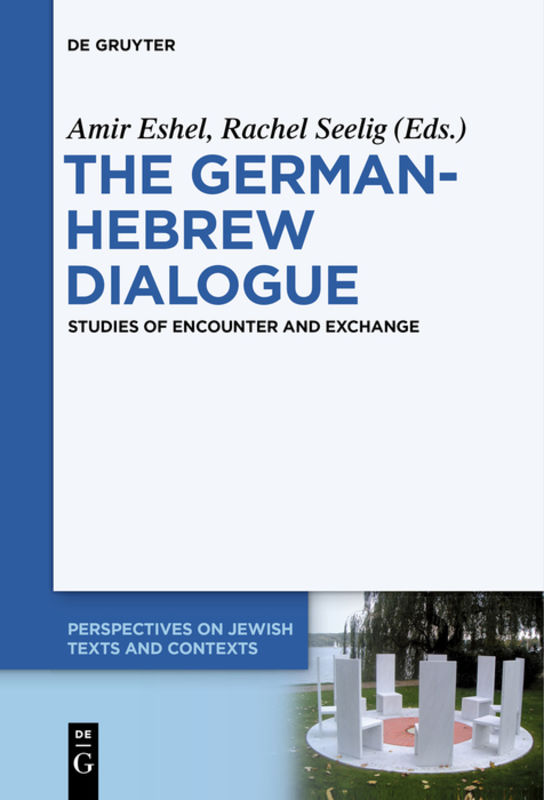
The German-Hebrew Dialogue
This series focuses on the Jewish textual tradition as well as the ways it evolves in response to new intellectual, historical, social and political contexts. Fostering dialogue between literary, philosophical, political and religious perspectives, this series, which consists of original scholarship and proceedings of international conferences, reflects contemporary concerns of Jewish Studies in the broadest sense. _x000D_.
eBook