
Catalogue Search | MBRL


Are you sure you want to remove the book from the shelf?

{{itemTitle}}
107,911
result(s) for
"Germanic"
Sort by:
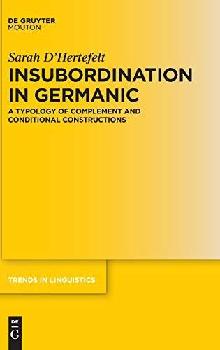
Insubordination in Germanic : a typology of complement and conditional constructions
\"This book studies insubordination using Germanic data. On a descriptive level, it distinguishes a wide number of (previously undescribed) types of complement and conditional insubordination in English, German, Dutch, Swedish, Danish and Icelandic. On a theoretical level, these data are used to investigate the boundaries of insubordination, and the degree to which insubordination is a constructionally and semantically unified phenomenon.\"--Back cover.
Book

Toward the Century of Words
In the decades between the French Revolution and the first stirrings of liberalism in the 1830s, German political culture defined itself apart from that of its neighbors to the west. Focusing on the career of Johann Cotta, the preeminent publisher of his generation, this book offers a lens through which we can more fully view and understand these turbulent years. Cotta is a familiar figure in the history of German letters, but his public life has never been studied comprehensively. He financed and directed the Allgemeine Zeitung of Augsburg, which would become one of the great European newspapers of the nineteenth century. He was the first German to convert money and cultural prestige into political power by means of the press. Cotta and his colleagues emerge not as liberals, but as characteristic figures of the Reform era. Their aim was to define and institutionalize a realm of thought and action beyond the control of the state, but short of opposed to it--a \"public\" realm in which intellectual independence and political loyalty would be equally well served. This title is part of UC Press's Voices Revived program, which commemorates University of California Press's mission to seek out and cultivate the brightest minds and give them voice, reach, and impact. Drawing on a backlist dating to 1893, Voices Revived makes high-quality, peer-reviewed scholarship accessible once again using print-on-demand technology. This title was originally published in 1990. Many titles in the Voices Revived program are also newly available as ebooks, offered at a discounted price to support wider access to scholarly work.
eBook


The Discursive Construction of National Identity
How do we construct national identities in discourse? Which topics, which discursive strategies and which linguistic devices are employed to construct national sameness and uniqueness on the one hand, and differences to other national collectives on the o
eBook

Early Germans
\"A history of the early German peoples, who lived, traded, and fought with the ancient Romans--covering the period from 230 BCE to 180 CE\"--Provided by publisher.
Book

A Satellite Empire
Satellite Empire is an in-depth investigation of the
political and social history of the area in southwestern Ukraine
under Romanian occupation during World War II. Transnistria was the
only occupied Soviet territory administered by a power other than
Nazi Germany, a reward for Romanian participation in Operation
Barbarossa.
Vladimir Solonari's invaluable contribution to World War II
history focuses on three main aspects of Romanian rule of
Transnistria: with fascinating insights from recently opened
archives, Solonari examines the conquest and delimitation of the
region, the Romanian administration of the new territory, and how
locals responded to the occupation. What did Romania want from the
conquest? The first section of the book analyzes Romanian policy
aims and its participation in the invasion of the USSR. Solonari
then traces how Romanian administrators attempted, in contradictory
and inconsistent ways, to make Transnistria \"Romanian\" and
\"civilized\" while simultaneously using it as a dumping ground for
150,000 Jews and 20,000 Roma deported from a racially cleansed
Romania. The author shows that the imperatives of total war
eventually prioritized economic exploitation of the region over any
other aims the Romanians may have had. In the final section, he
uncovers local responses in terms of collaboration and resistance,
in particular exploring relationships with the local Christian
population, which initially welcomed the occupiers as liberators
from Soviet oppression but eventually became hostile to them. Ever
increasing hostility towards the occupying regime buoyed the
numbers and efficacy of pro-Soviet resistance groups.
eBook

Jewish Pasts, German Fictions
Jewish Pasts, German Fictions is the first comprehensive study of how German-Jewish writers used images from the Spanish-Jewish past to define their place in German culture and society. Jonathan Skolnik argues that Jewish historical fiction was a form of cultural memory that functioned as a parallel to the modern, demythologizing project of secular Jewish history writing.
What did it imply for a minority to imagine its history in the majority language? Skolnik makes the case that the answer lies in the creation of a German-Jewish minority culture in which historical fiction played a central role. After Hitler's rise to power in 1933, Jewish writers and artists, both in Nazi Germany and in exile, employed images from the Sephardic past to grapple with the nature of fascism, the predicament of exile, and the destruction of European Jewry in the Holocaust. The book goes on to show that this past not only helped Jews to make sense of the nonsense, but served also as a window into the hopes for integration and fears about assimilation that preoccupied German-Jewish writers throughout most of the nineteenth century. Ultimately, Skolnik positions the Jewish embrace of German culture not as an act of assimilation but rather a reinvention of Jewish identity and historical memory.
eBook