
Catalogue Search | MBRL


Are you sure you want to remove the book from the shelf?

{{itemTitle}}
32
result(s) for
"Germanic Invasions, 3rd-6th centuries"
Sort by:


The Roman West, AD 200–500
This book describes and analyses the development of the Roman West from Gibraltar to the Rhine, using primarily the extensive body of published archaeological evidence rather than the textual evidence underlying most other studies. It situates this development within a longer-term process of change, proposing the later second century rather than the 'third-century crisis' as the major turning-point, although the latter had longer-term consequences owing to the rise in importance of military identities. Elsewhere, more 'traditional' forms of settlement and display were sustained, to which was added the vocabulary of Christianity. The longer-term rhythms are also central to assessing the evidence for such aspects as rural settlement and patterns of economic interaction. The collapse of Roman imperial authority emphasised trends such as militarisation and regionalisation along with economic and cultural disintegration. Indicators of 'barbarian/Germanic' presence are reassessed within such contexts and the traditional interpretations questioned and alternatives proposed.
eBook
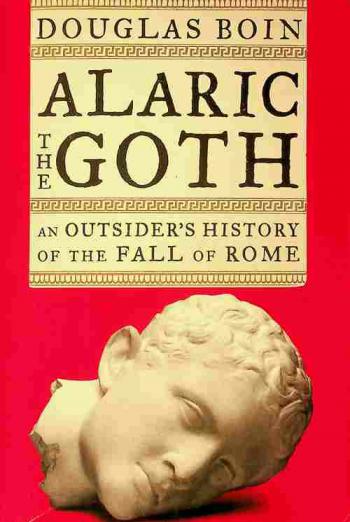
Alaric the Goth : an outsider's history of the fall of Rome
\"Did \"barbarians\" really cause the catastrophic collapse of civilization? Boin is the first to give an historically sound account from the \"barbarian\" perspective, through the life of Alaric the Goth. On August 24, 410 A.D., the Senate and the People of Rome awoke to a seismic shock. Intruders, led by a disaffected forty-year-old immigrant, known only as Alaric, had stormed the city. There were kidnappings, robbery, and acts of arson. The effects were long-lasting. Within two generations, Rome's world fell apart. A city predicted to rule an empire without end, in the words of its famous Latin poet Virgil, was governed by a savage band of foreigners, called Goths. Alaric the Goth offers a deeply researched look at the end of the Roman Empire but from a surprising point-of-view. Offering the first full-length biography of Alaric, a talented and frustrated immigrant living in a time of pervasive bigotry, state-supported Christian violence, and irrational xenophobia, it breaks out of decades of tired, traditional approaches to the period, most of which overidentify with the Roman people. And it reveals the lasting contributions Goths made to legal history, to the values of religious toleration, and to modern ideas of citizenship. By moving this man from the borders to the center of Rome's story, it asks readers to think deeply and differently about the lives of marginalized people too often invisible in our history books.\"-- Provided by publisher.

Barbarian Migrations and the Roman West, 376–568
This is a major survey of the barbarian migrations and their role in the fall of the Roman Empire and the creation of early medieval Europe, one of the key events in European history. Unlike previous studies it integrates historical and archaeological evidence and discusses Britain, Ireland, mainland Europe and North Africa, demonstrating that the Roman Empire and its neighbours were inextricably linked. A narrative account of the turbulent fifth and early sixth centuries is followed by a description of society and politics during the migration period and an analysis of the mechanisms of settlement and the changes of identity. Guy Halsall reveals that the creation and maintenance of kingdoms and empires was impossible without the active involvement of people in the communities of Europe and North Africa. He concludes that, contrary to most opinions, the fall of the Roman Empire produced the barbarian migrations, not vice versa.
eBook


Barbarian Tides
The Migration Age is still envisioned as an onrush of expansionary \"Germans\" pouring unwanted into the Roman Empire and subjecting it to pressures so great that its western parts collapsed under the weight. Further developing the themes set forth in his classicBarbarians and Romans, Walter Goffart dismantles this grand narrative, shaking the barbarians of late antiquity out of this \"Germanic\" setting and reimagining the role of foreigners in the Later Roman Empire. The Empire was not swamped by a migratory Germanic flood for the simple reason that there was no single ancient Germanic civilization to be transplanted onto ex-Roman soil. Since the sixteenth century, the belief that purposeful Germans existed in parallel with the Romans has been a fixed point in European history. Goffart uncovers the origins of this historical untruth and argues that any projection of a modern Germany out of an ancient one is illusory. Rather, the multiplicity of northern peoples once living on the edges of the Empire participated with the Romans in the larger stirrings of late antiquity. Most relevant among these was the long militarization that gripped late Roman society concurrently with its Christianization. If the fragmented foreign peoples with which the Empire dealt gave Rome an advantage in maintaining its ascendancy, the readiness to admit military talents of any social origin to positions of leadership opened the door of imperial service to immigrants from beyond its frontiers. Many barbarians were settled in the provinces without dislodging the Roman residents or destabilizing landownership; some were even incorporated into the ruling families of the Empire. The outcome of this process, Goffart argues, was a society headed by elites of soldiers and Christian clergy-one we have come to call medieval.
eBook


A history of the later Roman Empire, AD 284-641
The Second Edition of A History of the Later Roman Empire features extensive revisions and updates to the highly-acclaimed, sweeping historical survey of the Roman Empire from the accession of Diocletian in AD 284 to the death of Heraclius in 641.
* Features a revised narrative of the political history that shaped the late Roman Empire
* Includes extensive changes to the chapters on regional history, especially those relating to Asia Minor and Egypt
* Offers a renewed evaluation of the decline of the empire in the later sixth and seventh centuries
* Places a larger emphasis on the military deficiencies, collapse of state finances, and role of bubonic plague throughout the Europe in Rome's decline
* Includes systematic updates to the bibliography
eBook

