
Catalogue Search | MBRL


Are you sure you want to remove the book from the shelf?

{{itemTitle}}
38,482
result(s) for
"Germanic languages"
Sort by:
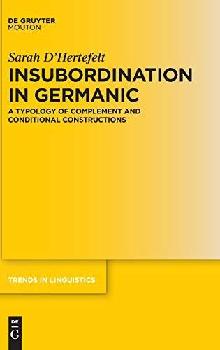
Insubordination in Germanic : a typology of complement and conditional constructions
\"This book studies insubordination using Germanic data. On a descriptive level, it distinguishes a wide number of (previously undescribed) types of complement and conditional insubordination in English, German, Dutch, Swedish, Danish and Icelandic. On a theoretical level, these data are used to investigate the boundaries of insubordination, and the degree to which insubordination is a constructionally and semantically unified phenomenon.\"--Back cover.
Book

The Discursive Construction of National Identity
How do we construct national identities in discourse? Which topics, which discursive strategies and which linguistic devices are employed to construct national sameness and uniqueness on the one hand, and differences to other national collectives on the o
eBook


Germanic Language Histories 'from Below' (1700-2000)
Focusing on the sociolinguistic history of Germanic languages, the current volume challenges the traditional teleological approach of language historiography. The 30 contributions present alternative histories of ten 'big' as well as 'small' Germanic languages and varieties in the last 300 years. Topics covered in this book include language variation and change and the politics of language contact and choice, seen against the background of standardization processes of written and oral text genres and from the viewpoint of larger sections of the population.
eBook


Children's Consonant Acquisition in 27 Languages: A Cross-Linguistic Review
The aim of this study was to provide a cross-linguistic review of acquisition of consonant phonemes to inform speech-language pathologists' expectations of children's developmental capacity by (a) identifying characteristics of studies of consonant acquisition, (b) describing general principles of consonant acquisition, and (c) providing case studies for English, Japanese, Korean, and Spanish.
A cross-linguistic review was undertaken of 60 articles describing 64 studies of consonant acquisition by 26,007 children from 31 countries in 27 languages: Afrikaans, Arabic, Cantonese, Danish, Dutch, English, French, German, Greek, Haitian Creole, Hebrew, Hungarian, Icelandic, Italian, Jamaican Creole, Japanese, Korean, Malay, Maltese, Mandarin (Putonghua), Portuguese, Setswana (Tswana), Slovenian, Spanish, Swahili, Turkish, and Xhosa.
Most studies were cross-sectional and examined single word production. Combining data from 27 languages, most of the world's consonants were acquired by 5;0 years;months old. By 5;0, children produced at least 93% of consonants correctly. Plosives, nasals, and nonpulmonic consonants (e.g., clicks) were acquired earlier than trills, flaps, fricatives, and affricates. Most labial, pharyngeal, and posterior lingual consonants were acquired earlier than consonants with anterior tongue placement. However, there was an interaction between place and manner where plosives and nasals produced with anterior tongue placement were acquired earlier than anterior trills, fricatives, and affricates.
Children across the world acquire consonants at a young age. Five-year-old children have acquired most consonants within their ambient language; however, individual variability should be considered.
https://doi.org/10.23641/asha.6972857.
Journal Article

The ditransitive alternation in present-day German : a corpus-based analysis
This monograph is the first to address the ditransitive (or \"dative\") alternation in present-day written German from a quantitative and qualitative perspective. It provides providing a corpus-based analysis as well as a novel three-layer approach to meaning and sense based on the work of E. Coseriu and S. Levinson.
eBook


The Language of Human Rights in West Germany
Human rights language is abstract and ahistorical because advocates intend human rights to be valid at all times and places. Yet the abstract universality of human rights discourse is a problem for historians, who seek to understand language in a particular time and place. Lora Wildenthal explores the tension between the universal and the historically specific by examining the language of human rights in West Germany between World War II and unification. In the aftermath of Nazism, genocide, and Allied occupation, and amid Cold War and national division, West Germans were especially obliged to confront issues of rights and international law.The Language of Human Rights in West Germanytraces the four most important purposes for which West Germans invoked human rights after World War II. Some human rights organizations and advocates sought to critically examine the Nazi past as a form of basic rights education. Others developed arguments for the rights of Germans-especially expellees-who were victims of the Allies. At the same time, human rights were construed in opposition to communism, especially with regard to East Germany. In the 1970s, several movements emerged to mobilize human rights on behalf of foreigners, both far away and inside West Germany. Wildenthal demonstrates that the language of human rights advocates, no matter how international its focus, can be understood more fully when situated in its domestic political context.
eBook