
Catalogue Search | MBRL


Are you sure you want to remove the book from the shelf?

{{itemTitle}}
35
result(s) for
"Gerson, Jean (1363-1429)"
Sort by:

Authorship and publicity before print
Widely recognized by contemporaries as the most powerful theologian of his generation, Jean Gerson (1363-1429) dominated the stage of western Europe during a time of plague, fratricidal war, and religious schism. Yet modern scholarship has struggled to define Gerson's place in history, even as it searches for a compelling narrative to tell the story of his era.Daniel Hobbins argues for a new understanding of Gerson as a man of letters actively managing the publication of his works in a period of rapid expansion in written culture. More broadly, Hobbins casts Gerson as a mirror of the complex cultural and intellectual shifts of the fourteenth and fifteenth centuries. In contrast to earlier theologians, Gerson took a more humanist approach to reading and to authorship. He distributed his works, both Latin and French, to a more diverse medieval public. And he succeeded in reaching a truly international audience of readers within his lifetime. Through such efforts, Gerson effectively embodies the aspirations of a generation of writers and intellectuals. Removed from the narrow confines of late scholastic theology and placed into a broad interdisciplinary context, his writings open a window onto the fascinating landscape of fifteenth-century Europe.The picture of late medieval culture that emerges from this study offers neither a specter of decaying scholasticism nor a triumphalist narrative of budding humanism and reform. Instead, Hobbins describes a period of creative and dynamic growth, when new attitudes toward writing and debate demanded and eventually produced new technologies of the written word.
eBook

Spiritual Grammar
Spiritual Grammar identifies a genre of religious literature that until now has not been recognized as such. In this surprising and theoretically nuanced study, F. Dominic Longo reveals how grammatical structures of language addressed in two medieval texts published nearly four centuries apart, from distinct religious traditions, offer a metaphor for how the self is embedded in spiritual reality. Reading The Grammar of Hearts (Nahw al-qulūb) by the great Sufi shaykh and Islamic scholar 'Abd al-Karīm al-Qushayrī (d. 1074) and Moralized Grammar (Donatus moralizatus) by Christian theologian Jean Gerson (d. 1429), Longo reveals how both authors use the rules of language and syntax to advance their pastoral goals. Indeed, grammar provides the two masters with a fresh way of explaining spiritual reality to their pupils and to discipline the souls of their readers in the hopes that their writings would make others adept in the grammar of the heart.
eBook
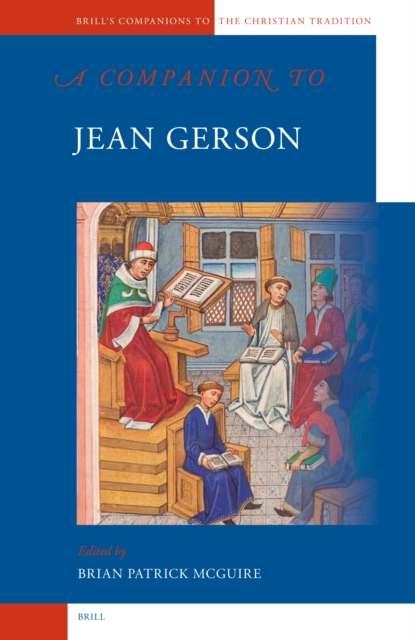
A companion to Jean Gerson
This guide to the life and writings of Jean Gerson (1363-1429) provides the reader with a state-of-the-art evaluation of the place of this central theologian and church reformer in the transition from medieval to early modern culture, spirituality and religion.
eBook

Some Aspects of Jean Gerson’s Legal Influence in Sixteenth Century England: The Issue of Epikeia
The present study focuses on one aspect of Jean Gerson’s (1363–1429) judicial influence in England: the development of the concept of equity or
. By analysing particularities of Gerson’s interpretation of
, the study examines the reasons why his take on equity attracted attention in the socio-political context of 16
century England. It also explores distinctions between various understandings of equity, which was gradually introduced into common law under Thomas More’s chancellorship and thanks to Christopher St. German’s writings. Making the reference to today’s interest in the concept of equity, article aims to serve as a link between scholarship and contemporary political and judicial thinking.
Journal Article

Die triomf van ‘n post-skolastieke mistiek oor skolastieke lojalisme: Gersonius versus Ruusbroec (postuum), 1399
The triumph of a post-scholastic mysticism over scholastic loyalism. Gerson versus Ruusbroec (posth.), 1399. This article provides an introduction to the thought of the Flemish-Brabant 14th-century mystical thinker, Jan van Ruusbroec, with special attention to the explosion in the niche research from 1981 (with the publication of the first volume of the Ruusbroec Opera Omnia) to 2017 (regarding the specialised outputs of the Ruusbroec Institute at the University of Antwerp). Ruusbroec is presented as a ‘post-scholastic’ thinker, who in an idiosyncratic way, transcended the high-scholastic aspirations of absolute clarity and certainty about God and human existence. His thought is contextualised within a polemical, posthumous context, namely the attempt of the chancellor of the University of Paris at the time, John Gerson, to get Ruusbroec’s text‘, ‘ Die geestelike brulocht’ declared as heresy and Ruusbroec himself as a heretic in the year 1399 AD, 18 years after Ruusbroec’s death. The attempts of Ruusbroec’s young colleagues at the modest monastery of Groenendaal, confronting and rearguing Gerson on this issue, are thoroughly explored. The fact that neither ‘ Die geestelike brulocht ’ nor Ruusbroec himself could eventually be effectively challenged by the high-powered Gerson, is presented as an example of the inherent potential of ‘post-scholasticism’ to contribute to the progression that eventually manifested itself as the ‘new world’, the Renaissance. No one won or lost this posthumous battle: but Gerson certainly did not win it. This is a remarkable note in, even a ‘triumph’ for, the archives of the small Augustinian monastery in Groenendaal, consisting of subtle ‘Augustinian’ monks, who had little more than a dedicated passion for Ruusbroec’s mysticism (and an undergraduate in theology at the University of Paris) on their side. A hermeneutic interpretation of the events of 1399 is henceforth presented, to indicate that within the socio-political turmoil of European societies in the 14th century, there were still places (and thinkers, such as Ruusbroec), where people were able to find ‘rest in God’ – as there should be today.
Journal Article

Il coraggio dell'esultanza dinanzi allo straordinario. L'impresa della Pulzella fra le righe dei suoi contemporanei
When Jeanne of Arc's triumphant march takes place, it is celebrated in enthusiastic tones by another woman, Christine de Pizan, who composed her Ditié giving way to her exultation. A different tone can be found in the writings by the contemporary theologians Jean Gerson and Jacques Gélu, justifying Jeanne's formidable undertaking: they examine the strange case and consider it admissible. Pizan's passion had previously created a City of Ladies and praised the experience of holy martyrs, whose very same voice Jeanne will hear. Two discrete precepts follow two ideas of justice -one human, the other divine- articulated in different styles of writing.
Journal Article

Jean Gerson, moral certainty and the Renaissance of ancient Scepticism
The early modern revival of scepticism and new scholastic trends in guiding uncertain consciences originated in the 15th century. This paper explores the motivating role of the Great Western Schism (1378–1417) on these developments, focusing on the work of the eminent theologian and philosopher Jean Gerson (1363–1429). The Schism created a rationale for a pluralistic handling of opinions and for a positive attitude towards scepticism, as Gerson's writings document. Moreover, innovations in the scholastic treatment of uncertainty, culminating in Gerson's concept of a moral certainty, made ancient scepticism palatable for scholastics. Hence, two major early modern traditions of dealing with uncertainty, the sceptic and the scholastic, were interrelated at the beginning. Gerson also addressed the problem of a reliable criterion of religious truth which Richard Popkin tied to the Reformation. The problem was much discussed well before the Reformation, notably in connection with the question of distinguishing true from false prophetic knowledge. The Schism, however, disqualified the Catholic hierarchy as arbiter of truth and motivated a reconsideration of established notions of epistemic uncertainty.
Journal Article

Conscience in the Early Renaissance: the case of Erasmus, Luther and Thomas More
In this paper we shall analyze the understanding of the concept of \"conscience\" in Early Renaissance, in other words what Luther, Erasmus and especially Thomas More called \"conscience\" to explain their decision. This analysis will be supported by Jean Gerson's concept of the decision-making process. Indeed, Gerson stressed that a decision should be made according to a personal evaluation of the risk to sin. Therefore, all decisions, according to Gerson, should be made on one's
bona fide
opinion and not exclusively on an exaggerated fear of Hell as it was often the case then. We shall see then how Luther, Erasmus, and Thomas More, all men of the Early Renaissance made the courageous decisions which changed not only their life but also the Western world's civilization: they freed men. Indeed, Luther showed that an individual could survive outside the power of the Roman Church, Erasmus showed that belonging to the Roman Church could also go together with an interpretation of the Scriptures, while Thomas More showed that the only true King one could and should follow was and is the Lord with the sole help of the Roman Church, the understanding of this help, and the acceptation of it based on a personal Faith.
Journal Article
St Joseph, St Peter, Jean Gerson and the Guelphs
The representation of St Joseph in Renaissance art has attracted scholarly attention in recent years, but not that of St Peter. Considering his prevalence in late antique and medieval art, Peter's artistic representation in the early modern period is remarkably rare. This article finds that the two saints were inextricably linked, particularly after the period of councils in the first half of the fifteenth century. It examines the significance of their conflation through the writings of Jean Gerson at the Council of Constance when the role and nature of a single pope to replace the three of the Great Schism was being debated. Joseph, as protector of the Holy Family and of the infant Jesus, was paralleled with Peter who accompanied the adult Christ: Joseph's marriage to the Virgin Mary was a model for the metaphorical marriage of Christ to his Church which he delegated Peter to look after as his vicar. Therefore Joseph was a model for the successors of Peter – the popes – to follow. The imagery was particularly relevant in a Guelph context, which ensured its prevalence until the period of the Italian Wars.
Journal Article

The Schoolman as Public Intellectual: Jean Gerson and the Late Medieval Tract
Daniel Hobbins proposes a new way of approaching the intellectual history of the later Middle Ages. He turns the focus from the history of ideas to what he terms the \"cultural situation\" of the medieval schoolman. Hobbins traces a crucial shift in literary genres to offer clues as to how intellectuals reconceived their public during this period. By the fifteenth century, he argues, the classic school genres such as the commentary had given way to the more flexible and reader-friendly \"tract\" addressing a specific case. As a way of coming to terms with this shift and thereby rethinking the role of intellectual life in this era, Hobbins proposes the model of \"public intellectual,\" a phrase that he believes captures the new cultural reality of the late medieval schoolman. Hobbins contends that the label applies particularly well to Jean Gerson, chancellor of the University of Paris, and uses him as a model of the new intellectual actor. Setting Gerson apart, first, was his awareness that earlier schoolmen had thus far ignored lay audiences, or had failed to tailor their delivery so that they could be clearly understood. Second, Gerson attempted to address this oversight through works written in the vernacular and through a clearer, more fluid style--here showing the influence of Italian humanists. Third, evidence on multiple levels indicates that Gerson succeeded in reaching a wide public. In this attempt at outreach, Gerson was entering a public arena where he frequently found himself challenged by medical masters and canon lawyers. Rather than dismiss this outreach as \"vulgarization,\" Hobbins argues that historians should recognize the historical shift that occurred. His engaging article thus illustrates how a fresh conceptual approach can transform our understanding of a historically marginalized period. [PUBLICATION ABSTRACT]
Journal Article