
Catalogue Search | MBRL


Are you sure you want to remove the book from the shelf?

{{itemTitle}}
907
result(s) for
"Geschichtsschreibung"
Sort by:


German Historians and the Bombing of German Cities
The Allied bombings during the Second World War have had a strong impact on German post-war society. German historians, journalists, and writers debated the historical significance and legitimacy of the Allied bombings to a much wider extent than is often claimed. In both the GDR and the Federal Republic before and after 1990, the air war became a topic of public and political interest as well as the subject of numerous historical accounts. Like many sensitive topics, the moral and historical interpretation of the Allied bombings has been fundamentally contested and has led to fierce debates among historians. In this book, Bas von Benda-Beckmann explores the German historiography on the Allied bombings and analyses how German historical accounts of the air war reflected broader debates on post-war German identity.
eBook

A laboratory of transnational history : Ukraine and recent Ukrainian historiography
\"An unrivalled collective effort by the finest scholars in the field, from Ukraine, Russia, USA, Germany, Austria and Canada, superbly written to a high academic standard. The various chapters are methodologically innovative and thought-provoking. The biggest country located in Eastern Europe has ancient roots but also the birth pangs of a newly independent state. Its historiography is characterized by animated, debates, in which this book lakes a definite stance.\" \"The history of Ukraine is not. written here as a linear, teleological narrative of ethnic Ukrainians but as a multidimensional history of a diversity of cultures, religious denominations, languages and historical experience. It is not presented as causal explanation of \"what has to have happened\" but rather as conjunctures and. contingencies, disruptions, and episodes of \"lack of history.\"\"--BOOK JACKET.
Book

Myth and the Making of History
Myth and the Making of History examines the relationship
between myth and history in early China, a topic that has been
explored by American paleographer and scholar of ancient China
Sarah Allan throughout her career. Allan has worked at a crucial
and sensitive intersection, where myth and history collide at the
very heart of China's origin story. Her work has created an
intellectual space in which the disciplines of philosophy, history,
anthropology, archeology, philology, and literature have come
together, helping to change the way scholars conceive of historical
patterns in China's past. In Myth and the Making of
History , eleven senior and emerging scholars, from both China
and the West, respond to the intellectual challenge raised by
Allan's theoretical model of analysis of mythologized and
historical figures (and even dynasties) that have intrigued
scholars for generations and play a central role in the Chinese
historical imagination. The book will be of great interest to all
scholars and students of China-of whatever level and
discipline-and, indeed, those concerned with other early
civilizations as well.
eBook

Unsettled History : Making South African Public Pasts
\"Unsettled History\" examines how South African society and its public pasts were constructed and presented from Nelson Mandela's release in 1990 to South Africa's hosting of the 2010 FIFA World Cup. While this period is conventionally represented as a moment for the rectification of the silences and distortions of settler history through inclusion and recovery, this volume instead focuses on how the processes and locations of historicizing shifted and categories of framing history were unsettled in post-apartheid South Africa. It shows how this period saw a number of fundamental transformations in the order of knowledge: from the academy to the public; from popular history to public history; from history-as-lesson to history-as-forum. This volume is the outcome of the authors' intensive collaborative research and engagement over 25 years on questions including the production and performance of apartheid history; the cultural politics of social history; South Africa's Truth and Reconciliation Commission and practices of orality; tourism as an arena of image-making and historical construction; museums as sites of heritage production for a new South Africa; photographs, archival meanings, and the construction of the social documentary; the centenary commemorations of the South African War and the making of race. The authors not only witnessed many of these instances of history-making but were also participants in their constitution.
Book

How to be a historian
This volume offers a stimulating new perspective on the history of historical studies. Through the prism of ‘scholarly personae’, it explores why historians care about attitudes or dispositions that they consider necessary for studying the past, yet often disagree about what virtues, skills, or competencies are most important. More specifically, the volume explains why models of virtue known as ‘personae’ have always been contested, yet also can prove remarkably stable, especially with regard to their race, class, and gender assumptions. Covering historical studies across Europe, North America, Africa, and East Asia, How to be a historian will appeal not only to historians of historiography, but to all historians who occasionally wonder: What kind of a historian do I want to be?
eBook

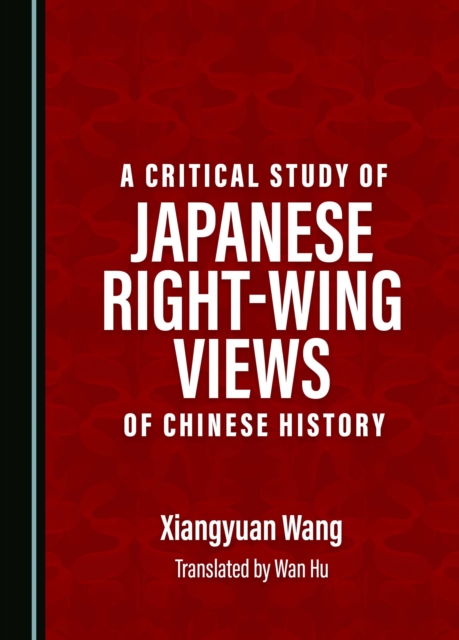
A Critical Study of Japanese Right-Wing Views of Chinese History
This book examines the historical views of Japanese right-wing scholars critically. It is devoted to the origins and backgrounds of the right-wing view of history and identifies the trajectory of its development in Japanese society. To be more specific, this book centres on the intellectual right-wing after the Cold War. It carries out in-depth case studies to thoroughly analyse the representative figures of the right-wing and criticizes their typical viewpoints towards the Japanese cultural invasion of China. This book represents interdisciplinarity, assessing the right-wing views from a comprehensive set of perspectives, including international politics, international relations, history and ideology.
eBook


A Brief History of History
In A Brief History of History , acclaimed historian
Jeremy Black seeks to reinvigorate and redefine our ideas about
history. The stories we tell about the past are a crucial aspect of
all cultures. However, while the traditional storytelling
process-what we think of as \"history\" in the proper sense-is
useful, it is also misleading, not least because it leads to the
repetition of bias and misinformation. Black suggests that the
conventional idea of history and historians is constructed too
narrowly, as it fails to engage with the broad nature of lived
experience. By focusing on a singular idea or story within the
history being explored, we fail to understand the interconnectivity
of the everyday experience. A Brief History of History
challenges accepted norms of the historical perspective and offers
a view of human history that will surprise many and (perhaps)
infuriate some. But above all, it is a history of historians
written for this moment in time, a time when the traditional
Eurocentric approach to history now appears wholly
inappropriate.
eBook