
Catalogue Search | MBRL


Are you sure you want to remove the book from the shelf?

{{itemTitle}}
5
result(s) for
"Gesundheitsinformationssystem"
Sort by:

Children's healthcare and parental media engagement in urban China : a culture of anxiety?
This book analyses parental anxieties about their children's healthcare issues in urban China, engaging with wider theoretical debates about modernity, risk and anxiety. It examines the broader social, cultural and historical contexts of parental anxiety by analysing a series of socio-economic changes and population policy changes in post-reform China that contextualise parental experiences. Drawing on Wilkinson's (2001) conceptualisation linking individual's risk consciousness to anxiety, this book analyses the situated risk experiences of parents' and grandparents', looking particularly into their engagement with various types of media. It studies the representations of health issues and health-related risks in a parenting magazine, popular newspapers, commercial advertising and new media, as well as parents' and grandparents' engagement with and response to these media representations.
Book

A Preventive Action Management Platform in Healthcare Information Systems
Preventive actions management plays a crucial role in clinical applications, not only for those who depend on data to make decisions, but also for those who monitor the operational and financial impact of the systems. This paper presents an open-source platform, named ScheduleIT, capable of managing preventive routines. The platform is based on an estimation model that determines the optimal time interval for interventions, according to the criticality of the system and the number of non-programmed faults, among others. ScheduleIT has a web-based interface available to a different area end-user, ranging from IT technicians to administrative staff. At this point, the platform covers around 75% of the healthcare systems and it is fully accepted by its main users as a reliable and effective preventive tool.
Journal Article

A Comparative Analysis of Chain-Based Access Control and Role-Based Access Control in the Healthcare Domain
The importance of electronic healthcare has caused numerous changes in both substantive and procedural aspects of healthcare processes. These changes have produced new challenges for patient privacy and information secrecy. Traditional privacy policies cannot respond to rapidly increased privacy needs of patients in electronic healthcare. Technically enforceable privacy policies are needed in order to protect patient privacy in modern healthcare with its cross-organizational information sharing and decision making. This paper proposes a personal information flow model that proposes a limited number of acts on this type of information. Ontology-classified chains of these acts can be used instead of the “intended business purposes” in the context of privacy access control. This enables the seamless integration of security and privacy into existing healthcare applications and their supporting infrastructures. In this paper, the authors present their idea of a Chain-Based Access Control (ChBAC) mechanism and provide a comparative analysis of it to Role-Based Access Control (RBAC). The evaluation is grounded in the healthcare domain and examines a range of typical access scenarios and approaches.
Journal Article

Health IT JumpStart
IT professionals can learn how to launch a career in health information technologyGovernment regulation is mandating that all physician practices, hospitals, labs, etc. move to electronic health records (EHR) by 2014, which, in turn, will create a demand for IT professionals to help medical facilities make this transition as smooth as possible. This book helps IT professionals make the move into health information technology (HIT) and shows you how EHRs can be securely created, maintained, distributed, and backed up under government regulations.The author duo is a pair of HIT experts who understand how medical data works and willingly share their expertise with you so that you can best serve this emerging, evolving market. You'll quickly benefit from using this book as your first step to understanding and preparing for a job in HIT.Opens the door to researching how to make the move from IT to the up-and-coming field of health information technology (HIT)Guides you through the four aspects of HIT: government regulation and funding, operational workflow, clinical understanding, and the technology that ties it all togetherPrepares you for the healthcare market with a roadmap of understandable advice that escorts you through complex government informationPares down the extraneous material and delivers the need-to-know information on securely maintaining electronic health recordsJump into the up-and-coming world of health IT with this helpful and insightful book.
eBook
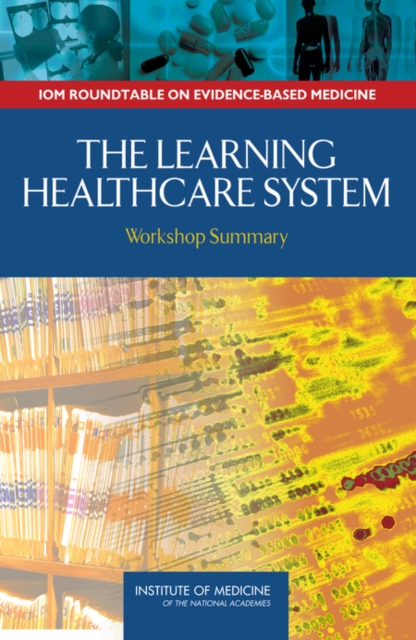
The Learning Healthcare System
As our nation enters a new era of medical science that offers the real prospect of personalized health care, we will be confronted by an increasingly complex array of health care options and decisions. The Learning Healthcare System considers how health care is structured to develop and to apply evidence-from health profession training and infrastructure development to advances in research methodology, patient engagement, payment schemes, and measurement-and highlights opportunities for the creation of a sustainable learning health care system that gets the right care to people when they need it and then captures the results for improvement. This book will be of primary interest to hospital and insurance industry administrators, health care providers, those who train and educate health workers, researchers, and policymakers.
The Learning Healthcare System is the first in a series that will focus on issues important to improving the development and application of evidence in health care decision making. The Roundtable on Evidence-Based Medicine serves as a neutral venue for cooperative work among key stakeholders on several dimensions: to help transform the availability and use of the best evidence for the collaborative health care choices of each patient and provider; to drive the process of discovery as a natural outgrowth of patient care; and, ultimately, to ensure innovation, quality, safety, and value in health care.
eBook