
Catalogue Search | MBRL


Are you sure you want to remove the book from the shelf?

{{itemTitle}}
257
result(s) for
"Ghost dance."
Sort by:


Ghost Dances and Identity
This innovative cultural history examines wide-ranging issues of religion, politics, and identity through an analysis of the American Indian Ghost Dance movement and its significance for two little-studied tribes: the Shoshones and Bannocks. The Ghost Dance has become a metaphor for the death of American Indian culture, but as Gregory Smoak argues, it was not the desperate fantasy of a dying people but a powerful expression of a racialized \"Indianness.\" While the Ghost Dance did appeal to supernatural forces to restore power to native peoples, on another level it became a vehicle for the expression of meaningful social identities that crossed ethnic, tribal, and historical boundaries. Looking closely at the Ghost Dances of 1870 and 1890, Smoak constructs a far-reaching, new argument about the formation of ethnic and racial identity among American Indians. He examines the origins of Shoshone and Bannock ethnicity, follows these peoples through a period of declining autonomy vis-a-vis the United States government, and finally puts their experience and the Ghost Dances within the larger context of identity formation and emerging nationalism which marked United States history in the nineteenth century.
eBook
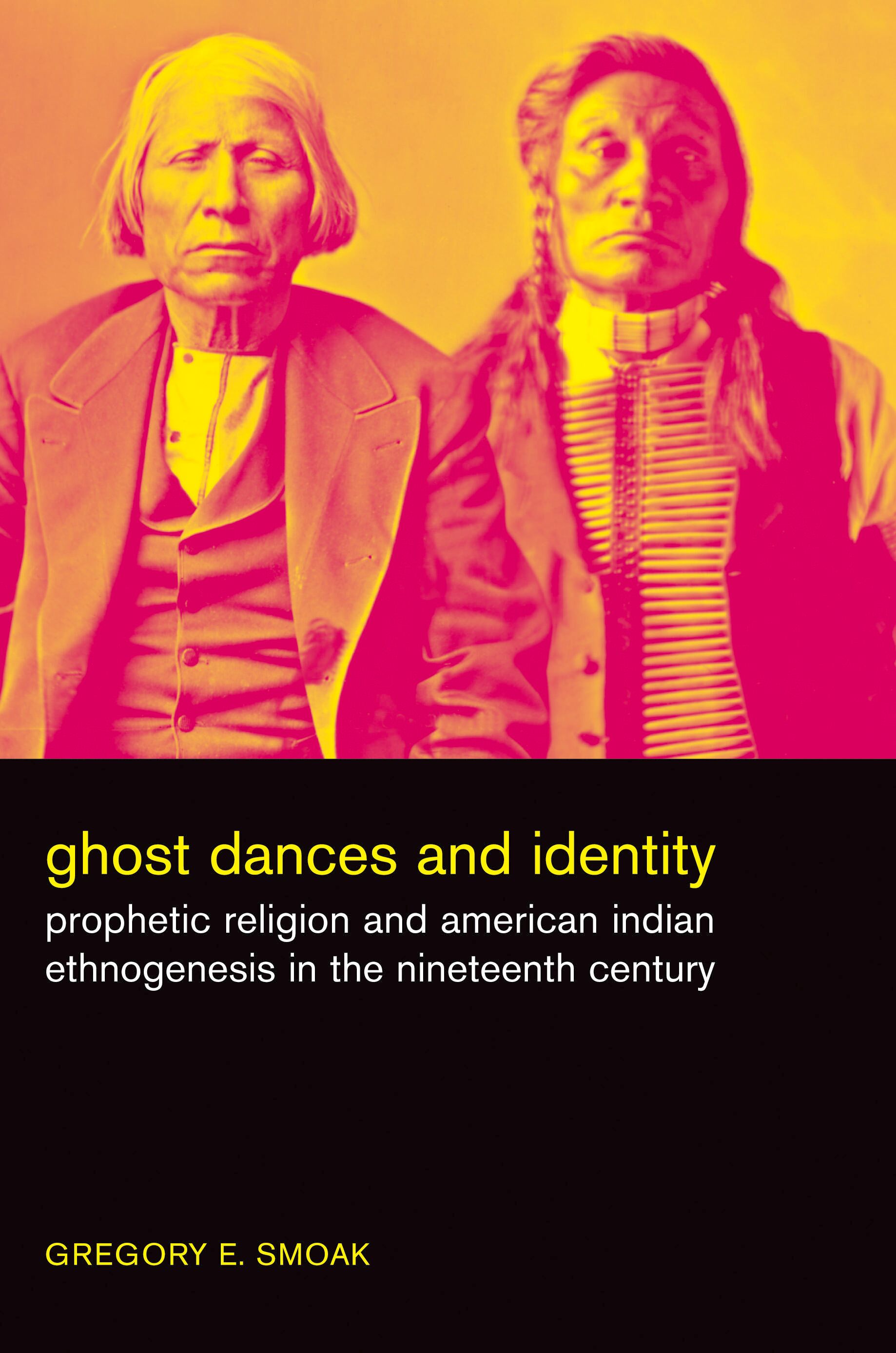
Ghost Dances and Identity
This innovative cultural history examines wide-ranging issues of religion, politics, and identity through an analysis of the American Indian Ghost Dance movement and its significance for two little-studied tribes: the Shoshones and Bannocks. The Ghost Dance has become a metaphor for the death of American Indian culture, but as Gregory Smoak argues, it was not the desperate fantasy of a dying people but a powerful expression of a racialized \"Indianness.\" While the Ghost Dance did appeal to supernatural forces to restore power to native peoples, on another level it became a vehicle for the expression of meaningful social identities that crossed ethnic, tribal, and historical boundaries. Looking closely at the Ghost Dances of 1870 and 1890, Smoak constructs a far-reaching, new argument about the formation of ethnic and racial identity among American Indians. He examines the origins of Shoshone and Bannock ethnicity, follows these peoples through a period of declining autonomy vis-a-vis the United States government, and finally puts their experience and the Ghost Dances within the larger context of identity formation and emerging nationalism which marked United States history in the nineteenth century.
eBook

Cross-Cultural Perceptions of Technology and Magic in the Ghost Dance, Boxer Uprising, and Maji Maji Rebellion
This article explores the widespread phenomenon of anti-colonial movements that relied on magical rituals for protection against European weapons. It examines both the beliefs of the magical practitioners themselves, and those of colonizing observers whose fascination with stories of “primitive magic” contributed to their contrasting self-representations as superior beings in possession of technological wonders. North America’s Ghost Dance movement, China’s Boxer Rebellion, and East Africa’s Maji Maji uprising took place on three different continents but occurred almost simultaneously. The cases come from a narrow period of time, roughly 1890 to 1910, during a peak of colonial violence all over the world.
Journal Article


When the spirits arrived
The Ghost Dance was a distinguishing phenomenon in Lakota history that caused a lot of friction and divisiveness among the Lakota people in 1890. From the very beginning, however, the Lakota Ghost Dance was studied mainly from the perspectives of white Americans, and the Lakota views were only in passing incorporated into this narrative. The earliest accounts created a tradition of treating the Lakota Ghost Dance as a military, political, or religious-political movement. This approach is characterized by phrases such as Sioux outbreak, Messiah Craze, or Ghost Dance war, so often used even in the titles of these works The tradition continued into the late twentieth century, when alternative interpretations began to emerge. However, there is still much to be understood about the Ghost Dance from the Lakota point of view. In The Lakota Ghost Dance of 1890, I was able to locate and use a number of Lakota accounts of the Ghost Dance that had not been used before. Since the Lakota voice was only one part of that study, much of the material could only be used partially or had to be left out. Some of the documents are long, 15–20 pages each, some are written in Lakota or Dakota and need time-consuming translation. Some of the documents have been at least partly published before, while others have not been used so far. In this article, I will present and analyze excerpts of some of the key documents representing different approaches to the Ghost Dance among the Lakotas.
Journal Article

Indigenous and Ecofeminist Reclamation and Renewal: The Ghost Dance in Silko’s Gardens in the Dunes
Early in the development of ecofeminist literary criticism, white feminists borrowed shallowly and unethically from Indigenous cultures. Using that underinformed discourse to interpret Native American women’s literature resulted in idealizing and silencing Indigenous women’s voices and concerns. Native American feminist literary critics have also asserted that a well-informed, inclusive “tribal-feminism” or Indigenous-feminist critical approach can be appropriate and productive, in that it focuses on unique and shared imbalances created by white patriarchal colonization, thinking, and ways of being that affect Indigenous and non-Indigenous women and cultures and the environment. In her third novel, Gardens in the Dunes, Leslie Marmon Silko interweaves an ecological critique of white imperialist botanical exploitation of landscapes and Indigenous peoples globally with both a celebration of Native American relationships to the land and Indigenous women’s resourceful resistance and an ecofeminist reclamation of European pagan/Great Goddess iconography, sacred landscapes, and white feminist autonomy. Expanding on earlier Indigenous-feminist readings, this ecofeminist analysis looks at a key trope in Gardens, the Ghost Dance, an environmentally and ancestrally focused nineteenth-century sacred resistance and reclamation rite. Silko’s is a late-twentieth-century literary adaptation/enactment in what is the continuing r/evolution of the Ghost Dance, a dynamic figure in Native American literature and culture.
Journal Article

Bulletproof
In 1856 and 1857, in response to a prophet’s command, the Xhosa people of southern Africa killed their cattle and ceased planting crops; the resulting famine cost tens of thousands of lives. Much like other millenarian, anticolonial movements—such as the Ghost Dance in North America and the Birsa Munda uprising in India—these actions were meant to transform the world and liberate the Xhosa from oppression. Despite the movement’s momentous failure to achieve that goal, the event has continued to exert a powerful pull on the South African imagination ever since. It is these afterlives of the prophecy that Jennifer Wenzel explores in Bulletproof. Wenzel examines literary and historical texts to show how writers have manipulated images and ideas associated with the cattle killing—harvest, sacrifice, rebirth, devastation—to speak to their contemporary predicaments. Widening her lens, Wenzel also looks at how past failure can both inspire and constrain movements for justice in the present, and her brilliant insights into the cultural implications of prophecy will fascinate readers across a wide variety of disciplines.
eBook