
Catalogue Search | MBRL


Are you sure you want to remove the book from the shelf?

{{itemTitle}}
1,323
result(s) for
"Giordano Bruno"
Sort by:


Christian Neoplatonism and Deep Incarnation: Nicholas of Cusa and Giordano Bruno as Inspirations for Contemporary Ecotheology
In response to the specter of looming anthropogenic ecological catastrophe, many Christian thinkers have begun to rethink the God/world relationship and reimagine the ontic cleavage between divinity and creation. The idea of “deep incarnation”, which expands the scope of divine incarnation in an attempt to draw God and creation into closer relation, is a prevalent framework for such reimagination. Two historic, underutilized thinkers that might help deep incarnation theologians expand their own theologies and make sense of the conceptual and ethical differences among them are Neo-Platonist philosopher–theologians Nicholas of Cusa and Giordano Bruno. Working within an ecofeminist framework, this article argues that while both Cusanus and Bruno provide significant philosophical grounds for contemporary ecotheologies of deep incarnation, a Brunist perspective is preferable because of its more expansive anthropology and its more inclusive understanding of divinity.
Journal Article

East Meets West: The New Gnoseology in Giordano Bruno and Wang Yangming
This study examines the various explanations of the deliberative humanity, regarding a new gnoseology in the intellectual contexts of Giordano Bruno and Wang Yangming during the 15th and 16th centuries. In a similar way to Marsilio Ficino and Giordano Bruno for the European Renaissance, Wang Yangming is the enlightener among the representatives of Neo-Confucianism in early modern China. Each of these three takes an individual’s mind as the point of departure. They then modify the traditional theory of gnoseology, in search of the good and principle. Nevertheless, behind these similarities on the surface, the metaphorical and theoretical interpretations follow different directions. Marsilio Ficino translates hierarchic Platonism as a transcendent norm. Giordano Bruno and Wang Yangming, however, seem to liberate the individual’s humanity from the traditional norms of gnoseology. In their methodologies, they both have developed a generative gnoseology that differs from the orthodox pattern of knowledge in their respective traditions.
Journal Article


Hasdai Crescas, Gianfrancesco Pico, Giordano Bruno: On Infinite Space and Time
This article examines the conception of infinite space and time in Hasdai Crescas, Gianfrancesco Pico della Mirandola and Giordano Bruno. If Crescas’ presence is explicit in Gianfrancesco Pico’s Examen vanitatis (1520), the reception by Bruno, who never mentions him, was postulated by Harry A. Wolfson in 1929. More recently, David Harari and Mauro Zonta posited the intermediary role of an unknown Jewish author. However, a comparison of the critique of Aristotle by Crescas and Bruno shows that, apart from two points, Bruno was able to reach his positions, independently of Crescas, from his own critical reading of Aristotle and from his knowledge of the developments in medieval scholasticism and the Neoplatonic concept of time. Significantly, Crescas qualifies space and time as attributes of God in a purely metaphorical sense, a question that Pico leaves aside, while Bruno conceives of infinite space and duration, together with matter, as real attributes of God, who, as an indifferent unity of opposites, is both mind and intellect as well as space and matter.
Journal Article
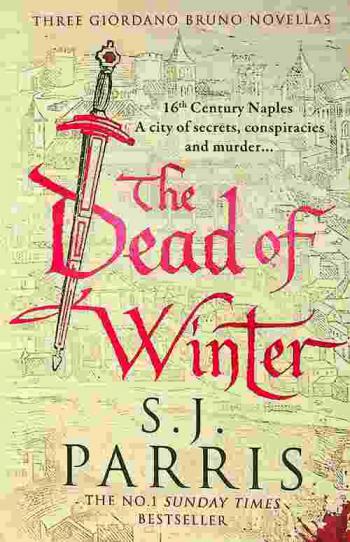
The dead of winter
Three exhilarating novellas 'The Secret Dead, The Academy of Secrets, and The Dead of Winter' following the early adventures of young priest Giordano Bruno in the dramatic days of sixteenth century Italy. Even the dead have a story to tell ... Naples, 1566. During a sweltering summer, eighteen-year-old Giordano Bruno takes his final vows at San Domenico Maggiore and is admitted to the Dominican Order despite doubts over his tendency to ask difficult questions. Assisting in the infirmary, Bruno witnesses an illicit autopsy performed on the body of a young woman. Her corpse reveals a dark secret, and Bruno suspects that hers may not have been an accidental death. His investigation leads him to a powerful figure who wants to keep the truth buried and Bruno is forced to make a choice between his future in the Order, and justice for an innocent victim and her grieving family.

Changing conceptions of mathematics and infinity in Giordano Bruno’s vernacular and Latin works
The purpose of this paper is to provide an analysis of Giordano Bruno’s conception of mathematics. Specifically, it intends to highlight two aspects of this conception that have been neglected in previous studies. First, Bruno’s conception of mathematics changed over time and in parallel with another concept that was central to his thought: the concept of infinity. Specifically, Bruno undertook a reform of mathematics in order to accommodate the concept of the infinitely small or “minimum,” which was introduced at a later stage. Second, contrary to what Héléne Védrine claimed, Bruno believed that mathematical objects were mind-dependent. To chart the parallel development of the conceptions of mathematics and infinity, a seven-year time span is considered, from the publication of Bruno’s first Italian dialogue (La cena de le ceneri, 1584) to the publication of one of his last Latin works (De minimo, 1591).
Journal Article

Sacrilege : a thriller
Summer, 1584. Sir Francis Walsingham, spymaster to Queen Elizabeth, has long suspected an undercurrent of Catholic resistance in the city that was once England's greatest centre of pilgrimage. He calls Giordano Bruno, his maverick secret agent, away from his post at the French Embassy to investigate. But when Bruno arrives in Canterbury, he has no idea of the dark secrets he's about to uncover. He must turn his detective's eye on history--on Saint Thomas Becket, the twelfth-century archbishop murdered in Canterbury Cathedral, and on the legend surrounding the disappearance of his body--in order to solve the crime.
BOOK
