
Catalogue Search | MBRL


Are you sure you want to remove the book from the shelf?

{{itemTitle}}
402
result(s) for
"Girard, René"
Sort by:


Toward an Islamic Theology of Nonviolence
This groundbreaking book offers the first systematic study of the Qur'ān and Islamic history in the light of René Girard's mimetic theory. Girard did not deal deeply with Islam, offering only scattered hints in some interviews after the September 11, 2001, attacks in the United States. Addressing this gap in Girardian studies, Adnane Mokrani aims to develop an Islamic theology that goes beyond just war theory to adopt a radical nonviolent approach. He analyzes the Qur'ānic text and classical and modern exegetical literature, focusing on the Qur'ānic narratives, then extends his research to the history of Islam, removing the sacred character attributed to some events and human choices in order to disarm theology and dismantle the ideologies of power. This same critique is also applied to the unprecedented levels of violence in modern and contemporary history. A radical and politically committed theology of peace is needed to recover the spiritual dimension of religion that frees people from the temptations of the individual and collective ego. It is a mystical and narrative theology in dialogue with other world theologies on the future of humanity-an urgent appeal needed now more than ever.
eBook

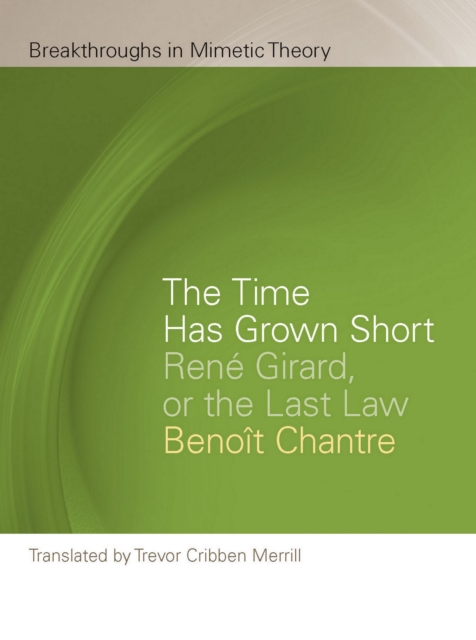
The Time Has Grown Short
The protagonist of Marcel Proust's In Search of Lost Time
observes with wonder the comings and goings of the crows that roost
in the belfry of the village church in Combray, his childhood home.
For René Girard, one of Proust's great interpreters, their
mysterious flight, first departing from and then returning to the
vertical axis of the steeple, suggests the movement of modern
history-the crisis of aristocratic models, the growing servitude of
individuals possessed by mimetic desire, and the final irruption of
authentic transcendence. In this rich exploration of Girard's
insights, his French editor and longtime collaborator Benoît
Chantre brings Saint Paul's Letter to the Romans into dialogue with
both Proust and Girard in order to push to its logical endpoint the
idea of a back-and-forth movement from chaos to order. History,
Chantre argues, has been driven mad by the revelation of its
sacrificial engine. The only way out lies in a transformation
internal to the crisis itself-only that faith which is capable of
hearing the One who speaks in the Law makes it possible to avoid
the perpetual ups and downs of rivalry. Acting and revealing
Himself at the heart of history, an intimate model \"hidden since
the foundation of the world\" deals a fatal blow to the circle of
sin. Authentic transcendence coincides with the eschaton, the
moment when-according to Saint Paul-historical time implodes into
eternity.
eBook

René Girard and Secular Modernity
Scott Cowdell provides the first systematic interpretation of René Girard’s controversial approach to secular modernity. Cowdell identifies the scope, development, and implications of Girard’s thought, the centrality of Christ in Girard's thinking, and, in particular, Girard's distinctive take on the uniqueness and finality of Christ in terms of his impact on Western culture. In Girard’s singular vision, according to Cowdell, secular modernity has emerged thanks to the Bible’s exposure of the cathartic violence that is at the root of religious prohibitions, myths, and rituals. In the literature, the psychology, and most recently the military history of modernity, Girard discerns a consistent slide into an apocalypse that challenges modern ideas of romanticism, individualism, and progressivism. In the first three chapters, Cowdell examines the three elements of Girard’s basic intellectual vision (mimesis, sacrifice, biblical hermeneutics) and brings this vision to a constructive interpretation of “secularization” and “modernity,” as these terms are understood in the broadest sense today. Chapter 4 focuses on modern institutions, chiefly the nation state and the market, that function to restrain the outbreak of violence. And finally, Cowdell discusses the apocalyptic dimension of Girard's theory in relation to modern warfare and terrorism. Here, Cowdell engages with the most recent writings of Girard (particularly his Battling to the End) and applies them to further conversations in cultural theology, political science, and philosophy.
eBook

Violence, the Sacred, and Things Hidden
Never before translated in English, this 1973 discussion between
René Girard (1923-2015) and other prominent scholars represents one
of the most significant breakthroughs in mimetic theory. Organized
by the French journal Esprit , the conversation was an
opportunity for Girard to debate with his interlocutors the
theories he expounded in Violence and the Sacred (1972).
These scholars prompted him to reconsider the book's strictly
sociological interpretation of religion, highlighting the
misrecognition of violent scapegoating at its origins and in its
myths and ritual practices, by addressing the relation between his
critique of primitive or archaic religion and the role of
Judeo-Christianity. The ensuing discussion opened up an entirely
new and admittedly startling phase of his thinking, where he
deployed an epistemology rooted in Biblical revelation, which he
viewed as an ongoing deconstruction of sacrificial practices. In
this text, he vindicates for the very first time the
anthropological relevance of Judeo-Christian scriptures. The 1973
discussion thus marks a new and decisive step in Girard's
intellectual journey, making this volume a critical document for
understanding the transition period between Violence and the
Sacred and Things Hidden Since the Foundation of the
World (1978).
eBook

René Girard's Mimetic Theory
A systematic introduction into the mimetic theory of the French-American literary theorist and philosophical anthropologist René Girard, this essential text explains its three main pillars (mimetic desire, the scapegoat mechanism, and the Biblical \"difference\") with the help of examples from literature and philosophy. This book also offers an overview of René Girard's life and work, showing how much mimetic theory results from existential and spiritual insights into one's own mimetic entanglements. Furthermore it examines the broader implications of Girard's theories, from the mimetic aspect of sovereignty and wars to the relationship between the scapegoat mechanism and the question of capital punishment. Mimetic theory is placed within the context of current cultural and political debates like the relationship between religion and modernity, terrorism, the death penalty, and gender issues. Drawing textual examples from European literature (Cervantes, Shakespeare, Goethe, Kleist, Stendhal, Storm, Flaubert, Dostoevsky, Proust) and philosophy (Plato, Camus, Sartre, Lévi-Strauss, Derrida, Vattimo), Palaver uses mimetic theory to explore the themes they present. A highly accessible book, this text is complemented by bibliographical references to Girard's widespread work and secondary literature on mimetic theory and its applications, comprising a valuable bibliographical archive that provides the reader with an overview of the development and discussion of mimetic theory until the present day.
eBook

Philosophy's Violent Sacred
Continental and postmodern thinking has misidentified the source of violence as originating from Western metaphysics. It has further failed to acknowledge the Judeo- Christian source of its ethic—the ethic of concern for victims. In this volume Duane Armitage attempts a critique of continental philosophy and postmodernism through the lens of René Girard’s mimetic theory. This critique is directed primarily at the philosophies of Nietzsche and Heidegger, both among the foremost representatives of continental and postmodern thought. Armitage argues that Girard’s engagement with Heidegger and Nietzsche radically alters many of the axioms of current postmodern continental philosophy, in particular the overcoming of metaphysics on the theoretical level and continental philosophy’s tacit commitments to (neo-)Marxism on the practical level. Detailed attention to the implications of Girard’s philosophical thought results in a paradigm shift that deals perhaps a deadly blow to continental and postmodern thinking. Armitage further argues that Girard’s thinking solves the very problems that continental and postmodern thinking sought (but failed) to solve, namely the problems of violence and victimization, particularly within the context of the aftermath of the Second World War. Ultimately, this volume shows that at the heart of postmodern thinking lies an entanglement with the violent sacred.
eBook

Intellectual Sacrifice and Other Mimetic Paradoxes
Intellectual Sacrifice and Other Mimetic Paradoxesis an account of Paolo Diego Bubbio's twenty-year intellectual journey through the twists and turns of Girard's mimetic theory. The author analyzes philosophy and religion as \"enemy sisters\" engaged in an endless competitive struggle and identifies the intellectual space where this rivalry can either be perpetuated or come to a paradoxical resolution. He goes on to explore topics ranging from arguments for the existence of God to mimetic theory's post-Kantian legacy, political implications, and capacity for identifying epochal phenomena, such as the crisis of the self, in popular culture. Bubbio concludes by advocating for an encounter between mimetic theory and contemporary philosophical hermeneutics-an encounter in which each approach benefits and is enriched by the resources of the other. The volume features a previously unpublished letter by René Girard on the relationship between philosophy and religion.
eBook

Persuasions of God
The nations of the global north find themselves in a
post-secular or post-Christian period, one in which the practice,
expression, and effects of religion are undergoing massive shifts.
In Persuasions of God , Paul Lynch pursues a project of
\"theorhetoric,\" a radical new approach to speaking about the
divine.
Searching for new religious forms amid the lingering influence
of Christianity, Lynch turns to René Girard, the most important
twentieth-century thinker on the sacred and its expression within
the Christian tradition. Lynch repurposes Girard's mimetic theory
to invent a post-Christian way of speaking to, for, and especially
about God. Girard theorized the sacred as the nexus of violence,
order, and sacralization that lies at the heart of religion. What
Lynch advocates in our current moment of religious kairos
is a paradoxically meek rhetoric that conscientiously refuses
rivalry, actively exploits tradition through complicit invention,
and boldly seeks a holiness free of exclusionary violence. The
project of theorhetoric is to reinvent God through the reimagined
themes of meekness, sacrifice, atonement, and holiness. From these,
Persuasions of God offers religion reimagined for our
post-secular age.
An interdisciplinary mix of philosophy, sociology, rhetorical
studies, and theology, this book draws on mimetic theory to answer
the question of where religion goes next. It will be valued by
religious studies and communications scholars as well as anyone
interested in the future of Christianity in our modern world.
eBook