
Catalogue Search | MBRL


Are you sure you want to remove the book from the shelf?

{{itemTitle}}
1,558
result(s) for
"Girls Education Developing countries."
Sort by:

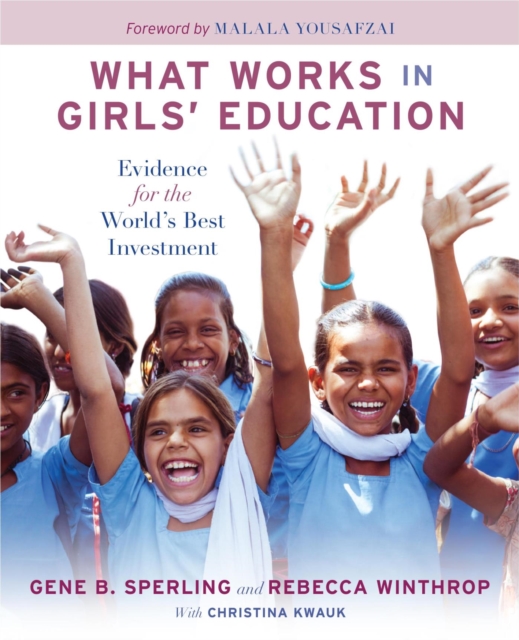
What Works in Girls' Education
Hard-headed evidence on why the returns from investing in girls are so high that no nation or family can afford not to educate their girls. Gene Sperling, author of the seminal 2004 report published by the Council on Foreign Relations, and Rebecca Winthrop, director of the Center for Universal Education, have written this definitive book on the importance of girls' education. As Malala Yousafzai expresses in her foreword, the idea that any child could be denied an education due to poverty, custom, the law, or terrorist threats is just wrong and unimaginable. More than 1,000 studies have provided evidence that high-quality girls' education around the world leads to wide-ranging returns: Better outcomes in economic areas of growth and incomes Reduced rates of infant and maternal mortality Reduced rates of child marriage Reduced rates of the incidence of HIV/AIDS and malaria Increased agricultural productivity Increased resilience to natural disasters Women's empowerment What Works in Girls' Education is a compelling work for both concerned global citizens, and any academic, expert, nongovernmental organization (NGO) staff member, policymaker, or journalist seeking to dive into the evidence and policies on girls' education.
eBook

Critical Perspectives on Schooling and Fertility in the Developing World
This volume assesses the evidence, and possible mechanisms, for the associations between women's education, fertility preferences, and fertility in developing countries, and how these associations vary across regions. It discusses the implications of these associations for policies in the population, health, and education sectors, including implications for research.
eBook

Investing in young children : an early childhood development guide for policy dialogue and project preparation
Investing in young children is the responsible thing to do. All children deserve a chance to grow into healthy, educated, and competent people, no matter where and when they were born. While parents bear most of the responsibility for raising their children, especially in the early years of life, governments also have an important role during this critical time of human capital accumulation. For example, governments can ensure that all expectant mothers and young children have access to quality health services and nutrition. They can support parents and other caregivers in providing a positive and stimulating environment for children from birth on by promoting parenting information programs, investing in direct services such as home-based visits, funding daycare centers and preschools, or providing financial incentives to access good quality programs for infants and children. This Early Childhood Development (ECD) guide presents lessons and experiences that have been useful in informing the policy debate about ECD interventions and the design of such programs across the world. Whether the user of this guide is at the initial stage of deciding whether to expand an ECD portfolio or already in the program design stage, the content offers a range of evidence- based options to inform policy and investment choices.
eBook

Opening doors
Since the early 1990s, countries in the Middle East and North Africa (MENA) Region have made admirable progress in reducing the gap between girls and boys in areas such as access to education and health care. Indeed, almost all young girls in the Region attend school, and more women than men are enrolled in university. Over the past two decades, maternal mortality declined 60 percent, the largest decrease in the world. Women in MENA are more educated than ever before. It is not only in the protest squares that have seen women whose aspirations are changing rapidly but increasingly unmet. The worldwide average for the participation of women in the workforce is approximately 50 percent. In MENA, their participation is half that at 25 percent. Facing popular pressure to be more open and inclusive, some governments in the region are considering and implementing electoral and constitutional reforms to deepen democracy. These reforms present an opportunity to enhance economic, social, and political inclusion for all, including women, who make up half the population. However, the outlook remains uncertain. Finally, there are limited private sector and entrepreneurial prospects not only for jobs but also for those women who aspire to create and run a business. These constraints present multiple challenges for reform. Each country in MENA will, of course, confront these constraints in different contexts. However, inherent in many of these challenges are rich opportunities as reforms unleash new economic actors. For the private sector, the challenge is to create more jobs for young women and men. The World Bank has been pursuing an exciting pilot program in Jordan to assist young women graduates in preparing to face the work environment.
eBook

Women Empowerment and Economic Development
Women empowerment and economic development are closely related: in one direction, development alone can play a major role in driving down inequality between men and women; in the other direction, empowering women may benefit development. Does this imply that pushing just one of these two levers would set a virtuous circle in motion? This paper reviews the literature on both sides of the empowerment—development nexus, and argues that the interrelationships are probably too weak to be self-sustaining, and that continuous policy commitment to equality for its own sake may be needed to bring about equality between men and women.
Journal Article

Additional returns to investing in girls' education
This article estimates the effect of the oldest sister's education on child human capital development. In many developing countries, the oldest sisters share significant childcare responsibilities in the household and can influence younger siblings' learning. I propose a model that predicts competing effects of increasing the oldest sister's schooling on younger sibling human capital. Using an identification strategy that exploits the gender segregation of schools in Pakistan, I find that the oldest sister's schooling significantly improves younger brothers' literacy, numeracy and schooling. These results indicate that evaluations of programmes targeting girls' education that ignore these spillovers on younger siblings systematically underestimate total benefits.
Journal Article

Trends in the age at reproductive transitions in the developing world: The role of education
Girls' school participation has expanded considerably in the developing world over the last few decades, a phenomenon expected to have substantial consequences for reproductive behaviour. Using Demographic and Health Survey data from 43 countries, this paper examines trends and differentials in the mean ages at three critical life-cycle events for young women: first sexual intercourse, first marriage, and first birth. We measure the extent to which trends in the timing of these events are driven either by the changing educational composition of populations or by changes in behaviour within education groups. Mean ages have risen over time in all regions for all three events, except age at first sex in Latin America and the Caribbean. Results from a decomposition exercise indicate that increases in educational attainment, rather than trends within education groups, are primarily responsible for the overall trends. Possible explanations for these findings are discussed.
Journal Article

Imperatives for achieving gender equity in education in developing countries: A systematic literature review approach
Despite the extensive efforts towards gender equity, girls and women still struggle to access, progress, and complete education at different levels. The purpose of this study is to present imperatives for achieving gender equity in education in developing countries. We use the postmodern feminism theory to argue that the one-size-fits-all approach in education is not ideal. We incorporate the empowerment theory to support the notion that girls need to be empowered with the right knowledge and resources to achieve gender equity in education. The Preferred Reporting Items for Systematic Review and Meta-Analysis protocols and checklist were used to conduct a systematic literature review. The Cadima web tool is used to screen and select relevant data. Out of one thousand one hundred and twenty-seven articles screened, thirty-four articles were retained. A thematic approach was used to analyse data. Results reveal that initiatives by government and educational institutions are imperative for achieving gender equity in education in developing countries. Likewise, the role of strong partnerships, media, families, and communities should not be underestimated. This study yields insightful theoretical and practical contributions towards the achievement of gender equity and inclusive development, especially for developing countries.
Journal Article

Gender Segregation in Education
This paper investigates gender-based segregation across different fields of study at the senior secondary level of schooling in a large developing country. We use a nationally representative longitudinal data set from India to analyze the extent and deter minants of gender gap in higher secondary stream choice. Using fixed-effects regressions that control for unobserved heterogeneity at the regional and house hold levels, we find that girls are about 20 percentage points less likely than boys to study in science (STEM) and commerce streams as compared with humanities. This gender disparity is unlikely to be driven by gender-specific differences in cognitive ability, given that the gap remains large and significant even after we control for individuals’ past test scores. We establish the robustness of these estimates through various sensitivity analyses: including sibling fixed effects, considering intrahousehold relationships among individuals, and addressing sample selection issues. Disaggregating the effect on separate streams, we find that girls are most underrepresented in the study of science. Our findings indicate that gender inequality in economic outcomes, such as occupational segregation and gender pay gaps, is determined by gendered trajectories set much earlier in the life course, especially at the school level.
Journal Article