
Catalogue Search | MBRL


Are you sure you want to remove the book from the shelf?

{{itemTitle}}
39
result(s) for
"Glassware, Ancient."
Sort by:


Ancient Glass
This book is an interdisciplinary exploration of archaeological glass in which technological, historical, geological, chemical, and cultural aspects of the study of ancient glass are combined. The book examines why and how this unique material was invented some 4,500 years ago and considers the ritual, social, economic, and political contexts of its development. The book also provides an in-depth consideration of glass as a material, the raw materials used to make it, and its wide range of chemical compositions in both the East and the West from its invention to the seventeenth century AD. Julian Henderson focuses on three contrasting archaeological and scientific case studies: Late Bronze Age glass, late Hellenistic-early Roman glass, and Islamic glass in the Middle East. He considers in detail the provenances of ancient glass using scientific techniques and discusses a range of vessels and their uses in ancient societies.
eBook


Obsidian and ancient manufactured glasses
This edited volume offers archaeologists and archaeometrists the latest technical information, the fundamentals of provenance studies, instrumentation used in these investigations, and strategies for the dating and interpretation of archaeological materials in glass studies.
eBook


HERODIAN INNOVATION: The Glass Industry
When timing, location, resources, experience, and inspiration coincide, a phenomenon can occur such as the invention of glass blowing and its impact on the development of the Roman glass industry. The impetus for this new industry came from Hellenistic glass production, particularly in Israel where Herod's personal relationship with Augustus assured economic, social, and political strength. The Herodian period is marked by creative energy, manifested in the technology of the time and demonstrated in remarkable advancements in the glass industry. New technology, originating in Jerusalem, spread so rapidly that it is difficult to track. This paper examines the late Hellenistic, Herodian and Augustan history of glass and how technical advancements coincided with improved Roman sea trade to transform glass making into a global industry. Earlier technical advancements had previously allowed greater production and lower prices, but it was the invention of glass blowing that truly revolutionized glass making.
Journal Article

Ancient glass research along the Silk Road
The Silk Road is a main artery connecting Europe and Asia for political, economical, cultural and technical exchange in antiquity, and glass is one of the earliest artificial materials to be invented. Studying the origin and evolution of ancient glass along the Silk Road is thus significant for understanding the development and exchange of culture and technology between China and abroad.
eBook

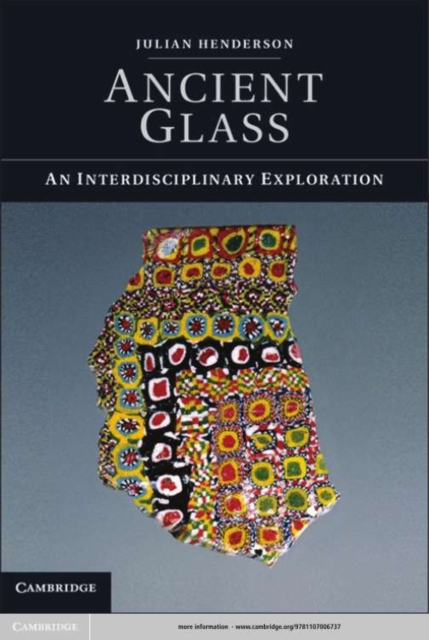
Ancient glass
This book is an interdisciplinary exploration of archaeological glass in which technological, historical, geological, chemical, and cultural aspects of the study of ancient glass are combined. The book examines why and how this unique material was invented some 4,500 years ago and considers the ritual, social, economic, and political contexts of its development. The book also provides an in-depth consideration of glass as a material, the raw materials used to make it, and its wide range of chemical compositions in both the East and the West from its invention to the seventeenth century AD. Julian Henderson focuses on three contrasting archaeological and scientific case studies: Late Bronze Age glass, late Hellenistic-early Roman glass, and Islamic glass in the Middle East. He considers in detail the provenances of ancient glass using scientific techniques and discusses a range of vessels and their uses in ancient societies.
eBook

Obsidian and Ancient Manufactured Glasses
This edited volume offers archaeologists and archaeometrists the latest technical information, the fundamentals of provenance studies, instrumentation used in these investigations, and strategies for the dating and interpretation of archaeological materials in glass studies. The contributors discuss recent advances in obsidian hydration dating, secondary ion mass spectrometry, and infrared photoacoustic spectroscopy, focusing on the application of these technologies to a variety of glass forms and incorporating studies that look at the social and economic strategies of past cultures.
With examples from Greece, the Middle East, Italy, Peru, Bolivia, Russia, Africa, and the Pacific region, provenance studies look at regional patterns of glass acquisition, production, and exchange, providing examples that use one or more instrumental methods to characterize materials from ancient societies.
Extensive figures and tables included.
eBook