
Catalogue Search | MBRL


Are you sure you want to remove the book from the shelf?

{{itemTitle}}
1,120
result(s) for
"Global Financial Crisis, 2008-2009."
Sort by:
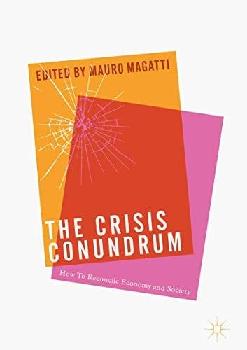
The crisis conundrum : how to reconcile economy and society
This collection addresses the path to a new prosperity after the Great Recession. The contributors ask that if the 2008 crisis proved the unsustainability of the neoliberal development model, what does well-being mean today in advanced western democracies? What kind of production and consumption will be a feature of the coming decades? What are the financial, economic, institutional and social innovations needed to reconcile economy and society after decades of disembedding? The Crisis Conundrum offers an interdisciplinary interpretation of the crisis as an opportunity to reform capitalism and consumption societies, structurally as well as culturally. Students and scholars across a range of disciplines, including sociology, economics, development studies and European studies, with find this book of interest.
Book

The leaderless economy
The Leaderless Economyreveals why international financial cooperation is the only solution to today's global economic crisis. In this timely and important book, Peter Temin and David Vines argue that our current predicament is a catastrophe rivaled only by the Great Depression. Taking an in-depth look at the history of both, they explain what went wrong and why, and demonstrate why international leadership is needed to restore prosperity and prevent future crises.
Temin and Vines argue that the financial collapse of the 1930s was an \"end-of-regime crisis\" in which the economic leader of the nineteenth century, Great Britain, found itself unable to stem international panic as countries abandoned the gold standard. They trace how John Maynard Keynes struggled for years to identify the causes of the Great Depression, and draw valuable lessons from his intellectual journey. Today we are in the midst of a similar crisis, one in which the regime that led the world economy in the twentieth century--that of the United States--is ending. Temin and Vines show how America emerged from World War II as an economic and military powerhouse, but how deregulation and a lax attitude toward international monetary flows left the nation incapable of reining in an overleveraged financial sector and powerless to contain the 2008 financial panic. Fixed exchange rates in Europe and Asia have exacerbated the problem.
The Leaderless Economyprovides a blueprint for how renewed international leadership can bring today's industrial nations back into financial balance--domestically and between each other.
eBook


Political bubbles
Behind every financial crisis lurks a \"political bubble\"--policy biases that foster market behaviors leading to financial instability. Rather than tilting against risky behavior, political bubbles--arising from a potent combination of beliefs, institutions, and interests--aid, abet, and amplify risk. Demonstrating how political bubbles helped create the real estate-generated financial bubble and the 2008 financial crisis, this book argues that similar government oversights in the aftermath of the crisis undermined Washington's response to the \"popped\" financial bubble, and shows how such patterns have occurred repeatedly throughout US history.
The authors show that just as financial bubbles are an unfortunate mix of mistaken beliefs, market imperfections, and greed, political bubbles are the product of rigid ideologies, unresponsive and ineffective government institutions, and special interests. Financial market innovations--including adjustable-rate mortgages, mortgage-backed securities, and credit default swaps--become subject to legislated leniency and regulatory failure, increasing hazardous practices. The authors shed important light on the politics that blinds regulators to the economic weaknesses that create the conditions for economic bubbles and recommend simple, focused rules that should help avoid such crises in the future.
The first full accounting of how politics produces financial ruptures,Political Bubblesoffers timely lessons that all sectors would do well to heed.
eBook

False dawn : the delusions of global capitalism
In the midst of the current financial crisis, John Gray revisits his polemic against the forces of global capitalism and deregulation. In a substantial new chapter he considers how the economic landscape has shifted in the last decade and asks the question: where do we go from here?
Book

Subprime cities
\"Subprime Cities: The Political Economy of Mortgage Markets presents a collection of works from social scientists that offer important insights into what is happening in today's mortgage market including the causes, effects, and aftermath of the 'subprime' mortgage crisis\"--
eBook


Non-Financial Disclosure and Integrated Reporting: Practices and Critical Issues
For researchers and managers interested in performance measurement, this volume includes innovative research that sheds light on topics such as the determinants of disclosure quality, the identification of appropriate metrics, the relationship among the different disclosure mechanisms and between voluntary and mandatory disclosure, and many more.
eBook

The 2008 global financial crisis in retrospect : causes of the crisis and national regulatory responses
This work addresses the causes and consequences of the international financial crisis of 2008. A range of esteemed contributors explore developments in the United States, where the crisis of 2008 originated, as well as the smallest country affected, Iceland, by evaluating developments since 2008. Currently, many countries are facing similar problems as Iceland did in 2008: this book is of interest to economists and policy makers in these countries to study what happened in Iceland, and why the recovery of that economy was strong and swift. The chapters originate from panel discussions and conferences and explore areas including regulation, state projects and inflation.
Book

European social democracy during the global economic crisis
This book makes an important contribution to the existing literature on European social democracy in the wake of the 2008 financial crash and ensuing recession. It assesses how social democratic parties have responded, at the national as well as at the European Union level. A wide range of leading political scientists provide the reader with an in-depth understanding of the prospects for social democracy in the midst of an unprecedented crisis for neoliberalism. The book draws together some of the most well-known and prestigious scholars of social democracy and social democratic parties, along with a number of impressive new scholars in the field, to present a compelling and up to date analysis of social democratic fortunes in the contemporary period. It benefits from an analysis of social democratic parties’ experiences in 6 different countries – the UK, Sweden, Germany, France, Spain and Greece – along with a number of chapters on the fate of social democracy in the institutions of the EU.
eBook