
Catalogue Search | MBRL


Are you sure you want to remove the book from the shelf?

{{itemTitle}}
286
result(s) for
"Global warming Fiction."
Sort by:

Sila's revenge
Eighteen-year old Ashley Anowiak is an eco-warrior who is prepared to go to any lengths to bring the world's attention to the plight of Planet Earth. She's already burned down the office for the local oil company. Now she's ready to move out of our her own Arctic community and into the international spotlight. After performing at Carnegie Hall, she and her band, The Dream Drummers, are pirated off to Australia by the powerful James Masters. Now, in front of an audience of half a million, Ashely must put on the performance of a lifetime to save the world.
Book

Imagining the Future of Climate Change
This title is part of American Studies Now and available as an e-book first. Visit ucpress.edu/go/americanstudiesnow to learn more.
From the 1960s to the present, activists, artists, and science fiction writers have imagined the consequences of climate change and its impacts on our future. Authors such as Octavia Butler and Leslie Marmon Silko, movie directors such as Bong Joon-Ho, and creators of digital media such as the makers of the Maori web series Anamata Future News have all envisioned future worlds during and after environmental collapse, engaging audiences to think about the earth's sustainability. As public awareness of climate change has grown, so has the popularity of works of climate fiction that connect science with activism.
Today, real-world social movements helmed by Indigenous people and people of color are leading the way against the greatest threat to our environment: the fossil fuel industry. Their stories and movements-in the real world and through science fiction-help us all better understand the relationship between activism and culture, and how both can be valuable tools in creating our future. Imagining the Future of Climate Change introduces readers to the history and most significant flashpoints in climate justice through speculative fictions and social movements, exploring post-disaster possibilities and the art of world-making.
eBook

Snow children
A story about two snow children who discover the importance of global warming and decide to do something about it.
Book

Posthuman Affirmative Business Ethics: Reimagining Human–Animal Relations Through Speculative Fiction
Posthuman affirmative ethics relies upon a fluid, nomadic conception of the ethical subject who develops affective, material and immaterial connections to multiple others. Our purpose in this paper is to consider what posthuman affirmative business ethics would look like, and to reflect on the shift in thinking and practice this would involve. The need for a revised understanding of human–animal relations in business ethics is amplified by crises such as climate change and pandemics that are related to ecologically destructive business practices such as factory farming. In this analysis, we use feminist speculative fiction as a resource for reimagination and posthuman ethical thinking. By focusing on three ethical movements experienced by a central character named Toby in Margaret Atwood’s MaddAddam trilogy, we show how she is continually becoming through affective, embodied encounters with human and nonhuman others. In the discussion, we consider the vulnerability that arises from openness to affect which engenders heightened response-ability to and with, rather than for, multiple others. This expanded concept of subjectivity enables a more relational understanding of equality that is urgently needed in order to respond affirmatively to posthuman futures.
Journal Article

The war beneath
\"Living and working underwater can be a dangerous thing. First the bulkheads sweat, then there's a trickle of water, and then in an instant you're gone. The only thing left is a bloody pulp in the dark water and crushed bone fragments on the seafloor. And you can't bolt to the surface in an emergency... The Bends will get you. But that's not the worst. When you're living underwater and also working as a spy for your city, that's when things get really dangerous. Truman McClusky has been out of the intelligence business for years, working the kelp farms and helping his city Trieste flourish on the shallow continental shelf just off the coast of Florida. Until his former partner shows up, that is, steals a piece of valuable new technology and makes a mad dash into the Atlantic. Before he knows it, Mac ends up back in the game, chasing the spy to not only recapture the tech, but to kill his former friend. But when he learns the grim truth behind the theft, it sends his stable life into turmoil and plunges him into an even deadlier mission: evade the submarines of hostile foreign powers, escape assassins, and forge through the world's oceans at breakneck pace on a daring quest to survive, with more lethal secrets than he thought possible in his pocket. The future of the city depends on McClusky... if he can make it back home.\"-- Provided by publisher.
Book

Cli-Fi—helping us manage a crisis
[...]the water was hotter than their body temperature. Some stories and books centre on the climate crisis; in others, conventional plots unfold, with climate change forming the background. Strictly speaking not cli-fi, as the global warming and resulting sea level rise that have submerged London resulted not from carbon emissions but from a solar event. When the US bans the use of fossil fuels in 2074, five southern states secede from the Union, triggering a civil war.
Journal Article
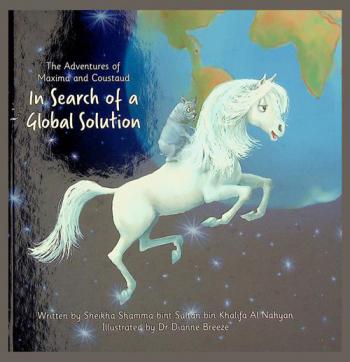
The adventures of Maxima and Coustaud : in search of a global solution
Coustaud, a small black dog and his best friend, a horse called Magical Maxima, set off on an adventure to help a new friend, but soon discover the problems they face are far bigger than they could have imagined. Can they find a global solution to these environmental issues and save the planet?
Book

Theory and Praxis, Eco-narratives and Environmental Awakening in Gun Island
By articulating the issue and problems of climate change, the novel Gun Island endeavours to develop agency for an appropriate response. [...]through such an analysis, this paper attempts to place this novel in the category of fictions which make a call to action to see the \"novel as a privileged form to explore what it means to live in the Anthropocene moment\" (Trexler 27). Novels and literary works resist bringing attention to these events for framing their narratives. [...]he summons writers to face head-on the most gruesome consequences stirred by anthropogenic climate change. (24) Trexler questions traditional approaches to criticism as they \"have little to say about ... foregrounding collective human actions\" (12-13). [...]contemporary literature about environment and climate change has ignored the need for collective human responsibility in its plots and focussed on the individual self. Since the onset of the Industrial Revolution, human activities have significantly altered the Earth's atmosphere, leading to severe weather events, higher sea levels, the melting of polar ice caps, and widespread species extinctions.
Journal Article

The final warning
While on a mission to Antarctica to save the world from global warming, fourteen-year-old Maximum Ride and the other members of the Flock (a band of genetically modified children who can fly) are pursued by their creator, the Uber-Director, who wants to auction them off to the highest bidder.
Book

Out of This World: Embodying Uncanny Precarity in Amitav Ghosh’s Speculative Intertext on Global Warming
Abstract
Climate science has been one essential aspect of generating consensus that global warming is happening, is caused by human actions, and is harmful to biodiversity and the habitability of Earth for the human species. Climate action epistemologies draw on climate science to trace the origins of global warming to the Industrial Revolution. In contrast, the diverse epistemologies of the transnational climate justice movement take as a starting point the centuries of anti-Indigenous and anti-Black colonial dispossession, extraction, and enslavement through which global warming has emerged. Decolonial speculative fiction writers name systemic injustices of patriarchal colonial impunity through worldbuilding that foregrounds characters creating relationships of accountability and care on planet Earth: out of this world. This article focuses on how Amitav Ghosh’s speculative intertext of the novel Gun Island and non-fiction books The Great Derangement: Climate Change and the Unthinkable and The Nutmeg’s Curse: Parables for a Planet in Crisis disrupts the neoliberal rationale of international climate action frameworks that limit accountability to pursuing state transparency through goal setting to mitigate the harms of global warming. I propose that a decolonial feminist reading of aesthetic invocations of the transnational uncanny that stage encounters with the agency of the more-than-human world is a method of reassembling the systematically repressed knowledge of colonial extraction and hierarchies of precarity through which the planetary condition of global warming has emerged.
Journal Article