
Catalogue Search | MBRL


Are you sure you want to remove the book from the shelf?

{{itemTitle}}
47
result(s) for
"Globalization Netherlands History."
Sort by:


A tiny spot on the earth
In this survey of the Dutch political culture of the nineteenth and twentieth centuries, Piet de Rooij reveals that the \"polder model\" often used to describe economic and social policymaking based on consensus is a myth. Instead, modern political culture in the Dutch Low Countries began with a revolution and is rife with rivalries among political and ideological factions. He argues that because of its extremely open economy, the country is vulnerable to external political, cultural, and economic pressures, and Dutch politics is a balancing act between profiting from international developments and maintaining sovereignty. The sudden rise of populism and Euroscepticism at the turn of the millennium, then, indicated a loss of this balance. Shining new light on the political culture of the Netherlands, this book provides insights into the polder model and the principles of pillarization in Dutch society.
eBook

Dutch art in a global age
\"The seventeenth century has long been considered a \"golden age\" for Dutch art, fueled by the Dutch Republic's growth as an economic world power. Nourished by an innovative stock market and burgeoning global trade network, this vibrant economy not only provided artists with a rich context in which to make their art, but also directly influenced the art itself--in its subject matter, materials, meaning, and interpretation. The genre scenes and still lifes that today seem quintessentially Dutch actually project a global vision, and often address the positive and the negative of economic and global expansion. Drawing on the world-renowned collection of Dutch paintings, works on paper, decorative arts, and illustrated books at the Museum of Fine Arts, Boston, this book offers a fresh look at seventeenth-century Dutch art, accompanied by authoritative essays that ask readers to consider the global context in which this work was made.\" -- Publisher's website.
Book

Global Calvinism
A comprehensive study of the connection between Calvinist
missions and Dutch imperial expansion during the early modern
period \"A tour de force offering the reader the
best study of global Calvinism in the realms of the Dutch East
India Company.\"-Ronnie Po-Chia Hsia, editor,
Calvinism and Religious Toleration in the Dutch Golden
Age Calvinism went global in the seventeenth and
eighteenth centuries, as close to a thousand Dutch Reformed
ministers, along with hundreds of lay chaplains, attached
themselves to the Dutch East India and West India companies. Across
Asia, Africa, and the Americas where the trading companies set up
operation, Dutch ministers sought to convert \"pagans,\" \"Moors,\"
Jews, and Catholics and to spread the cultural influence of
Protestant Christianity. As Dutch ministers labored under the
auspices of the trading companies, the missionary project
coalesced, sometimes grudgingly but often readily, with empire
building and mercantile capitalism. Simultaneously, Calvinism
became entangled with societies around the world as encounters with
indigenous societies shaped the development of European religious
and intellectual history. Though historians have traditionally
treated the Protestant and European expansion as unrelated
developments, the global reach of Dutch Calvinism offers a unique
opportunity to understand the intermingling of a Protestant faith,
commerce, and empire.
eBook

Trade, Globalization, and Dutch Art and Architecture
We all look to our past to define our present, but we don’t always realize that our view of the past is shaped by subsequent events. It’s easy to forget that the Dutch dominated the world’s oceans and trade in the seventeenth century when our cultural imagination conjures up tulips and wooden shoes instead of spices and slavery. This book examines the Dutch so-called “Golden Age” though its artistic and architectural legacy, recapturing the global dimensions of this period by looking beyond familiar artworks to consider exotic collectibles and trade goods, and the ways in which far-flung colonial cities were made to look and feel like home. Using the tools of art history to approach questions about memory, history, and how cultures define themselves, this book demonstrates the centrality of material and visual culture to understanding history and cultural identity.
eBook

Imagining global Amsterdam
Imagining Global Amsterdambrings together new essays on the image of Amsterdam as articulated in film, literature, art, and urban discourse, considered within the context of globalization and its impact on urban culture. Subjects include: Amsterdam's place in global cultural memory; expressions of global consciousness in Amsterdam in the 'Golden Age'; articulations of Amsterdam as a tolerant, multicultural, and permissive 'global village'; and globalization's impact 'on the ground' through city branding, the cultural heritage industry, and cultural production in the city.
Written by an interdisciplinary team of scholars, and united by a broad humanities approach, this collection forms a multifaceted inquiry into the dynamic relationship between Amsterdam, globalization, and the urban imaginary.
eBook

Globalization in the Early Modern Era: New Evidence from the Dutch-Asiatic Trade, c. 1600–1800
This article contributes to the ongoing debate on the origins of globalization. It examines the process of commodity price convergence, an indicator of globalization, between Europe and Asia on the basis of newly obtained price data from the Dutch East India Company (VOC) archives. Prices for many commodities in the Dutch-Asiatic trade converged already in the seventeenth and eighteenth centuries as a result of the growth of trade and competition among traders and companies. The extent of convergence, however, was determined, in part, by the ability of the VOC to control commodity markets.
Journal Article

Globalization, long memory, and real interest rate convergence: a historical perspective
This paper investigates whether the real interest rate parity (RIRP) is valid during the three waves of globalizations that occurred in the last 150 years (1870–1914, 1944–1971, 1989 to the present). If any, these periods should favor RIRP, since globalization is a process where economies and financial markets become increasingly integrated into a global economic system. In contrast to the existing literature, we model the departures from RIRP as a long-term memory process and apply fractional integration methods on a sample of real interest rate differentials of seven developed countries: France, Germany, Holland, Italy, Japan, Spain, and the UK across the three globalization waves paired against the USA. We compute impulse response functions (IRF) to gain further insight into the memory characteristics of the RIRP differential processes and provide half-life estimates. We find that deviations from RIRP are mean reverting, providing robust evidence of real interest rate convergence during the three globalization waves. We shed further light on financial and commodity market integration during the three globalization waves by assessing the memory properties of uncovered interest rate parity (UIP) and relative purchasing power parity (PPP) differential processes. We find that deviations from relative PPP and UIP are not always mean-reverting processes. RIRP, relative PPP, and UIP hold simultaneously only in 7 out of 21 cases; RIRP and UIP hold in 11 out of 21 cases; RIRP hold without the support of relative PPP and UIP in 3 out of 21 cases. Thus, the evidence in favor of real interest rate convergence appears to be driven more by UIP than relative PPP. All these results are, to the authors knowledge, new to the literature.
Journal Article
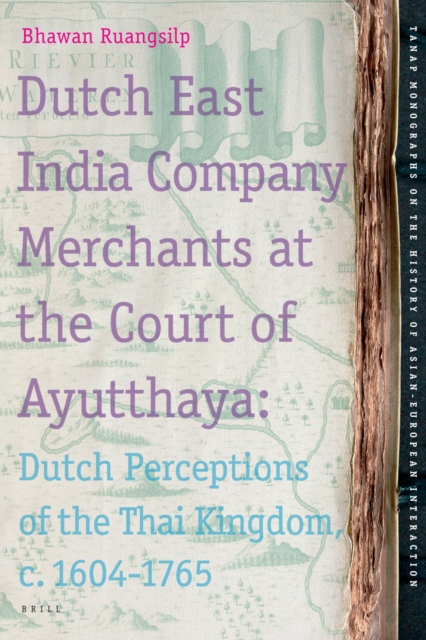
Dutch East India Company merchants at the court of Ayutthaya: Dutch perceptions of the Thai kingdom, ca. 1604-1765
No European country enjoyed such long-standing relations with the Thai Kingdom of Ayutthaya as the Netherlands. This study focuses on the perceptions of the merchants of the Dutch East India Company (VOC) of the Thai royal court in the seventeenth and eighteenth century. Basing herself on a wealth of Dutch primary sources, the author shows how trade, politics, and diplomacy shaped a unique relationship based on 'partnership' and a 'sense of differences'. The book contributes to expanding the study of the history of Ayutthaya-known for its scarcity of sources- with the help of contemporary Dutch views.
eBook

Did the great influenza of 1918–1920 trigger a reversal of the first era of globalization?
I revisit the 1918–20 pandemic and ask whether it led to a reversal in the rise of trade and financial globalization that preceded it. Using annual data for 17 countries for the 1870–1928 period, a variety of tests and techniques are used to draw some robust conclusions. Overall, the pandemic a century ago interrupted, but did not put an end, to the first globalization of the twentieth century. However, two blocs consisting of combatant and non-combatant countries, experienced significantly different consequences. Globalization was sharply curtailed for the combatant countries while there were few, if any, consequences for globalization in the non-combatant group of countries. That said, there was considerable resilience especially in trade openness among several of the combatant economies. Perhaps changes in the make-up of economic blocs, post-pandemic, is a fallout from shocks of this kind. While there are lessons for the ongoing COVID pandemics differences between the 1920s and today also play a role.
Journal Article