
Catalogue Search | MBRL


Are you sure you want to remove the book from the shelf?

{{itemTitle}}
1,151
result(s) for
"Globalization--Economic aspects"
Sort by:


All politics is global
Has globalization diluted the power of national governments to regulate their own economies? Are international governmental and nongovernmental organizations weakening the hold of nation-states on global regulatory agendas? Many observers think so. But in All Politics Is Global, Daniel Drezner argues that this view is wrong. Despite globalization, states--especially the great powers--still dominate international regulatory regimes, and the regulatory goals of states are driven by their domestic interests. As Drezner shows, state size still matters. The great powers--the United States and the European Union--remain the key players in writing global regulations, and their power is due to the size of their internal economic markets. If they agree, there will be effective global governance. If they don't agree, governance will be fragmented or ineffective. And, paradoxically, the most powerful sources of great-power preferences are the least globalized elements of their economies. Testing this revisionist model of global regulatory governance on an unusually wide variety of cases, including the Internet, finance, genetically modified organisms, and intellectual property rights, Drezner shows why there is such disparity in the strength of international regulations.
eBook


Globalizing justice : the ethics of poverty and power
The claim that people in developed countries have vast, unmet obligations to help people in developing countries is usually based on duties of kindness or a global extrapolation of justice among compatriots. This book constructs a different basis, the need for responsible engagement in transnational interactions in which power is currently abused. After arguing for an undemanding principle of beneficence and deriving duties of justice among compatriots from their special relations, the book develops standards of responsible conduct in current global interactions that determine: what must be done to avoid exploitation in transnational manufacturing, what framework for world trade and investment would be fair, what response to the challenge of global warming is adequate and equitable, what responsibilities to help meet basic needs arise when foreign powers steer the course of development, and what obligations are created by uses of violence to sustain global power. Through detailed empirical inquiries, the book argues that there has been a massive failure to live up to these standards, creating demanding duties to avoid undue advantage and repair abuses of power, on the part of developed countries in general and especially the United States. The book describes policies that would meet these obligations, leading obstacles, and the role of social movements in reducing injustice, especially a global form of social democracy expressing the book's perspective
eBook
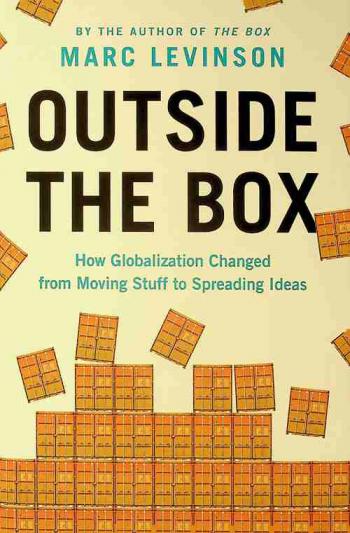
Outside the box : how globalization changed from moving stuff to spreading ideas
\"Marc Levinson offers a brief history of globalization through the stories of the fascinating people and companies that built global supply chains. In Small World he will follow the thread of the balance between people in the private sector pursuing new ways to make goods and do business and governments eliminating barriers. These two spheres-the private sector and government-did not go global in tandem, and many developments in one sphere were far more impactful in the other than imagined at the time. The book will narrate the development of global supply chains in response to trends in both, telling stories ranging from a Prussian-born trader in New Jersey in the 1760s who dreamed of building a vertically-integrated metals empire, to new megaships too big to call on most of the world's ports leaving half empty, as globalization entered a new stage in its history around 2006. Bringing the story up to the present, Levinson engagingly illustrates how we're not experiencing the end of globalization, only its transformation. As one type of globalization is declining, a new one is on the rise\"-- Provided by publisher.

The other half of macroeconomics and the fate of globalization
Get a new perspective from the 'other half' of macroeconomics The failure of the vast majority of economists in government, academia and the private sector to predict either the post-2008 Great Recession or the degree of its severity has raised serious credibility issues for the profession.
eBook


China's Regulatory State
Today's China is governed by a new economic model that marks a radical break from the Mao and Deng eras; it departs fundamentally from both the East Asian developmental state and its own Communist past. It has not, however, adopted a liberal economic model. China has retained elements of statist control even though it has liberalized foreign direct investment more than any other developing country in recent years. This mode of global economic integration reveals much about China's state capacity and development strategy, which is based on retaining government control over critical sectors while meeting commitments made to the World Trade Organization.
InChina's Regulatory State, Roselyn Hsueh demonstrates that China only appears to be a more liberal state; even as it introduces competition and devolves economic decisionmaking, the state has selectively imposed new regulations at the sectoral level, asserting and even tightening control over industry and market development, to achieve state goals. By investigating in depth how China implemented its economic policies between 1978 and 2010, Hsueh gives the most complete picture yet of China's regulatory state, particularly as it has shaped the telecommunications and textiles industries.
Hsueh contends that a logic of strategic value explains how the state, with its different levels of authority and maze of bureaucracies, interacts with new economic stakeholders to enhance its control in certain economic sectors while relinquishing control in others. Sectoral characteristics determine policy specifics although the organization of institutions and boom-bust cycles influence how the state reformulates old rules and creates new ones to maximize benefits and minimize costs after an initial phase of liberalization. This pathbreaking analysis of state goals, government-business relations, and methods of governance across industries in China also considers Japan's, South Korea's, and Taiwan's manifestly different approaches to globalization.
eBook


New neoliberalism and the other
The exhaustion of neoliberal globalization is marked by three great tendencies or inflections: the first is the scornful failure of the South-American attempt to construct a neo-developmentalist exit; the second is the increasingly unavoidable Chinese-effect macro and micro dynamics within globalization; the third is the combination of austerity policies and monetary emissions (Quantitative Easing) that characterize, for instance, the financial conduct of the Central European Bank. The dramatic failure to renew traditional state interventionism in the sphere of Pink Tide in Latin American politics—in particular with the violent recession of the biggest economy on the Latin American continent, Brazil—shows and confirms that the escape from neoliberal regulation does not pass through the return of the traditional role of the state. At the same time, the Chinese economy came to play a double role. On one hand, it appears to represent the great and irreversible novelty of neoliberal globalization, particularly when our point of perspective is South America. While almost nothing remains of the legacy of the center-left-leaning regimes, the last South American decade appears to have genuinely been a Chinese decade. The Chinese advance is seen, especially by voices of the critical globalization studies, as a new “outside” of Empire, as something that stands for an alternative path, even if it is nothing more than an “old new” outside. Meanwhile, the role played by the financial sector continues to be regarded per se as the fundamental problem of contemporary capitalism. For some, this is a case of a deviation from an otherwise “good capitalism, the misleading result of a fictitious and unreal sphere (as opposed to the sphere of material economy, of good old bosses and hard workers), while for others, it is a case of one of the moral characteristics of Western civilization: infinite debt, and capitalism happens to be its modern drift.
eBook