
Catalogue Search | MBRL


Are you sure you want to remove the book from the shelf?

{{itemTitle}}
49
result(s) for
"God (Islam) Name"
Sort by:

Representation and Presence: Divine Names in Judaism and Islam
Divine names are linguistic objects that underlie the grammar of religious language. They serve as both representations and presentations of the divine. As representations, divine names carry information pertaining to God’s nature or actions, and his unique will, in a manner that adequately represents him. As presentations, divine names are believed to somehow effect divine presence in proximity to the believer, opening a path of direct connection to God. This paper seeks to analyze the interaction between presentation and representation concerning divine names in major trends within Judaism and Islam, from the Hebrew Bible and the Qur’an to medieval theological debates. It aims to demonstrate how central currents within both traditions shaped the intricate relation between divine presentation and representation through the prism of divine names. Whereas positions in philosophy of language focus on either the representational or the presentational functions of proper names, Jewish and Islamic theologies suggest ways to combine the two functions with regard to divine names.
Journal Article

On the origins of the god Ruḍaw and some remarks on the pre-Islamic North Arabian pantheon
This contribution proposes an interpretation of a newly attested divine title of the ancient Arabian deity Ruḍaw, mkśd ‘(the one) from Chaldea’. It explores what sense this title could have had and its implications on our understanding of Ruḍaw's position in the ancient Arabian pantheon, especially in relation to Allāt. It also examines mentions of Ruḍaw in Islamic-period narrative sources and concludes that his cult likely disappeared by Islamic times; tales of the destruction of his cult site reflect the use of the ‘smashing idols’ topos to narrativize the passage from pre-Islam to Islam.
Journal Article
Note on a peculiar Arab-Sasanian coinage of Ibn al-Ashʿath
The present note offers a new, and hopefully more nuanced, reading for a cryptic marginal legend on an issue of the Umayyad-era rebel ʿAbd al-Raḥmān ibn al-Ashʿath (d. circa 85 ah/704 ce). Comparing this legend with several marginal legends of like character, and contextualising the formulae within contemporary religious idiom as expressed in late ancient Arabic-Islamic epigraphy, it is argued that all these legends contain proper nouns invariably belonging to the issuing authority, in conjunction with invocations addressed to God, in an attempt to establish a hierarchic relationship between the two. Drawing on literary sources, it is then demonstrated that the legend of the Ibn al-Ashʿath issue does indeed mention the name of an individual, the local governor, Kharasha ibn Masʿūd ibn Wathīma, a new name in the repertoire of governors known through Arab-Sasanian coinage. Based on these results, a case for further reliance on literary, epigraphic, papyrological, and other forms of evidence in the study of numismatics is made. A new chronology, based on numismatic evidence, for Ibn al-Ashʿath's rebellion is also proposed.
Journal Article

The repose of the spirits : a Sufi commentary on the divine names
The Repose of the Spirits' is a translation of one of the earliest and most comprehensive treatises on Sufism in the Persian language. Written by Ahmad Sam'ani, an expert in Islamic law from a famous Central Asian scholarly family in about the year 1135, it is one of the handful of early Sufi texts available in English and is by far the most accessible. It also may well be the longest and the most accurately translated. Ostensibly a commentary on the divine names, it avoids the abstract discourse of theological nitpicking and explains the human significance of the names with a delightful mix of Quranic verses and sayings of the Prophet and various past teachers, interspersed with original interpretations of the received wisdom. Unlike the usual books on the divine names (such as that of al-Ghazali), 'The Repose of the Spirits' reminds the reader of the later poetical tradition, especially the work of Rumi. The prose is richly embroidered with imagery and interspersed with a great variety of Arabic and Persian poetry. What is especially remarkable is the manner in which the author speaks to his readers about their own personal situations, explaining why they are driven by a love affair with God, a God who is full of compassion and good humor, whether they know it or not. William C. Chittick?s masterful new translation brings this work to an English-language audience for the first time.00Transl. from Persian by William C. Chittick.
BOOK

Adam and the names
This paper examines the naming episode in the Quran's Adam story, in which God teaches Adam “the names, all of them”, to counter the angels' objection to the creation of the human creature on the basis that he will “spread corruption … and will shed blood”. I try to show that the traditional understanding of this narrative in Western scholarship, which connects it ultimately to the Genesis 2 episode in which Adam names all the creatures of the land and sky, fails to do justice to a close reading of the quranic text itself. Instead, I argue for an alternative reading of the passage already suggested by early Muslim exegetes, in which God's teaching Adam the “names” refers to Adam being introduced to his future offspring. This, in turn, is central to the Quran's engagement with the problem of theodicy.
Journal Article

The Unspoken and The Forbidden in André Scrima’s Thought as a Way to Encounter the Other
André Scrima’s interest in Christian–Muslim dialogue goes beyond a historical or comparative approach. In this sense, knowledge from within the two monotheisms is achieved through an apophatic theology. Through it, the spiritual and mystical language that is characteristic of any authentic religious experience offers the possibility of a renewed approach to the differences between Islam and Christianity, and at the same time, clears a path for a truly authentic encounter. Fresh insight into the faith of the other does not put into parentheses the specific identity of the two monotheisms, but deepens it from the perspective of its apophatic content, where the possibility of experiencing the transcendent in a much deeper way is rooted, not by making new affirmations, but by adopting an attitude of stillness and silence.
Journal Article
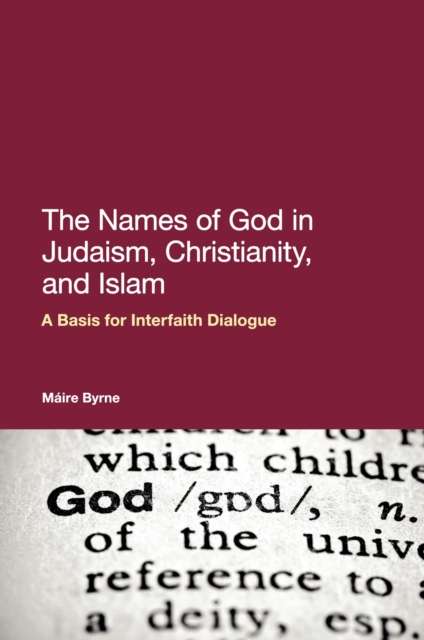
The names of God in Judaism, Christianity and Islam : a basis for interfaith dialogue
This book offers a welcome solution to the growing need for a common language in interfaith dialogue; particularly between the three Abrahamic faiths in our modern pluralistic society. The book suggests that the names given to God in the Hebrew Bible, the New Testament and the Qur'an, could be the very foundations and building blocks for a common language between the Jewish, Christian and Islamic faiths. On both a formal interfaith level, as well as between everyday followers of each doctrine, this book facilitates a more fruitful and universal understanding and respect of each sacred text; exploring both the commonalities and differences between each theology and their individual receptions. In a practical application of the methodologies of comparative theology, Maire Byrne shows that the titles, names and epithets given to God in the sacred texts of Judaism, Christianity and Islam contribute towards similar images of God in each case, and elucidates the importance of this for providing a viable starting point for interfaith dialogue.
eBook