
Catalogue Search | MBRL


Are you sure you want to remove the book from the shelf?

{{itemTitle}}
1,602
result(s) for
"Goddess"
Sort by:

Spirits without borders : Vietnamese spirit mediums in a transnational age
\"Spirits without Borders is an ethnographic study of the transnational and multicultural expansion of Vietnam's Mother Goddess Religion and its spirit possession ritual. The product of collaborative research by an American anthropologist and a Vietnamese folklorist, the work explores how and why the ritual spread from Vietnam to the US and back again, the impact of ritual transnationalism in both countries, and the current spread of the ritual to non-Vietnamese in the USA\"--Provided by publisher.
Book

The Mother of the Gods, Athens, and the Tyranny of Asia
Among maternal deities of the Greek pantheon, the Mother of the Gods was a paradox. She is variously described as a devoted mother, a chaste wife, an impassioned lover, and a virgin daughter; she is said to be both foreign and familiar to the Greeks. In this erudite and absorbing study, Mark Munn examines how the cult of Mother of the Gods came from Phrygia and Lydia, where she was the mother of tyrants, to Athens, where she protected the laws of the Athenian democracy. Analyzing the divergence of Greek and Asiatic culture at the beginning of the classical era, Munn describes how Kybebe, the Lydian goddess who signified fertility and sovereignty, assumed a different aspect to the Greeks when Lydia became part of the Persian empire. Conflict and resolution were played out symbolically, he shows, and the goddess of Lydian tyranny was eventually accepted by the Athenians as the Mother of the Gods, and as a symbol of their own sovereignty. This book elegantly illustrates how ancient divinities were not static types, but rather expressions of cultural systems that responded to historical change. Presenting a new perspective on the context in which the Homeric and Hesiodic epics were composed, Munn traces the transformation of the Asiatic deity who was the goddess of Sacred Marriage among the Assyrians and Babylonians, equivalent to Ishtar. Among the Lydians, she was the bride to tyrants and the mother of tyrants. To the Greeks, she was Aphrodite. An original and compelling consideration of the relations between the Greeks and the dominant powers of western Asia, The Mother of the Gods, Athens, and the Tyranny of Asia is the first thorough examination of the way that religious cult practice and thought influenced political activities during and after the sixth and fifth centuries B.C.
eBook

Queens of the Wild
A concise history of the goddess-like figures who evade
both Christian and pagan traditions, from the medieval period to
the present day In this riveting account, renowned scholar
Ronald Hutton explores the history of deity-like figures in
Christian Europe. Drawing on anthropology, archaeology, literature,
and history, Hutton shows how hags, witches, the fairy queen, and
the Green Man all came to be, and how they changed over the
centuries. Looking closely at four main figures-Mother Earth, the
Fairy Queen, the Mistress of the Night, and the Old Woman of Gaelic
tradition-Hutton challenges decades of debate around the female
figures who have long been thought versions of pre-Christian
goddesses. He makes the compelling case that these goddess figures
found in the European imagination did not descend from the
pre-Christian ancient world, yet have nothing Christian about them.
It was in fact nineteenth-century scholars who attempted to
establish the narrative of pagan survival that persists today.
eBook

The Great Mother
This landmark book explores the Great Mother as a primordial image of the human psyche. Here the renowned analytical psychologist Erich Neumann draws on ritual, mythology, art, and records of dreams and fantasies to examine how this archetype has been outwardly expressed in many cultures and periods since prehistory. He shows how the feminine has been represented as goddess, monster, gate, pillar, tree, moon, sun, vessel, and every animal from snakes to birds. Neumann discerns a universal experience of the maternal as both nurturing and fearsome, an experience rooted in the dialectical relation of growing consciousness, symbolized by the child, to the unconscious and the unknown, symbolized by the Great Mother.
Featuring a new foreword by Martin Liebscher, this Princeton Classics edition of The Great Mother introduces a new generation of readers to this profound and enduring work.
eBook

From Historical Memory to Cultural Identity: The Construction of Archetypal Symbols for the Statues and Images of Mazu
The archetypal symbols of Mazu’s statues and pictorial art are the mapping of a religious concept, a way of belief, and some programmed behaviours and rituals. They are also emotional imagery used to arouse the cultural awareness of international Chinese, inspire them to help and trust each other, to encourage and to comfort each other, to share weal and woe, and to always forge ahead. From the perspectives of historical memory, visual signs, and cultural identity, this paper explores the construction of archetypal symbols for the statues and images of Mazu. In addition, this paper generalizes the foundation and methods of this construction by analyzing the artistic forms and characteristics of the surviving Mazu images and statues and comparing the rules and regulations for making statues of other religions. Moreover, we consider the function of artistic signs that refer to and symbolize broader religious concepts and beliefs. The purpose of this work is to make the image of Mazu more visually present and strengthen cultural identity.
Journal Article

Occidental Mythology
Occidental Mythology begins with an anthropological description of the development of religions from the East and Middle East and how they evolved into or influenced Occidental religious traditions. Campbell describes how early polytheistic goddess religions were replaced in pre-history by patriarchal monotheism. His argument is that many episodes in the Bible make sense if they are understood as a record of a dim memory of the Neolithic goddess worship replaced by patriarchic monotheism.
Journal Article
Occidental Mythology , by Joseph Campbell
Occidental Mythology begins with an anthropological description of the development of religions from the East and Middle East and how they evolved into or influenced Occidental religious traditions. Campbell describes how early polytheistic goddess religions were replaced in pre-history by patriarchal monotheism. His argument is that many episodes in the Bible make sense if they are understood as a record of a dim memory of the Neolithic goddess worship replaced by patriarchic monotheism.
Journal Article
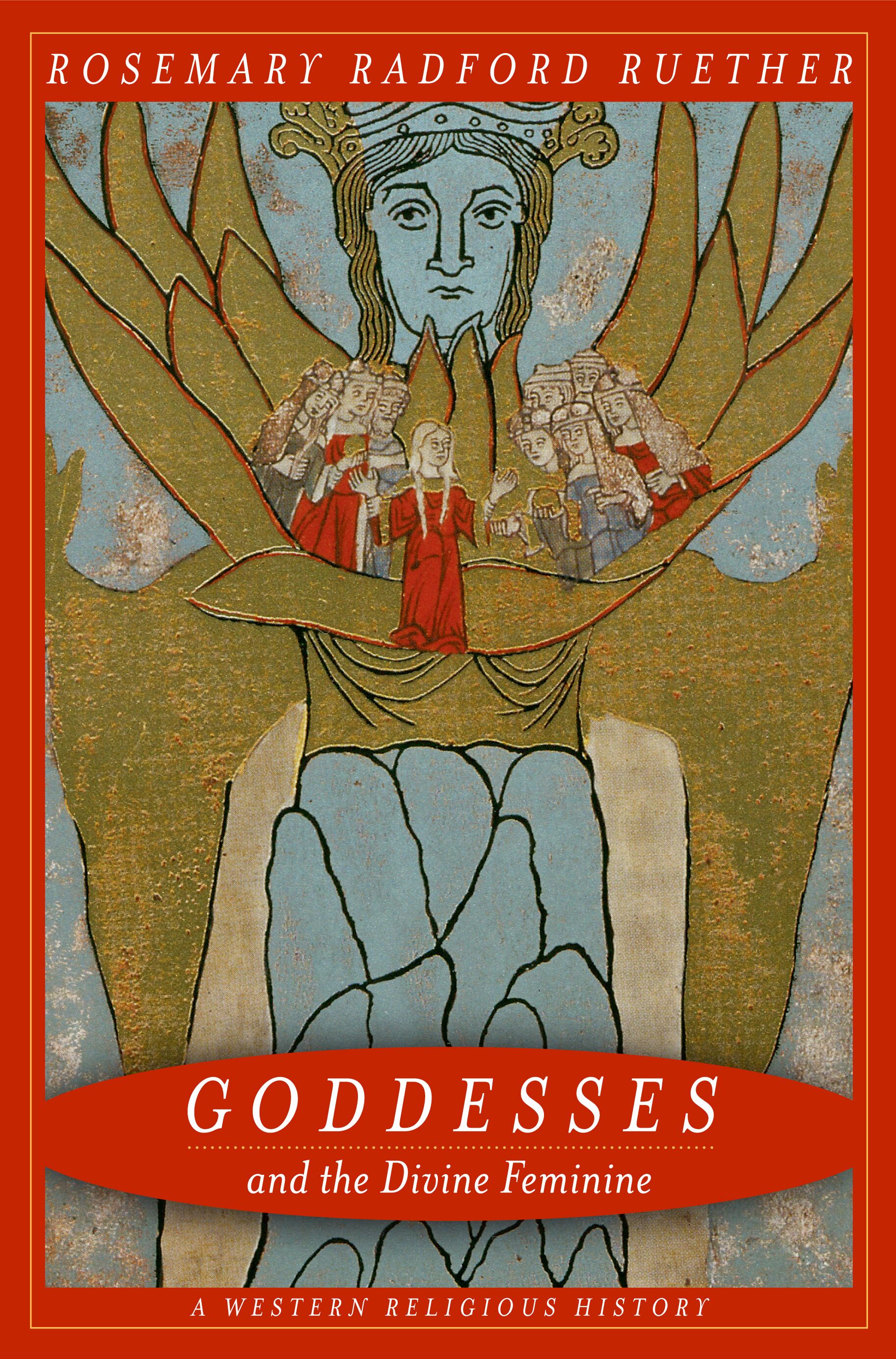
Goddesses and the Divine Feminine
This landmark work presents the most illuminating portrait we have to date of goddesses and sacred female imagery in Western culture—from prehistory to contemporary goddess movements. Beautifully written, lucidly conceived, and far-ranging in its implications, this work will help readers gain a better appreciation of the complexity of the social forces— mostly androcentric—that have shaped the symbolism of the sacred feminine. At the same time, it charts a new direction for finding a truly egalitarian vision of God and human relations through a feminist-ecological spirituality. Rosemary Radford Ruether begins her exploration of the divine feminine with an analysis of prehistoric archaeology that challenges the popular idea that, until their overthrow by male-dominated monotheism, many ancient societies were matriarchal in structure, governed by a feminine divinity and existing in harmony with nature. For Ruether, the historical evidence suggests the reality about these societies is much more complex. She goes on to consider key myths and rituals from Sumerian, Babylonian, Egyptian, and Anatolian cultures; to examine the relationships among gender, deity, and nature in the Hebrew religion; and to discuss the development of Mariology and female mysticism in medieval Catholicism, and the continuation of Wisdom mysticism in Protestanism. She also gives a provocative analysis of the meeting of Aztec and Christian female symbols in Mexico and of today's neo-pagan movements in the United States.
eBook

A Calabash of Cowries
A Calabash of Cowries: Ancient Wisdom for Modern Times is a collection of tales featuring the Orishas and the wonders of the natural world. Suitable for adults and children, artists and teachers, readers of all cultures will discover in these retellings of traditional tales a resource that illuminates the mythic and the real, the ancient past and the emerging present. An offering of spiritual wisdom and cultural celebration through stories that have and will continue to endure the test of time.
eBook
The Phenomenon of Presenting and Worshipping Buddha(s) at the Mother Goddess Worship’s Điện thờ Tư gia in Contemporary Vietnam
The Mother Goddess Worship’s (MGW) private shrine—Điện thờ Mẫu tư gia—has been a prominent worshipping place of a Vietnamese folk religion; however, it is rarely documented in scholarship in both Vietnamese and English. This paper is based mainly on in-depth interviews and numerous follow-up conversations with sixteen MGW spirit mediums in Hanoi capital city, additionally verified and supported by the authors’ field notes. The findings reveal that worshipping Buddha(s) at MGW private shrines is a remarkable phenomenon and becoming common; however, they vary at different levels because of different reasons in which non-religious causes are significantly considered. The absence of worshipping Buddha(s), if there is any, is explained by the problems of lacking space or being in serious spiritual conflicts that cannot be avoided. In those cases, a Buddha(s) altar is often immediately added when the space is improved, and Buddha(s) statues/pictures are still displayed. Furthermore, the continuous blending of MGW—a Vietnamese folk religion—with Buddhism—a world religion—is proved to be not only a way that religious people choose to nurture their faith and seek preferable religious practices but additionally to be flexible to adapt their religion in the modern era. Finally, regarding religious freedom and tolerance, we argue that private shrines are able to be active freely without any control by the government such as they used to be prohibited in the past. In some circumstances, government officers also benefit from services offered by local mediums, even though they might not be MGW followers. Furthermore, mediums’ neighbors are friendly to or even enjoy shrines’ activities. Such facts show the improvement in religious freedom in Vietnam in recent decades, as well as once again proving the tolerance of the Vietnamese people towards different religions and beliefs.
Journal Article