
Catalogue Search | MBRL


Are you sure you want to remove the book from the shelf?

{{itemTitle}}
2,355
result(s) for
"Gothic Literature"
Sort by:


Taxidermy and the Gothic
Taxidermy and the Gothic: The Horror of Still Life is the first extended study of the Gothic's collusion with taxidermy. Focusing on contemporary cultural and material texts, it shows how taxidermy's imbrication with Gothic horror is more than skin deep: these are rich discourses stuffed by affinities for corporeal transgressions, the uncanny, and the counterfeit.
eBook


Gothic Literature
New edition of bestselling introductory text outlining the history and ways of reading Gothic literatureThis revised edition includes:A new chapter on Contemporary Gothic which explores the Gothic of the early twenty first century and looks at new critical developmentsAn updated Bibliography of critical sources and a revised Chronology
The book opens with a Chronology and an Introduction to the principal texts and key critical terms, followed by five chapters: The Gothic Heyday 1760-1820; Gothic 1820-1865; Gothic Proximities 1865-1900; Twentieth Century; and Contemporary Gothic. The discussion examines how the Gothic has developed in different national contexts and in different forms, including novels, novellas, poems, films, radio and television. Each chapter concludes with a close reading of a specific text - Frankenstein, Jane Eyre, Dracula, The Silence of the Lambs and The Historian - to illustrate ways in which contextual discussion informs critical analysis. The book ends with a Conclusion outlining possible future developments within scholarship on the Gothic.
eBook


Monstrous media/spectral subjects : imaging gothic from the nineteenth century to the present
Monstrous media/spectral subjects explores the intersection of monsters, ghosts, representation and technology in Gothic texts from the nineteenth century to the present. It argues that emerging media technologies from the phantasmagoria and magic lantern to the hand-held video camera and the personal computer both shape Gothic subjects and in turn become Gothicised.
In a collection of essays that ranges from the Victorian fiction of Wilkie Collins, Bram Stoker and Richard Marsh to the music of Tom Waits, world horror cinema and the TV series Doctor Who, this book finds fresh and innovative contexts for the study of Gothic. Combining essays by well-established and emerging scholars, it should appeal to academics and students researching both Gothic literature and culture and the cultural impact of new technologies.
eBook

The encyclopedia of the Gothic
Comprehensive and wide-ranging, this book brings together over 200 newly-commissioned essays by leading scholars writing on all aspects of the Gothic as it is currently taught and researched, along with challenging insights into the development of the genre and its impact on contemporary culture. The A-Z entries provide comprehensive coverage of relevant authors, national traditions, critical developments, and notable texts that continue to define, shape, and inform the genre. The volume's approach is truly interdisciplinary, with essays by specialist international contributors whose expertise extends beyond Gothic literature to film, music, drama, art, and architecture.
Book
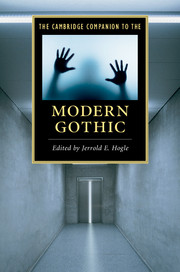
The Cambridge Companion to the Modern Gothic
This Companion explores the many ways in which the Gothic has dispersed in the twentieth and twenty-first centuries, and in particular how it has come to offer a focus for the tensions inherent in modernity. Fourteen essays by world-class experts show how the Gothic in numerous forms - including literature, film, television, and cyberspace - helps audiences both to distance themselves from and to deal with some of the key underlying problems of modern life. Topics discussed include the norms and shifting boundaries of sex and gender, the explosion of different forms of media and technology, the mixture of cultures across the western world, the problem of identity for the modern individual, what people continue to see as evil, and the very nature of modernity. Also including a chronology and guide to further reading, this volume offers a comprehensive account of the importance of Gothic to modern life and thought.
eBook

The gothic : a very short introduction
The Gothic is wildly diverse. It can refer to ecclesiastical architecture, supernatural fiction, cult horror films, and a distinctive style of rock music. It has influenced political theorists and social reformers, as well as Victorian home dâecor and contemporary fashion. This Very Short Introduction captures the history of the Gothic from ancient times to the present. It covers the sack of Rome by the barbarian tribes, mediaeval architecture, popular culture in the sixteenth century (including ballads and Revenge Tragedy), political theories of the seventeenth and eighteenth centuries, the rise of the Gothic novel, the Victorian Gothic Revival, and the influence of Gothic culture on film, music, and fashion. It includes familiar Gothic novels such Frankenstein and Dracula, while also covering Gothic gardening, slasher movies, and the current Goth scene. It is the only account of the Gothic that describes the entire history of the term, presenting it in all its richly complex and perversely contradictory glory.
Book

Haunted Empire
Haunted Empire shows that Gothic elements in Russian
literature frequently expressed deep-set anxieties about the
Russian imperial and national identity.
Valeria Sobol argues that the persistent presence of Gothic
tropes in the literature of the Russian Empire is a key literary
form that enacts deep historical and cultural tensions arising from
Russia's idiosyncratic imperial experience. Her book brings
together theories of empire and colonialism with close readings of
canonical and less-studied literary texts as she explores how
Gothic horror arises from the threatening ambiguity of Russia's own
past and present, producing the effect Sobol terms \"the imperial
uncanny.\" Focusing on two spaces of the imperial uncanny-the Baltic
north/Finland and the Ukrainian south- Haunted Empire
reconstructs a powerful discursive tradition that reveals the
mechanisms of the Russian imperial imagination that are still at
work today.
eBook