
Catalogue Search | MBRL


Are you sure you want to remove the book from the shelf?

{{itemTitle}}
182
result(s) for
"Gothic fiction (Literary genre) -- History and criticism"
Sort by:

Sinister histories : Gothic novels and representations of the past, from Horace Walpole to Mary Wollstonecraft
Showing how the Gothic can be read as a complex reaction to Enlightenment methods of historical representation, Sinister histories uncovers hitherto neglected relationships between Gothic texts and prominent works of eighteenth-century history.
Book

Dangerous bodies
Through an investigation of the body and its oppression by the church, the medical profession and the state, this book reveals the actual horrors lying beneath fictional horror in settings as diverse as the monastic community, slave plantation, operating theatre, Jewish ghetto and battlefield trench. The book provides original readings of canonical Gothic literary and film texts including The Castle of Otranto, The Monk, Frankenstein, Dracula and Nosferatu. This collection of fictionalised dangerous bodies is traced back to the effects of the English Reformation, Spanish Inquisition, French Revolution, Caribbean slavery, Victorian medical malpractice, European anti-Semitism and finally warfare, ranging from the Crimean up to the Vietnam War. The endangered or dangerous body lies at the centre of the clash between victim and persecutor and has generated tales of terror and narratives of horror, which function to either salve, purge or dangerously perpetuate such oppositions. This ground-breaking book will be of interest to academics and students of Gothic studies, gender and film studies and especially to readers interested in the relationship between history and literature.
eBook


Women and the Gothic
This collection of newly commissioned essays brings together major scholars in the field of Gothic studies in order to re-think the topic of 'Women and the Gothic'.
eBook


The Gothic and death
The Gothic and death offers the first ever published study
devoted to the subject of the Gothic and death across the
centuries. It investigates how the multifarious strands of the
Gothic and the concepts of death, dying, mourning and
memorialisation ('the Death Question') - have intersected and been
configured cross-culturally to diverse ends from the mid-eighteenth
century to the present day. Drawing on recent scholarship in such
fields as Gothic Studies, film theory, Women's and Gender Studies
and Thanatology Studies, this interdisciplinary collection of
fifteen essays by international scholars combines an attention to
socio-historical and cultural contexts with a rigorous close
reading of works, both classic and lesser known. This area of
enquiry is considered by way of such popular and uncanny figures as
corpses, ghosts, zombies and vampires, and across various cultural
and literary forms such as Graveyard Poetry, Romantic poetry,
Victorian literature, nineteenth-century Italian and Russian
literature, Anglo-American film and television, contemporary Young
Adult fiction and Bollywood film noir.
eBook


Industrial Gothic
This volume carves out a new area of study, the 'industrial
Gothic', placing the genre in dialogue with the literature of the
Industrial Revolution. The book explores a significant subset of
transatlantic nineteenth-century literature that employs the
tropes, themes and rhetoric of the Gothic to portray the real-life
horrors of factory life, framing the Industrial Revolution as a
site of Gothic excess and horror. Using archival materials from the
nineteenth century, localised incidences of Gothic
industrialisation (in specific cities like Lowell and Manchester)
are considered alongside transnational connections and comparisons.
The author argues that stories about the real horrors of factory
life frequently employed the mode of the Gothic, while nineteenth
century writing in the genre (stories, novels, poems and stage
adaptations) began to use new settings - factories, mills, and
industrial cities - as backdrops for the horrors that once
populated Gothic castles.
eBook

The female gothic : new directions
\"This rich and varied collection of essays makes a timely contribution to critical debates about the Female Gothic, a popular but contested area of literary studies. The contributors revisit key Gothic themes - gender, race, the body, monstrosity, metaphor, motherhood and nationality - to open up new critical directions\"--Provided by publisher.
Book
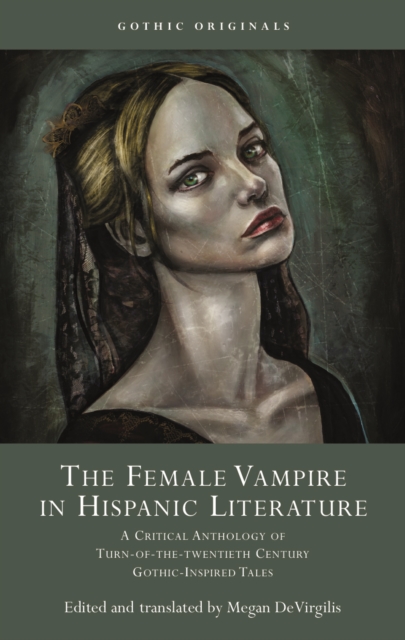
The Female Vampire in Hispanic Literature: A Critical Anthology of Turn of the 20th Century Gothic-Inspired Tales
This book exposes how turn-of-the-twentieth-century Hispanic authors broke from European and American Gothic models to contend with their own anxieties over modernity and rising first-wave feminisms. The result was a trend of sympathetic female vampires, predating comparable Anglo and European representations by several decades. In its analysis of the female vampire in Hispanic literature, the critical introduction also traces the Gothic's origins and developments in Latin America and Spain, presenting a working theory of Gothic traditions in the form of a transhispanic literary phenomenon. The tales compiled in the collection include Leopoldo Lugones's 'The Female Vampire' (1899), Clemente Palma's 'The White Farmhouse' (1904), Antonio de Hoyos y Vinent's 'Mr. Cadaver and Miss Vampire' (1910), Carmen de Burgos's The Cold Woman (1922), and Horacio Quiroga's 'The Vampire' (1927). Only two of these tales have been previously been translated into English, and each appears here for the first time with scholarly annotations and accompanying analysis.
eBook