
Catalogue Search | MBRL


Are you sure you want to remove the book from the shelf?

{{itemTitle}}
842
result(s) for
"Goths."
Sort by:

Goths
\"A history of the Goths, who rose as a power in the early third century and, under their famous leader Alaric, succeeded in sacking Rome in 410\"--Provided by publisher.
Book
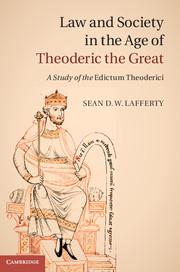
Law and Society in the Age of Theoderic the Great
This book explores the evolution of Roman law and society in Italy from 493, with the proclamation of the Ostrogoth Theoderic the Great as king, until about 554, when the eastern Emperor Justinian was able to re-establish imperial authority in the region. Drawing upon evidence from a variety of legal and historical sources, it investigates how Theoderic and his successors attempted to govern the peninsula in the wake of foreign invasions, the collapse of civic administration, the break-up of the Mediterranean economy, and the emergence of new forms of religious and secular authority. It challenges long-held assumptions as to just how peaceful, prosperous and Roman-like Theoderic's Italy really was. Its primary focus is the Edictum Theoderici, a significant but largely overlooked document that offers valuable historical insights into the complex and sometimes contested social, political and religious changes that marked Italy's passage from Antiquity into the Middle Ages.
eBook

Procopius
History of the Wars by the Byzantine historian Procopius (late fifth century to after 558 CE) consists largely of sixth century CE military history, with much information about peoples, places, and special events. Powerful description complements careful narration. Procopius is just to the empire's enemies and boldly criticises emperor Justinian. Procopius, born at Caesarea in Palestine late in the 5th century, became a lawyer. In 527 CE he was made legal adviser and secretary of Belisarius, commander against the Persians, and went with Belisarius again in 533 against the Vandals and in 535 against the Ostrogoths. Sometime after 540 he returned to Constantinople. He may have been that Procopius who was prefect of Constantinople in 562, but the date of his death (after 558) is unknown. Procopius's History of the Wars in 8 books recounts the Persian Wars of emperors Justinus and Justinian down to 550 (2 books); the Vandalic War and after-events in Africa 532-546 (2 books); the Gothic War against the Ostrogoths in Sicily and Italy 536-552 (3 books); and a sketch of events to 554 (1 book). The whole consists largely of military history, with much information about peoples and places as well, and about special events. He was a diligent, careful, judicious narrator of facts and developments and shows good powers of description. He is just to the empire's enemies and boldly criticises emperor Justinian. Other works by Procopius are the Anecdota or Secret History--vehement attacks on Justinian, Theodora, and others; and The Buildings of Justinian (down to 558 CE) including roads and bridges as well as churches, forts, hospitals, and so on in various parts of the empire. The Loeb Classical Library edition of Procopius is in seven volumes.
BOOK

Theodahad
Educated in Platonic philosophy rather than the military arts, the Ostrogothic king Theodahad was never meant to rule. His unexpected nomination as co-regent by his cousin Queen Amalasuintha plunged him into the intrigues of the Gothic court, and Theodahad soon conspired to assassinate the queen. But, once alone on the throne, his lack of political experience and military skill made him ineffective at best and dangerously incompetent at worst. Defeated by the Byzantine emperor Justinian, Theodahad was killed by his own subjects.
InTheodahad, Massimiliano Vitiello rigorously investigates the ancient sources in order to reconstruct the events of Theodahad's life and the contours of sixth-century diplomacy and political intrigues. Painting a picture of an unlikely king whose reign helped spell the end of Ostrogothic Italy, Vitiello's book not only illuminates Theodahad's own life but also offers new insight into the sixth-century Mediterranean world.
eBook

Theoderic and the Roman imperial restoration
\"This book provides a new interpretation of the fall of the Roman Empire and the \"barbarian\" kingdom known conventionally as Ostrogothic Italy. Relying primarily on Italian textual and material evidence, and in particular the works of Cassiodorus and Ennodius, Jonathan J. Arnold argues that contemporary Italo-Romans viewed the Ostrogothic kingdom as the Western Roman Empire and its \"barbarian\" king, Theoderic (r. 489/93-526), as its emperor. Investigating conceptions of Romanness, Arnold explains how the Roman past, both immediate and distant, allowed Theoderic and his Goths to find acceptance in Italy as Romans, with roles essential to the Empire's perceived recovery. Theoderic and the Roman Imperial Restoration demonstrates how Theoderic's careful attention to imperial traditions, good governance, and reconquest followed by the re-Romanization of lost imperial territories contributed to contemporary sentiments of imperial resurgence and a golden age. There was no need for Justinian to restore the Western Empire: Theoderic had already done so\"-- Provided by publisher.
Book

Rome and Byzantium in the Visigothic Kingdom
This volume interrogates the assumption that Visigothic practices and institutions were mere imitations of the Byzantine empire. Contributors rethink these practices not as uncritical and derivative adoptions of Byzantine customs, but as dynamic processes in dialogue with not only the Byzantine empire but also with the contemporary Iberian context, as well as the Roman past. The goal of the volume is to approach Visigothic customs not as an uncritical adoption and imitatio of contemporary Roman models (an 'acculturation' model), but as unique interpretations of a common pool of symbols, practices, and institutions that formed the legacy of Rome. The contributors argue that it is necessary to reconsider the idea of imitatio imperii as a process that involved specific actors taking strategic decisions in historically contingent circumstances.
eBook

Wulfila, the Gothic Bible, and the Mission to the Goths: Rethinking the ‘Apostle to the Goths’ in Terms of Homoian Theology, Conversion as a Strategy of Empire, and Fourth Century Social and Cultural Transformations
Wulfila (c. 311–c. 383) translated the Bible into Gothic, creating the first literary text in a Germanic language. His biography is contested; his parentage, place of birth, episcopal consecration, and theological position are all disputed. The fourth century saw heated debates about the Trinity, and the Goths were often termed ‘Arians’, despite the fact that the teachings of the African presbyter Arius (c. 256–336) were not directly transmitted to them. This article notes a rebirth of interest in Wulfila, his mission, and the Gothic Bible, employing the notion that ‘Homoian’ (a more neutral term than ‘Arian’) theology was a possible bridge between Catholic monotheism and Gothic polytheism as the starting point for a re-examination of Wulfila’s evangelism as both an imperially mandated strategy and the creation of a route into civilization and modernity for the Goths. Christianity was modern and fashionable in the fourth century; Germanic tribes wishing to abandon their status as pagani (rustics) or heathens (heath-dwellers, not civilized city dwellers), viewed conversion as a move ‘up’. The Gothic Bible played a role in developing Gothic literacy, but was also a magical object, the first of its kind, a book/roadmap for a people undergoing a great cultural transformation.
Journal Article

Cosmopolitanism in the depths of Barbaricum evidenced by archaeogenomic data from the Late Iron Age Goth community of the Masłomęcz group
Background
High mobility and extensive trade and military interactions are well recognized throughout the Late Iron Age Europe. The extremely rich archaeological record for the Masłomęcz group – a Goth-associated assemblage flourishing between 2
nd
and 4
th
century CE in what is now eastern Poland – has long been providing evidence for their wide cross-cultural contacts. However, the extent to which these were ephemeral or involved long-term immigration and interbreeding, remained unresolved.
Results
Here, by obtaining archaeogenomic data from 37 burials and reanalysing published data, we provide evidence that, while the Masłomęcz group was built mostly on Scandinavian-derived ancestry it extensively assimilated individuals from diverse directions and distances, including the Baltics, the Balkans and even further into the Mediterranean, creating a highly genetically heterogenous population. Additionally, we shed more light on the burial customs of this community by finding no close kin relations within multiperson burials.
Conclusions
Our findings provide evidence for long-range mobility far outside the borders of the Roman Empire. The Masłomęcz group was a highly open community embracing external contacts and immigration, perhaps contradicting popular presumptions about the so-called barbarians.
Journal Article

The Last Period of the History of Olbia: the First Gothic Town
Olbia’s archaeological materials show that after the departure of the Roman garrison and local residents, the city was briefly abandoned (270s – early 280s AD). Then a new barbarian population appeared. It had clear signs of the Cherniakhiv culture, the ethnic basis of which were the Germanic Goths. Probably, at the beginning the only interest of barbarians was the seaport. The last prosperity of the city occurred in the Hunnic period, and it came to the end together with the Cherniakhiv culture in the first third of the 5th century. Olbia was reborn as a small fortified city, a craft and trade centre. The Goths restored the Roman Citadel, as well as several forts on the borders of the former Olbian state. Perhaps here was the military-administrative centre of one of the early kingdoms, which arose after the collapse of the Ostrogothic “power of Ermanaric”, and was dependent on the Hun leaders.
Journal Article
Olbia in the Hunnic Time. A Historical Perspective
In this paper, the author presents the historical background of the period of functioning of the site of Olbia in the Gothic and Hunnic periods. He presents the most important studies on the Goths and Huns in recent decades, reconstructs the course of the Gothic wars (third to sixth centuries) and analyses selected sagas of Germanic mythology. On the basis of this and using the results of the recent archaeological excavations, he formulates the thesis that Olbia, functioning in the Gothic period from the 3rd/4th centuries to the beginning of the 5th century AD, could have been an important administrative centre of pagan Goths who actively fought against their Christianized brethren. He also hypothesizes that it can be identified with the land of Oium (Olbium) and with the Árheimar á Danparstoeðum, the capital of Reiðgotaland, mentioned in the oldest Germanic sagas.
Journal Article