
Catalogue Search | MBRL


Are you sure you want to remove the book from the shelf?

{{itemTitle}}
30
result(s) for
"Gouges, Olympe de"
Sort by:
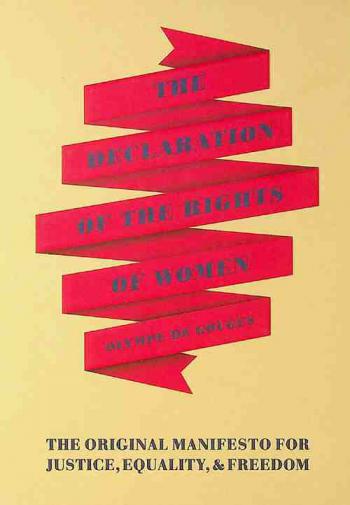
The declaration of the rights of women : the original manifesto for justice, equality, & freedom
Olympe de Gouges was the most important fighter for women's rights you've never heard of. An activist and writer in revolutionary Paris, she published 'The Declaration of the Rights of Women' in 1791, and was beheaded two years later, her articulate demands for equality proving too much for their time. Over one hundred and fifty years later, the key statements of her declaration were internationally endorsed by the United Nations in its Declaration on the Elimination of Discrimination against Women, which in turn went on to be legally recognized by nearly every country in the world. This volume presents both of these key texts along with enlightening and inspiring commentary from a host of powerful women, from Virginia Woolf to Hillary Clinton.
BOOK

Between the Queen and the Cabby
In Between the Queen and the Cabby, John Cole provides the first full translation of de Gouges's Rights of Woman and the first systematic commentary on its declaration, its attempt to envision a non-marital partnership agreement, and its support for persons of colour. Cole compares and contrasts de Gouges's two texts, explaining how the original text was both her model and her foil. By adding a proposed marriage contract to her pamphlet, she sought to turn the ideas of the French Revolution into a concrete way of life for women. Further examination of her work as a playwright suggests that she supported equality not only for women but for slaves as well. Cole highlights the historical context of de Gouges's writing, going beyond the inherent sexism and misogyny of the time in exploring why her work did not receive the reaction or achieve the influential status she had hoped for. Read in isolation in the gender-conscious twenty-first century, de Gouges's Rights of Woman may seem ordinary. However, none of her contemporaries, neither the Marquis de Condorcet nor Mary Wollstonecraft, published more widely on current affairs, so boldly attempted to extend democratic principles to women, or so clearly related the public and private spheres. Read in light of her eventual condemnation by the Revolutionary Tribunal, her words become tragically foresighted: \"Woman has the right to mount the Scaffold; she must also have that of mounting the Rostrum.\"
eBook

Between the queen and the cabby : Olympe de Gouges's Rights of woman
\"Students of the French Revolution and of women's right are generally familiar with Olympe de Gouges's bold adaptation of the Declaration of the Rights of Man and of the Citizen. However, her Rights of Woman has usually been extracted from its literary context and studied without proper attention to the political consequences of 1791. In Between the Queen and the Cabby, John Cole provides the first full translation of de Gouges's Rights of Woman and the first systematic commentary on its declaration, its attempt to envision a non-marital partnership agreement, and its support for persons of colour. Cole compares and contrasts de Gouges's two texts, explaining how the original text was both her model and her foil. By adding a proposed marriage contract to her pamphlet, she sought to turn the ideas of the French Revolution into a concrete way of life for women. Further examination of her work as a playwright suggests that she supported equality not only for women but for slaves as well. Cole highlights the historical context of de Gouges's writing, going beyond the inherent sexism and misogyny of the time in exploring why her work did not receive the reaction or achieve the influential status she had hoped for. Read in isolation in the gender-conscious twenty-first century, de Gouges's Rights of Woman may seem ordinary. However, none of her contemporaries, neither the Marquis de Condorcet nor Mary Wollstonecraft, published more widely on current affairs, so boldly attempted to extend democratic principles to women, or so clearly related the public and private spheres. Read in light of her eventual condemnation by the Revolutionary Tribunal, her words become tragically foresighted: \"Woman has the right to mount the Scaffold; she must also have that of mounting the Rostrum.\" --Publisher's website.
Book

La Déclaration des droits de la femme et de la citoyenne d’Olympe de Gouges (1791): Une femme entre semi-fiction et dogme politique
This article deconstructs the legal semi-fiction written by Olympe de Gouges: The Declaration of the Rights of Women (1791). Using the French discourse analysis software TROPES, it examines the universe, actors and semantic relations that compose this legislative simulacrum around the notions of women and citizenship. Between the ideal and the real, Olympe de Gouges introduces multiple conscious faults to create a fictional \"as if\" scenario (Hans Vaihinger) with the ultimate goal of transforming her semi-fiction into political dogma.
Journal Article
La Déclaration des droits de la femme et de la citoyenne d’Olympe de Gouges (1791): Une femme entre semi-fiction et dogme politique
This article deconstructs the legal semi-fiction written by Olympe de Gouges: The Declaration of the Rights of Women (1791). Using the French discourse analysis software TROPES, it examines the universe, actors and semantic relations that compose this legislative simulacrum around the notions of women and citizenship. Between the ideal and the real, Olympe de Gouges introduces multiple conscious faults to create a fictional \"as if\" scenario (Hans Vaihinger) with the ultimate goal of transforming her semi-fiction into political dogma.
Journal Article

Cocks on Dunghills – Wollstonecraft and Gouges on the Women’s Revolution
While many historians and philosophers have sought to understand the ‘failure’ of the French Revolution to thrive and to avoid senseless violence, very few have referred to the works of two women philosophers who diagnosed the problems as they were happening. This essay looks at how Mary Wollstonecraft and Olympe de Gouges theorised the new tyranny that grew out of the French Revolution, that of ‘petty tyrants’ who found themselves like ‘cocks on a dunghill’ able to wield a new power over those less fortunate than themselves. Both offer diagnoses and prognoses that revolve around education. Wollstonecraft argues that a revolution that is not backed by a previous education of the people is bound to result in chaos and violence. Such education, however, must be slow, and it necessitates the reform of the institutions that most shape the public’s character. A revolution, perforce, is fast, and it often takes several years, or even generations before the spirit of the reforms finds itself implemented into new institutions. Olympe de Gouges shares Wollstonecraft’s worry and she observes that the men who were once dominated quickly become tyrants themselves unless their moral character is already virtuous. But the state of being dominated leaves little room for virtue; hence, newly minted citizens need to be educated in order not to replicate the reign of tyranny onto other. Gouges suggests that the answer to the difficulty she and Wollstonecraft highlighted was to educate the people where they could be found: on the streets, or, where they could easily and willingly be gathered: in theatres. By helping organise revolutionary festivals, highlighting the ways in which citizens could be virtuous, and writing plays to awaken their virtue, and proposing a reform of the theatre, so that the production of such plays would be possible, Gouges offered a plan for the civic education of French citizens in the immediate aftermaths of the Revolution. Unfortunately, the chaos she and Wollstonecraft had sought to remedy, led by the cocks or petty tyrants, ensured that they were unable to see through their plans, with Wollstonecraft having to leave Paris and Gouges being sent to the guillotine.
Journal Article

blah blah WOMEN blah blah EQUALITY blah blah DIFFERENCE
In this article I critically consider the usefulness of Jacques Rancière's “politics of literarity,” as explicated by Samuel Chambers, for understanding feminist politics. Emphasizing the historical and grammatical dimensions of the speech acts central to a politics of literarity, I show that women's assertions of gender injustice remain tightly tethered to a police order whose disruption remains crucial to establishing the political bona fides of any such claim to equality. While Chambers embraces this paradoxical aspect of a politics of literarity—that it both disrupts police and remains embedded within it—I suggest that the paradoxes confronted by those who articulate the “wrongs” of the gender order perforce raise questions about the adequacy of literarity as a linchpin of democratic politics. I elaborate this claim by reconsidering the historical example of Olympe de Gouges, first as her feminist speech is parsed by Joan Scott and second as it is parsed by Rancière.
Journal Article

Performing Justice: The Trials of Olympe de Gouges
Examines the radical republicanism, arrest and trials of Olympe de Gouges, in 1793 at the onset of the French Revolution, in relation to the manuscript of an unfinished play, \"La France sauvée ou le tyran détroné\" (France preserved, or the tyrant dethroned). States that in the projected 5-act play de Gouges planned a sweeping historical drama, centered on the desperate machinations of Queen Marie-Antoinette on the eve of the impending demise of the monarchy. Juxtaposes what might be called the \"declarative politics in de Gouges's \"Declaration of the Rights of Woman.\"
Journal Article
