
Catalogue Search | MBRL


Are you sure you want to remove the book from the shelf?

{{itemTitle}}
18
result(s) for
"Gouges, Olympe de (1748-1793)"
Sort by:
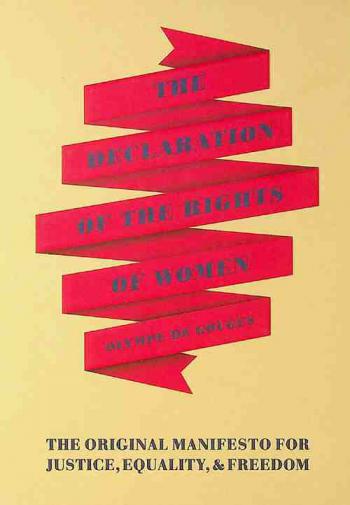
The declaration of the rights of women : the original manifesto for justice, equality, & freedom
Olympe de Gouges was the most important fighter for women's rights you've never heard of. An activist and writer in revolutionary Paris, she published 'The Declaration of the Rights of Women' in 1791, and was beheaded two years later, her articulate demands for equality proving too much for their time. Over one hundred and fifty years later, the key statements of her declaration were internationally endorsed by the United Nations in its Declaration on the Elimination of Discrimination against Women, which in turn went on to be legally recognized by nearly every country in the world. This volume presents both of these key texts along with enlightening and inspiring commentary from a host of powerful women, from Virginia Woolf to Hillary Clinton.
BOOK

Between the Queen and the Cabby
In Between the Queen and the Cabby, John Cole provides the first full translation of de Gouges's Rights of Woman and the first systematic commentary on its declaration, its attempt to envision a non-marital partnership agreement, and its support for persons of colour. Cole compares and contrasts de Gouges's two texts, explaining how the original text was both her model and her foil. By adding a proposed marriage contract to her pamphlet, she sought to turn the ideas of the French Revolution into a concrete way of life for women. Further examination of her work as a playwright suggests that she supported equality not only for women but for slaves as well. Cole highlights the historical context of de Gouges's writing, going beyond the inherent sexism and misogyny of the time in exploring why her work did not receive the reaction or achieve the influential status she had hoped for. Read in isolation in the gender-conscious twenty-first century, de Gouges's Rights of Woman may seem ordinary. However, none of her contemporaries, neither the Marquis de Condorcet nor Mary Wollstonecraft, published more widely on current affairs, so boldly attempted to extend democratic principles to women, or so clearly related the public and private spheres. Read in light of her eventual condemnation by the Revolutionary Tribunal, her words become tragically foresighted: \"Woman has the right to mount the Scaffold; she must also have that of mounting the Rostrum.\"
eBook

Between the queen and the cabby : Olympe de Gouges's Rights of woman
\"Students of the French Revolution and of women's right are generally familiar with Olympe de Gouges's bold adaptation of the Declaration of the Rights of Man and of the Citizen. However, her Rights of Woman has usually been extracted from its literary context and studied without proper attention to the political consequences of 1791. In Between the Queen and the Cabby, John Cole provides the first full translation of de Gouges's Rights of Woman and the first systematic commentary on its declaration, its attempt to envision a non-marital partnership agreement, and its support for persons of colour. Cole compares and contrasts de Gouges's two texts, explaining how the original text was both her model and her foil. By adding a proposed marriage contract to her pamphlet, she sought to turn the ideas of the French Revolution into a concrete way of life for women. Further examination of her work as a playwright suggests that she supported equality not only for women but for slaves as well. Cole highlights the historical context of de Gouges's writing, going beyond the inherent sexism and misogyny of the time in exploring why her work did not receive the reaction or achieve the influential status she had hoped for. Read in isolation in the gender-conscious twenty-first century, de Gouges's Rights of Woman may seem ordinary. However, none of her contemporaries, neither the Marquis de Condorcet nor Mary Wollstonecraft, published more widely on current affairs, so boldly attempted to extend democratic principles to women, or so clearly related the public and private spheres. Read in light of her eventual condemnation by the Revolutionary Tribunal, her words become tragically foresighted: \"Woman has the right to mount the Scaffold; she must also have that of mounting the Rostrum.\" --Publisher's website.
Book

La Déclaration des droits de la femme et de la citoyenne d’Olympe de Gouges (1791): Une femme entre semi-fiction et dogme politique
This article deconstructs the legal semi-fiction written by Olympe de Gouges: The Declaration of the Rights of Women (1791). Using the French discourse analysis software TROPES, it examines the universe, actors and semantic relations that compose this legislative simulacrum around the notions of women and citizenship. Between the ideal and the real, Olympe de Gouges introduces multiple conscious faults to create a fictional \"as if\" scenario (Hans Vaihinger) with the ultimate goal of transforming her semi-fiction into political dogma.
Journal Article

The self-fashinonings of Olympe de Gouges, 1784-1789
Brown investigates Olympe de Gouges's experiences as a woman writer in late-eighteenth-century literary culture and explores her self-presentations in her correspondence and in some of her published works.
Journal Article

Performing Justice: The Trials of Olympe de Gouges
Examines the radical republicanism, arrest and trials of Olympe de Gouges, in 1793 at the onset of the French Revolution, in relation to the manuscript of an unfinished play, \"La France sauvée ou le tyran détroné\" (France preserved, or the tyrant dethroned). States that in the projected 5-act play de Gouges planned a sweeping historical drama, centered on the desperate machinations of Queen Marie-Antoinette on the eve of the impending demise of the monarchy. Juxtaposes what might be called the \"declarative politics in de Gouges's \"Declaration of the Rights of Woman.\"
Journal Article

DAYS LIKE THESE
A woman has the right to mount the scaffold,\" wrote Olympe de Gouges. \"She must possess equally the right to mount the speaker's platform.\" Playwright, political activist, abolitionist and feminist, she was years ahead of her time.
Newspaper Article

La liberté ou la mort. Il progetto politico e giuridico di Olympe de Gouges
Loche, Annamaria, La liberté ou la mort. Il progetto politico e giuridico di Olympe de Gouges, Epílogo de Thomas Casadei, Módena, Mucchi Editore, 2021, ISBN: 9788870008807, 153 pp.
Book Review

FOOTNOTE TO THE REVOLUTION
Olympe de Gouges, a pioneer of feminism, drafted the first \"Declaration of the Rights of Woman and the Citizen\" for presentation to the National Assembly in 1791. It consisted of 17 articles of which the preamble appears below. Among another activities, considered outrageous and scandalous at the time, she dared to launch a vehement attack on the bloodshed unleashed by Robespierre in which 16,000 were guillotined and some 200,000 later died in the Vendee. She held that \"the blood even of the guilty, shed in cruel profusion, eternally sullies revolutions.\" At one point she suggested that she and Robespierre swim together in the Seine with cannonballs tied to their ankles. \"Then my death would serve some purpose,\" she declared. She was sent to the guillotine in 1793.
Newspaper Article