
Catalogue Search | MBRL


Are you sure you want to remove the book from the shelf?

{{itemTitle}}
414
result(s) for
"Government, Resistance to, in literature"
Sort by:

Humpty Dumpty lived near a wall
Harsh laws and the wall that keeps them in darkness make life dreary for the King's subjects, but Humpty Dumpty defies the King to look over the wall.
Book

Zwischen Innerer Emigration und Exil
Der Band sucht die bisher traditionell getrennten Forschungsgebiete ,Exilliteratur' und ,Innere Emigration' einander anzunähern und die verschiedenen Erfahrungsfelder der vertriebenen und der in Deutschland gebliebenen Schriftsteller aufeinander zu beziehen.
eBook

Resistance in Contemporary Middle Eastern Cultures
This study highlights the connections between power, cultural products, resistance, and the artistic strategies through which that resistance is voiced in the Middle East. Exploring cultural displays of dissent in the form of literary works, films, and music, the collection uses the concept of 'cultural resistance' to describe the way culture and cultural creations are used to resist or even change the dominant political, social, economic, and cultural discourses and structures either consciously or unconsciously. The contributors do not claim that these cultural products constitute organized resistance movements, but rather that they reflect instances of defiance that stem from their peculiar contexts. If culture can be used to consolidate and perpetuate power relations in societies, it can also be used as the site of resistance to oppression in its various forms: gender, class, ethnicity, and sexuality, subverting existing dominant social and political hegemonies in the Middle East.
eBook

The concept of resistance in Italy
The Concept of Resistance in Italy brings together experts from different fields to reflect in a new, comprehensive critical approach, on an event that has shaped the young Italian nation from the onset of Fascism in the early 20s. Although grounded in the Italian context, its theoretical frameworks, provided by the variety of disciplines involved in the volume, will prove beneficial for any critical discourse on the concept of resistance nowadays. Moving from a reflection on the legacy of the Italian Resistance to Fascism and the Resistance Movement born in the latest years of WWII, when Italy witnessed the presence on its territory of foreign troops from opposite corners, and was involved in a Civil War at the very same time, this collection reassesses the concept of Resistance within the Italian 20th and 21st century cultural context, moving beyond historical perspectives. The multidisciplinary scope allows for an historical, philosophical and artistic exploration of the concrete actions that define resistance to Fascism, and the Resistance Movement during WWII, their representations in literature, cinema and music, and the more abstract philosophical concept of Resistance in a rapidly changing globalized world, with oppressive political orders, new global economic structures, and emerging new philosophical fields.
eBook

Zwischen Innerer Emigration und Exil: Deutschsprachige Schriftsteller 1933-1945
Der Band sucht die bisher traditionell getrennten Forschungsgebiete 'Exilliteratur' und 'Innere Emigration' einander anzunähern und die verschiedenen Erfahrungsfelder der vertriebenen und der in Deutschland gebliebenen Schriftsteller aufeinander zu beziehen. Erörtert wird das Widerstandspotential der deutschsprachigen Literatur innerhalb und außerhalb des Deutschen Reiches und die Aussagekraft der Bezeichnungen 'innere?' und 'äußere' Emigration.
eBook

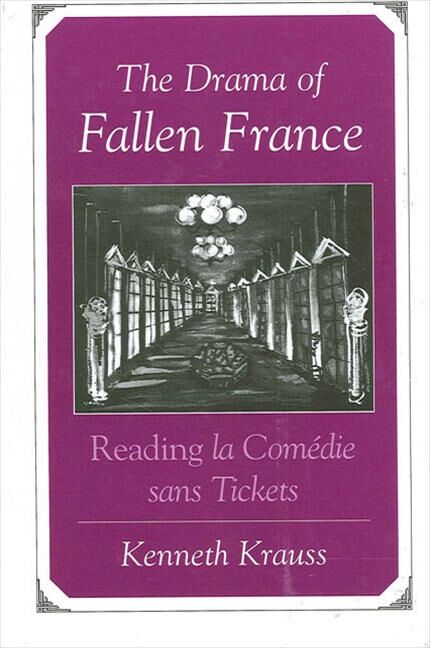
The Drama of Fallen France
The Drama of Fallen France examines various dramatic works
written and/or produced in Paris during the four years of Nazi
occupation and explains what they may have meant to their original
audiences. Because of widespread financial support from the new
French government at Vichy, the former French capital underwent a
renaissance of theatre during this period, and both the public
playhouses and the private theatres provided an amazing array of
new productions and revivals. Some of the plays considered here are
well known: Anouilh's Antigone , Sartre's The
Flies , Claudel's The Satin Slipper . Others have
remained obscure, such as Cocteau's The Typewriter ,
Giraudoux's The Apollo of Marsac , and Montherlant's
Nobody's Son ; and two-André Obey's Eight Hundred
Meters and Simone Jollivet's The Princess of
Ursins -have remained virtually unread since the early 1940s.
In examining French culture under the Vichy regime and the Nazis,
Kenneth Krauss links the politics of gender and sexuality with the
more traditional political concepts of collaboration and
resistance. A final chapter on Truffaut's 1980 film, The Last
Métro , demonstrates how the present manages to rewrite and
revision the complex and seemingly contradictory reality of the
past.
eBook

The drama of fallen France : reading la comédie sans tickets
The Drama of Fallen France examines various dramatic works written and/or produced in Paris during the four years of Nazi occupation and explains what they may have meant to their original audiences. Because of widespread financial support from the new French government at Vichy, the former French capital underwent a renaissance of theatre during this period, and both the public playhouses and the private theatres provided an amazing array of new productions and revivals. Some of the plays considered here are well known: Anouilh’s Antigone, Sartre’s The Flies, Claudel’s The Satin Slipper. Others have remained obscure, such as Cocteau’s The Typewriter, Giraudoux’s The Apollo of Marsac, and Montherlant’s Nobody’s Son; and two—André Obey’s Eight Hundred Meters and Simone Jollivet’s The Princess of Ursins—have remained virtually unread since the early 1940s. In examining French culture under the Vichy regime and the Nazis, Kenneth Krauss links the politics of gender and sexuality with the more traditional political concepts of collaboration and resistance. A final chapter on Truffaut’s 1980 film, The Last Métro, demonstrates how the present manages to rewrite and revision the complex and seemingly contradictory reality of the past.
eBook

Visible Borders, Invisible Economies
Globalization in the United States can seem paradoxical: free
trade coincides with fortification of the southern border, while
immigration is reimagined as a national-security threat. US
politics turn aggressively against Latinx migrants and subjects
even as post-NAFTA markets become thoroughly reliant on migrant and
racialized workers. But in fact, there is no incongruity here.
Rather, anti-immigrant politics reflect a strategy whereby capital
uses specialized forms of violence to create a reserve army of the
living, laboring dead.
Visible Borders, Invisible Economies turns to Latinx
literature, photography, and films that render this unseen scheme
shockingly vivid. Works such as Valeria Luiselli's Tell Me How
It Ends and Alex Rivera's Sleep Dealer crystallize
the experience of Latinx subjects and migrants subjugated to social
death, their political existence erased by disenfranchisement and
racist violence while their bodies still toil in behalf of
corporate profits. In Kristy L. Ulibarri's telling, art clarifies
what power obscures: the national-security state performs
anti-immigrant and xenophobic politics that substitute cathartic
nationalism for protections from the free market while ensuring
maximal corporate profits through the manufacture of disposable
migrant labor.
eBook

In the shadow of Enoch Powell
Fifty years ago Enoch Powell made national headlines with his 'Rivers of Blood' speech, warning of an immigrant invasion in the once respectable streets of Wolverhampton. This local fixation brought the Black Country town into the national spotlight, yet Powell's unstable relationship with Wolverhampton has since been overlooked. Drawing from interviews and archival material, this book offers a rich local history through which to investigate the speech, bringing to life the racialised dynamics of space during a critical moment in British history. What was going on beneath the surface in Wolverhampton and how did Powell's constituents respond to this dramatic moment? The research traces the ways in which Powell's words reinvented the town and uncovers highly contested local responses. While Powell left Wolverhampton in 1974, the book returns to the city to explore the collective memories of the speech which continue to reverberate. In a contemporary period of new crisis and national divisions, revisiting the shadow of Powell allows us to reflect on racism and resistance from 1968 to today.
eBook