
Catalogue Search | MBRL


Are you sure you want to remove the book from the shelf?

{{itemTitle}}
138
result(s) for
"Government, Resistance to -- Africa -- History"
Sort by:


Rethinking resistance : revolt and violence in African history
Rethinking Resistance analyzes revolts from the nineteenth century and early colonial Africa, post-colonial rebellions and recent conflicts in African history by reinterpreting resistance studies in the light of current scholarly thought and linking them to new conceptual perspectives on the changing nature of violence.
eBook

External mission : the ANC in exile, 1960-1990
Nelson Mandela's release from prison in February 1990 was one of the most memorable moments of recent decades. It came a few days after the removal of the ban on the African National Congress; founded a century ago and outlawed in 1960, it had transferred its headquarters abroad and opened what it termed an External Mission. For the thirty years following its banning, the ANC had fought relentlessly against the apartheid state. Finally voted into office in 1994, the ANC today regards its armed struggle as the central plank of its legitimacy. External Mission is the first study of the ANC's period of exile.
BOOK

External mission : the ANC in exile, 1960-1990
Nelson Mandela’s release from prison in February 1990 was one of the most memorable moments of recent decades. It came a few days after the removal of the ban on the African National Congress (ANC); founded a century ago and outlawed in 1960, the ANC had transferred its headquarters abroad and opened what it termed an External Mission. For the thirty years following its banning, the ANC had fought relentlessly against the apartheid state. Finally voted into office in 1994, the ANC today regards its armed struggle as the central plank of its legitimacy. This book studies the ANC’s period in exile, based on a full range of sources in southern Africa and Europe. These include the ANC’s own archives and also those of the Stasi, the East German ministry that trained the ANC’s security personnel. The book reveals that the decision to create the Umkhonto we Sizwe (Spear of the Nation)—a guerrilla army which later became the ANC’s armed wing—was made not by the ANC but by its allies in the South African Communist Party after negotiations with Chinese leader Mao Zedong. It shows that many of the strategic decisions made, and many of the political issues which arose during the course of that protracted armed struggle, had a lasting effect on South Africa, shaping its society even up to the present day.
eBook


Umkhonto we Sizwe : the ANC's armed struggle
\"The armed struggle waged by the ANC's military wing, Umkhonto we Sizwe (MK), was the longest sustained insurgency in South African history. This book offers the first full account of the rebellion in its entirety, from its early days in the 1950s to the inauguration of Nelson Mandela asSouth African president in 1994. Vast in scope, this story traverses every corner of South Africa and extends throughout southern Africa, where MK's largest campaigns and heaviest engagements occurred, as well as to the solidarity networks that the rebellion mobilised around the world. Drawing principally from previously unpublished writings and testimonies by the men and women who fought the armed struggle, this book recreates the drama, heroism and tragedy of their experiences. It tells the story of leaders like Nelson Mandela, Oliver Tambo, Joe Slovo and Chris Hani, whose reputations were forged in the crucible of the armed struggle, but it is also a tale of martyrs such as Looksmart Ngudle, Ashley Kriel and Phila Ndwandwe, as well as of MK cadres such as Leonard Nkosi and Glory Sedibe, who would ultimately turn against the ANC and collaborate with the state in hunting down their former comrades. Written in a fresh, immediate style, Umkhonto we Sizwe is an honest account of the armed struggle and a fascinating chronicle of events that changed South African history.\"--Book jacket.
BOOK
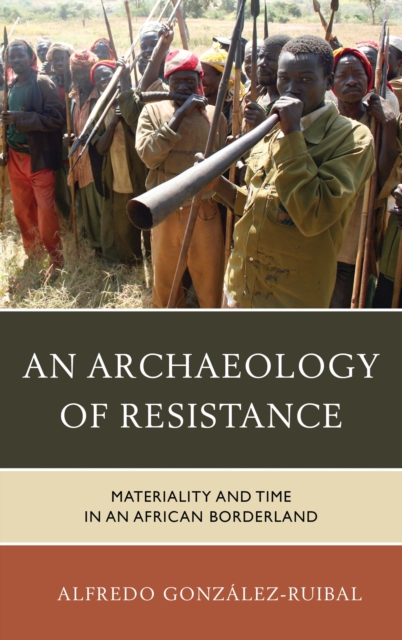
An Archaeology of Resistance
An Archaeology of Resistance: Materiality and Time in an African Borderland studies the tactics of resistance deployed by a variety of indigenous communities in the borderland between Sudan and Ethiopia. The Horn of Africa is an early area of state formation and at the same time the home of many egalitarian, small scale societies, which have lived in the buffer zone between states for the last three thousand years. For this reason, resistance is not something added to their sociopolitical structures: it is an inherent part of those structures—a mode of being. The main objective of the work is to understand the diverse forms of resistance that characterizes the borderland groups, with an emphasis on two essentially archaeological themes, materiality and time, by combining archaeological, political and social theory, ethnographic methods and historical data to examine different processes of resistance in the long term.
eBook

Place of thorns : black political protest in Kroonstad since 1976
\"Place of Thorns: Black Political Protest in Kroonstad since 1976, is a landmark study that examines the tumultuous and often fractious politics in Kroonstad's black townships. In spite of the town's relative obscurity, the author demonstrates a rich tradition of civic and political life in its townships and provides a persuasive explanation for the violence unleashed in the 1990s after decades of relative political 'quiescence'. Based on scores of life history interviews, the book illustrates a shift in the political mood from 1976 onwards. Inspired by the philosophies of Black Consciousness and the Congress movement, students developed a radical attitude and they spearheaded and shaped political protests in the townships up to the 1990s. However, tensions between the local civic associations and the regional and national ANC leadership ultimately cost the ANC the first democratic local government elections in Kroonstad. As a work of revisionist history, this book showcases South Africa's nuanced liberation history that unfolded in smaller, less known places.\" -- Publisher's description: http://witspress.co.za/catalogue/place-of-thorns/
Book

Warfare in African History
This book examines the role of war in shaping the African state, society, and economy. Richard J. Reid helps students understand different patterns of military organization through Africa's history; the evolution of weaponry, tactics, and strategy; and the increasing prevalence of warfare and militarism in African political and economic systems. He traces shifts in the culture and practice of war from the first millennium into the era of the external slave trades, and then into the nineteenth century, when a military revolution unfolded across much of Africa. The repercussions of that revolution, as well as the impact of colonial rule, continue to this day. The frequency of coups d'états and civil war in Africa's recent past is interpreted in terms of the continent's deeper past.
eBook