
Catalogue Search | MBRL


Are you sure you want to remove the book from the shelf?

{{itemTitle}}
9
result(s) for
"Government and the press Great Britain History 19th century."
Sort by:


Slow Print
This book explores the literary culture of Britain's radical press from 1880 to 1910, a time that saw a flourishing of radical political activity as well as the emergence of a mass print industry. While Enlightenment radicals and their heirs had seen free print as an agent of revolutionary transformation, socialist, anarchist and other radicals of this later period suspected that a mass public could not exist outside the capitalist system. In response, they purposely reduced the scale of print by appealing to a small, counter-cultural audience. \"Slow print,\" like \"slow food\" today, actively resisted industrial production and the commercialization of new domains of life. Drawing on under-studied periodicals and archives, this book uncovers a largely forgotten literary-political context. It looks at the extensive debate within the radical press over how to situate radical values within an evolving media ecology, debates that engaged some of the most famous writers of the era (William Morris and George Bernard Shaw), a host of lesser-known figures (theosophical socialist and birth control reformer Annie Besant, gay rights pioneer Edward Carpenter, and proto-modernist editor Alfred Orage), and countless anonymous others.
eBook


States of inquiry : social investigations and print culture in nineteenth-century Britain and the United States
In the mid-nineteenth century, American and British governments marched with great fanfare into the marketplace of knowledge and publishing. British royal commissions of inquiry, inspectorates, and parliamentary committees conducted famous social inquiries into child labor, poverty, housing, and factories. The American federal government studied Indian tribes, explored the West, and investigated the condition of the South during and after the Civil War.Performing, printing, and then circulating these studies, government established an economy of exchange with its diverse constituencies. In this medium, which Frankel terms \"print statism,\" not only tangible objects such as reports and books but knowledge itself changed hands. As participants, citizens assumed the standing of informants and readers. Even as policy investigations and official reportage became a distinctive feature of the modern governing process, buttressing the claim of the state to represent its populace, government discovered an unintended consequence: it could exercise only limited control over the process of inquiry, the behavior of its emissaries as investigators or authors, and the fate of official reports once issued and widely circulated.This study contributes to current debates over knowledge, print culture, and the growth of the state as well as the nature and history of the \"public sphere.\" It interweaves innovative, theoretical discussions into meticulous, historical analysis.
eBook

Writing Against Revolution
Conservative culture in the Romantic period should not be understood merely as an effort to preserve the old regime in Britain against the threat of revolution. Instead, conservative thinkers and writers aimed to transform British culture and society to achieve a stable future in contrast to the destructive upheavals taking place in France. Kevin Gilmartin explores the literary forms of counterrevolutionary expression in Britain, showing that while conservative movements were often inclined to treat print culture as a dangerously unstable and even subversive field, a whole range of print forms - ballads, tales, dialogues, novels, critical reviews - became central tools in the counterrevolutionary campaign. Beginning with the pamphlet campaigns of the loyalist Association movement and the Cheap Repository in the 1790s, Gilmartin analyses the role of periodical reviews and anti-Jacobin fiction in the campaign against revolution, and closes with a fresh account of the conservative careers of Robert Southey and Samuel Taylor Coleridge.
eBook

The Romantic Crowd
In the long eighteenth century, sympathy was understood not just as an emotional bond, but also as a physiological force, through which disruption in one part of the body produces instantaneous disruption in another. Building on this theory, Romantic writers explored sympathy as a disruptive social phenomenon, which functioned to spread disorder between individuals and even across nations like a 'contagion'. It thus accounted for the instinctive behaviour of people swept up in a crowd. During this era sympathy assumed a controversial political significance, as it came to be associated with both riotous political protest and the diffusion of information through the press. Mary Fairclough reads Edmund Burke, Mary Wollstonecraft, William Godwin, John Thelwall, William Hazlitt and Thomas De Quincey alongside contemporary political, medical and philosophical discourse. Many of their central questions about crowd behaviour still remain to be answered by the modern discourse of collective psychology.
eBook
Palmerston and the Times
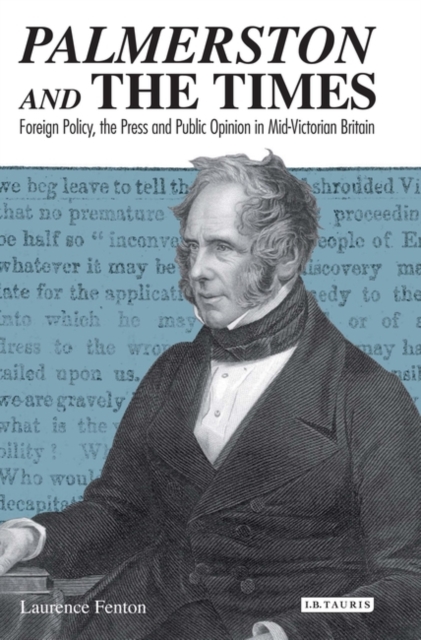
England in the Age of Palmerston had two players of colossal influence on the world stage: Lord Palmerston himself - the dominant figure in foreign affairs in the mid-nineteenth century - and The Times - the first global newspaper, read avidly by statesmen around the world. Palmerston was also one of the first real media-manipulating politicians of the modern age, forging close links with a number of publications to create the so-called 'Palmerston press'. His relationship with The Times was more turbulent, a prolonged and bitter rivalry preceding eventual rapprochement during the Crimean War. In this book, Laurence Fenton explores the highly charged rivalry between these two titans of the mid-Victorian era, revealing the personal and political differences at the heart of an antagonism that stretched over the course of three decades. Fenton focuses on the years from 1830 to 1865, when Palmerston was British Foreign Secretary and Prime Minister for a combined total of almost twenty-five years, and when The Times, under the editorship of first Thomas Barnes and then John Delane, reached the zenith of its success. It was a period during which public interest in foreign affairs grew immeasurably, encompassing the tumultuous 'Year of Revolutions', the famous 'Don Pacifico' debate and the Crimean War. Palmerston and The Times adds significantly to the understanding of the life and career of Lord Palmerston, in particular the relationship he enjoyed with the press and public opinion that was so vital to his incredibly long and multifaceted political career. It also brings to light the remarkable men behind the success of The Times, paying fair tribute to their abilities while at the same time warning against the long-standing view of The Times as a paragon of newspaper independence in this era. It will be essential reading for researchers of Victorian history and for anyone interested in the tumultuous relationship between politics and the press.
eBook

Marriage or Celibacy?
In July 1868 the Daily Telegraph congratulated itself on providing the arena for a controversy marked by `good sense, liveliness, practical wisdom, and hearty humanity.' The controversy was over the choice -: 'Marriage or Celibacy?' - faced by middle-class youth trying to reconcile economic facts with moral values, social customs - and love. The arena was the correspondence page of a newspaper just establishing itself as the most successful London daily through its appeal to the middle-class reader.
Public attention was first caught by a court report of a failed attempt to entrap a Belgian girl into prostitution. This induced blistering editorial comment and angry letters to the paper deploring ineffectual controls over the 'Great Social Evil.' The next development was unusual for the Victorian press: readers began to write extensive and richly varied comment on the root of the problem - young people did not have in possession or expectation enough money or the right qualifications for marriage. TheTelegraphinitiated a new form of popular journalism by filling its correspondence columns for almost a month with readers' letters under the heading 'Marriage or Celibacy?', which they supplemented with lengthy leading articles.
John Robson places in contemporary context the central issues facing Victorian youth: What is a proper marriage? How to balance income and expenditure? What are the ideal qualities of young women and men? 'Emigration or starvation?' In examining these debates, he looks closely into methods of argument, connecting rhetorical techniques with public persuasion. The letters being a special kind of discourse, he shows how in the debates rhetorical and logical arguments are specifically designed to persuade the Telegraph's readers.
Marriage or Celibacy?contributes to our knowledge of Victorian manners and mores, particularly among the lower middle-class, and is a telling episode to the history of popular journalism.
eBook

The press and Anglo-Ottoman relations, 1876-1909
In the latter half of the 19th century, the press played an important role in the development of pan-Islamic feelings and in communication among Muslims of many nations. The effect that newspapers had on Anglo-Ottoman relations in the period 1876-1909 is examined, focusing on \"Paik-i Islam,\" \"Al-Khalifa\" and \"al-Ghayrat.
Journal Article