
Catalogue Search | MBRL


Are you sure you want to remove the book from the shelf?

{{itemTitle}}
10,028
result(s) for
"Government consultants."
Sort by:

Hyper-active governance : how governments manage the politics of expertise
\"Hyper-active Governance is a new way of thinking about governing that puts debates over expertise at the heart. Contemporary governing requires delegation to experts, but also increases demands for political accountability. In this context, politicians and experts work together under political stress to adopt different governing relationships that appear more 'hands-off' or 'hands-on'. These approaches often serve to displace profound social and economic crises. Only a genuinely collaborative approach to governing, with an inclusive approach to expertise, can create democratically legitimate and effective governance in our accelerating world. Using detailed case studies and global datasets in various policy areas including medicines, flooding, water resources, central banking and electoral administration, the book develops a new typology of modes of governing. Drawing from innovative social theory, it breathes new life into debates about expert forms of governance and how to achieve real paradigm shifts in how we govern our increasingly hyper-active world\"-- Provided by publisher.
Book
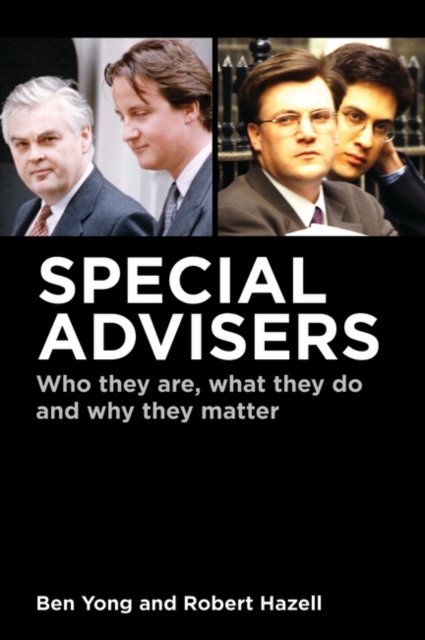
Special advisers
This book is the most detailed study yet carried out of special advisers. The Constitution Unit's research team, led by Dr Ben Yong and Professor Robert Hazell, assembled a comprehensive database of over 600 special advisers since 1979.
eBook

Trusting judgements : how to get the best out of experts
\"Policy- and decision-makers in government and industry constantly face important decisions without full knowledge of all the facts. They rely routinely on expert advice to fill critical scientific knowledge gaps. There are unprecedented opportunities for experts to influence decisions. Yet even the most experienced can be over-confident and error-prone, and the hidden risk is that scientists and other experts can over-reach, often with good intentions, placing more weight on the evidence they provide than is warranted. This book describes how to identify potentially risky advice, explains why group judgements outperform individual estimates, and provides an accessible and up-to-date guide to the science of expert judgement. Finally, and importantly, it outlines a simple, practical framework that will help policy- and decision-makers to ensure that the advice that they receive is relatively reliable and accurate, thus substantially improving the quality of information on which critical decisions are made\"-- Provided by publisher.
Book
Managing Consultants
Public service cutbacks have increased reliance on consultants. But new legislation and rules governing the procurement of services from consultants are scattered over different legislative instruments. The first edition of this book attracted a record number of online hits. Busy public sector managers now have available to them an updated version that integrates an easy-to-follow, step-by-step guide that incorporates the many practical tips needed for successful procurement activity.
eBook

Science and Technology in the National Interest
This report is the second edition of the 1992 COSEPUP report \"Science and Technology Leadership in American Government: Ensuring the Best Presidential Appointments.\" As was the case with the original report, this report analyzes the federal government's capacity to recruit highly qualified individuals for the top science and technology (S&T)-related leadership positions in the executive branch and makes appropriate recommendations.
eBook


British Think-Tanks And The Climate Of Opinion
Investigating think tanks on both sides of the political divide, the author defines these groups in the context of British politics, explores their impact on the climate of opinion, and calculates how effective they have been in influencing government in general and key policy areas in particular. Think tanks have rarely come under the spotlight and the author offers a probing but balanced overview of a political phenomenon.; This book should prove to be valuable reading for students of political science, public administration and contemporary British history.
eBook

Dangerous counsel : accountability and advice in ancient Greece
We often talk loosely of the \"tyranny of the majority\" as a threat to the workings of democracy. But, in ancient Greece, the analogy of demos and tyrant was no mere metaphor, nor a simple reflection of elite prejudice. Instead, it highlighted an important structural feature of Athenian democracy. Like the tyrant, the Athenian demos was an unaccountable political actor with the power to hold its subordinates to account. And like the tyrant, the demos could be dangerous to counsel since the orator speaking before the assembled demos was accountable for the advice he gave. With Dangerous Counsel, Matthew Landauer analyzes the sometimes ferocious and unpredictable politics of accountability in ancient Greece and offers novel readings of ancient history, philosophy, rhetoric, and drama. In comparing the demos to a tyrant, thinkers such as Herodotus, Plato, Isocrates, and Aristophanes were attempting to work out a theory of the badness of unaccountable power; to understand the basic logic of accountability and why it is difficult to get right; and to explore the ways in which political discourse is profoundly shaped by institutions and power relationships. In the process they created strikingly portable theories of counsel and accountability that traveled across political regime types and remain relevant to our contemporary political dilemmas.
Book
