
Catalogue Search | MBRL


Are you sure you want to remove the book from the shelf?

{{itemTitle}}
7
result(s) for
"Governors Indiana Biography."
Sort by:


Paul V. McNutt and the Age of FDR
In this major biography of an important politician and statesman, Dean Kotlowski presents the life of Paul V. McNutt, a great understudied figure in the era of FDR. McNutt was governor of Indiana, high commissioner to the Philippines (while serving he helped 1,300 Jews flee Nazi Germany for Manila), head of the WWII Federal Security Agency, and would-be presidential candidate. Paul V. McNutt and the Age of FDR explores McNutt's life, his era, and his relationship with Franklin Roosevelt. It sheds light on the expansion of executive power at the state level during the Great Depression, the theory and practice of liberalism as federal administrators understood it in the 1930s and 1940s, the mobilization of the American home front during World War II, and the internal dynamics of the Roosevelt and Truman administrations. McNutt's life underscores the challenges and changes Americans faced during an age of economic depression, global conflict, and decolonialization.
eBook

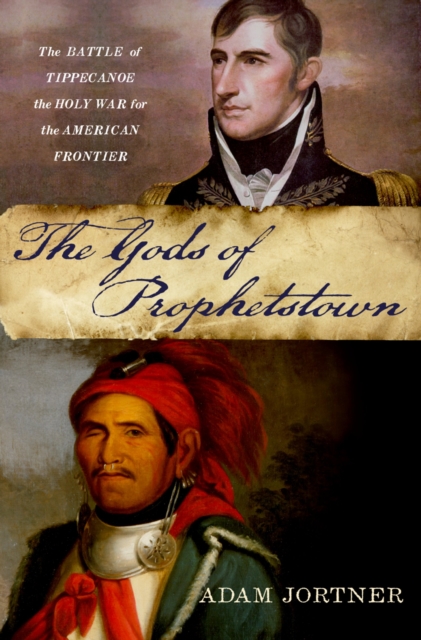
The gods of Prophetstown : the Battle of Tippecanoe and the holy war for the American frontier
Written with profound insight and narrative verve, The Gods of Prophetstown recaptures a forgotten turning point in American history in time for the 200th anniversary of the Battle of Tippecanoe. Adam Jortner provides a gripping account of the conflict between Tenskwatawa and William Henry Harrison, who finally collided in 1811 at a place called Tippecanoe.
eBook

Oliver P. Morton and the Politics of the Civil War and Reconstruction
Remembered as the \"Great War Governor\" who led the state of Indiana during the Civil War, Oliver P. Morton has always been a controversial figure. His supporters praised him as a statesman who helped Abraham Lincoln save the Union, while his critics blasted him as a ruthless tyrant who abused the power of his office. Many of his contemporaries and some historians saw him as a partisan politician and an opportunist who shifted his positions to maintain power. Later generations treated Governor Morton as either a hero or a villain and generally forgot about his postwar career as a Radical Republican leader in the U.S. Senate.
In this first full biography of Morton to be published in over a century, A. James Fuller offers a groundbreaking new interpretation of Indiana's most significant political leader in the nineteenth century. Overturning traditional views, Fuller argues that Morton's nationalist ideology motivated him throughout his career and that the Hoosier leader held consistently to the ideas of freedom, Union, power, and party. Those core principles drove Morton's politics and actions, including his support for Indiana soldiers, his fight against the Democrats in the state legislature, and his twenty-two months of one-man rule, a period in which his opponents accused him of being a virtual dictator. His principles also framed his struggle against the disloyal Copperheads who tried to assassinate him and whose leaders he helped bring to justice in the Indianapolis Treason Trials.
Fuller also restores the historical significance of Morton's long neglected career as a Reconstruction senator. Seeing Reconstruction as a continuation of the Civil War, Morton became a leading Radical Republican who championed racial equality. He continually waved the bloody shirt, reminding voters that the Democrats had caused the rebellion. Morton supported the civil rights of African Americans and fought against the Democrats and the Ku Klux Klan. He enjoyed widespread support for the presidency in 1876, but when his bid for the Republican nomination came up short, he helped decide the disputed election for Rutherford B. Hayes. When Morton died in 1877, Reconstruction died with him, symbolically marking the end of an era. In the decades after his death, Hoosiers built monuments to Morton, remembering him in ways that reflected their own times, keeping his controversial legacy alive in historical memory.
eBook

Golden lads and girls
Fantastic: The Life of Arnold Schwarzenegger by Laurence Learner (Sidgwick & Jackson, £18.99, pp. 421, ISBN 0283070242)
Book Review

Books Explore Schwarzenegger's Psyche, Strategies; Two authors say the governor gets what he wants by undermining enemies, brushing off failures and relentlessly moving forward
[Arnold Schwarzenegger] turned to [Sergio Oliva] on stage and asked if they should leave together, with Oliva departing first. Oliva agreed and left the stage, but Schwarzenegger stayed behind for more poses, despite their informal agreement to finish. The crowd went wild, screaming for Schwarzenegger, believing Oliva had given up. \"Few judges would have dared deny the crowd its verdict,\" [Laurence Leamer] writes. Schwarzenegger captured his first Mr. Olympia contest. * Arnold's triumph was only a skirmish before the Mr. Olympia contest, and Arnold used the occasion to plant what he hoped would be the seeds of [Sergio] Oliva's defeat in New York. He gently suggested to Oliva that to be at his prime, he needed to gain some weight before their next meeting...
Newspaper Article