
Catalogue Search | MBRL


Are you sure you want to remove the book from the shelf?

{{itemTitle}}
248
result(s) for
"Grammaire cognitive."
Sort by:

The language game : how improvisation created language and changed the world
\"Think about the game charades. Its rules are simple: no talking, of course, and little else. Each time we play with a new group, we have to figure each other out, with our different styles, backgrounds, and senses of the world, as we struggle to connect how we would act out something (say, Christopher Columbus crossing the Atlantic) with how other people might understand it. But as we play, a lingo can develop-with time, an upheld hand, bobbing along, might not just come to represent the ship on the Santa Maria, but a vast range of possibilities, including both conceptual ones such as exploration or trade, actions like sailing, or even a place like India or Santo Domingo. Almost from nothing, the players can create something like a language. Such nearly rule-less games are a hallmark of the human species: testament not just to our intelligence, but our flexibility of mind as well as our desires to cooperate, to understand, and to be understood. In The Language Game, cognitive scientists Nick Chater and Morten Christiansen show games like charades reveal something more: where language comes from and how it works. Language is perhaps humanity's most astonishing traits, and one of its most studied, but as Chater and Christiansen, it has been our most poorly understood. Several generations of scientists sought to understand how the rules of language could be hardwired in the brain. It was a colossal mistake. Chater and Christiansen show that language is hardly about rules at all, let alone those welded into our brain by evolution, but rather about near-total freedom, where the only real constraints are our imaginations and our desire to be understood. And with that as the point of departure, they are able to find compelling solutions to old riddles and new puzzles, including why chimpanzees don't understand pointing fingers; whether having two words for \"blue\" changes what we see; why Danish is so much harder to learn than Norwegian; how words change meanings; and whether computers will ever truly understand a human. The Language Game will bewitch readers of classic books on mind and language, such as Douglas Hofstadter's Godel Escher Bach and John McWhorter's The Power of Babel, and find a welcome spot on the shelf of readers of Joseph Henrich's Weirdest People in the World and Frans de Waal's Mama's Last Hug. And like the game of charades, it will engage, amuse, and dazzle readers for years to come\"-- Provided by publisher.
Book


Corpora in cognitive linguistics : corpus-based approaches to syntax and lexis
Cognitive Linguistics, the branch of linguistics that tries to \"make one's account of human language accord with what is generally known about the mind and the brain,\" has become one of the most flourishing fields of contemporary linguistics.The chapters address many classic topics of Cognitive Linguistics.
eBook

Structural Priming in the Grammatical Network
This book combines research to come up with a plausible account of grammar as a mental network. This is done by examining evidence from structural priming. Previous experimental findings are reinterpreted and new experiments are reported. These extend structural priming to understudied phenomena.
eBook
A Cognitive Perspective on Spatial Prepositions: Intertwinning Networks
A Cognitive Perspective on Spatial Prepositions: Intertwining networks is devoted to the issue of the relation between language and thought approached from the perspective of spatial relations encoded by four equivalent spatial prepositions - English to, German zu, Polish do and Russian ?. Regarding these prepositions as path-prepositions, the authors show that the prepositional semantic structures are conceptually grounded in the PATH and the MOTION-EVENT frames and explain that prepositional senses emerge as a result of the PATH image schema transformations and metaphorical mappings related to the EVENT STRUCTURE metaphor. Based on their findings, the authors show how senso-motoric functioning, life experience, individual knowledge, imagery and different ways in which people conceptualize the world influence the relation between language and conceptualization.
eBook
Cultural conceptualisations and language : theoretical framework and applications
This book presents a multidisciplinary theoretical model of cultural conceptualisations and language. Viewing language as firmly grounded in cultural cognition, the model draws on analytical tools and theoretical advancements in several disciplines, including cognitive linguistics, cognitive anthropology, anthropological linguistics, distributed cognition, complexity science, and cognitive psychology. The result is a framework that has significant implications for those disciplines as well as for applied linguistics. Applications of the model to intercultural communication, cross-cultural pragmatics, English as an International Language/World Englishes, and political discourse analysis are explored in detail.
eBook

Mind Style and Cognitive Grammar
Mind Style and Cognitive Grammar advances our understanding of mind style: the experience of other minds, or worldviews, through language in literature. This book is the first to set out a detailed, unified framework for the analysis of mind style using the account of language and cognition set out in cognitive grammar. Drawing on insights from cognitive linguistics, Louise Nuttall aims to explain how character and narrator minds are created linguistically, with a focus on the strange minds encountered in the genre of speculative fiction. Previous analyses of mind style are reconsidered using cognitive grammar, alongside original analyses of four novels by Margaret Atwood, Kazuo Ishiguro, Richard Matheson and J.G. Ballard. Responses to the texts in online forums and literary critical studies ground the analyses in the experiences of readers, and support an investigation of this effect as an embodied experience cued by the language of a text. Mind Style and Cognitive Grammar advances both stylistics and cognitive linguistics, whilst offering new insights for research in speculative fiction.
eBook
Cognitive Linguistics
Cognitive Linguistics: Current Applications and Future Perspectives is an up-to-date survey of recent research in Cognitive Linguistics and its applications by prominent researchers. The volume brings together generally accessible syntheses and special studies of Cognitive Linguistics strands in a sizable format and is thus an asset not only to the Cognitive Linguistics community, but also to neighbouring disciplines and linguists in general. The volume covers a wide range of fields and combines wide accessibility with a highly specific information value.
Key features:
* An excellent source for the study of Applied Cognitive Linguistics, one of the most popular and fastest growing areas in Linguistics.
* Authoritative and detailed survey articles by leading scholars in the field.
* Accessible to a general audience, yet also characterized by a highly specific information value.
eBook
Figurativity and Human Ecology
Figurativity has attracted scholars' attention for thousands of years and yet there are still open questions concerning its nature. This volume endorses a view of figurativity as ubiquitous in human reasoning and language, and as a key example of how a human organism and its perceived or imagined environment co-function as a system.
eBook
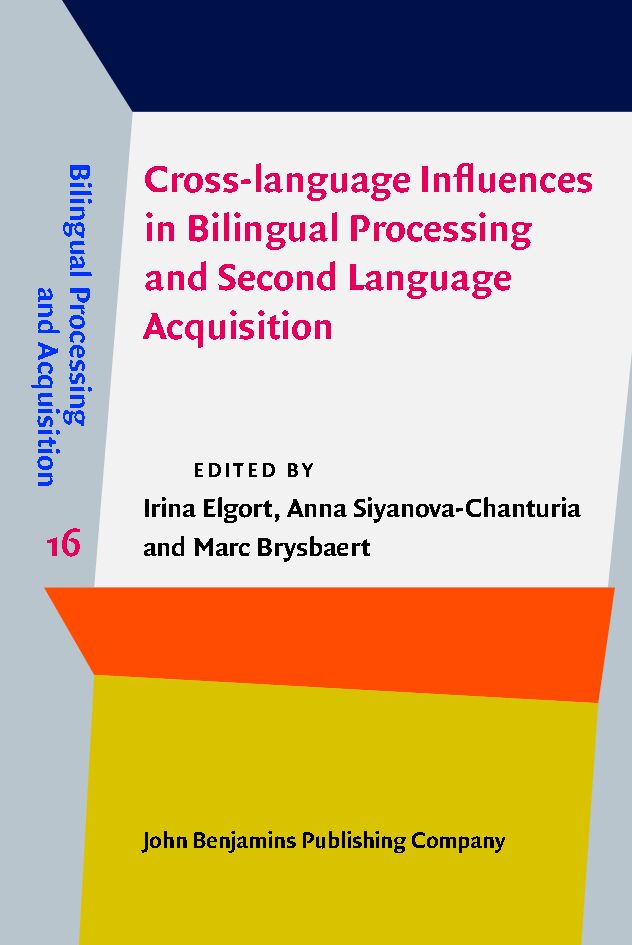
Cross-language Influences in Bilingual Processing and Second Language Acquisition
A great majority of people around the world know more than one language. So, how does knowing one language affect the learning and use of additional languages? The question of cross-language influences is the focus of this book.
eBook