
Catalogue Search | MBRL


Are you sure you want to remove the book from the shelf?

{{itemTitle}}
38
result(s) for
"Grammar, Comparative and general -- Interrogative"
Sort by:
Wh-In Situ Licensing in Questions and Sluicing
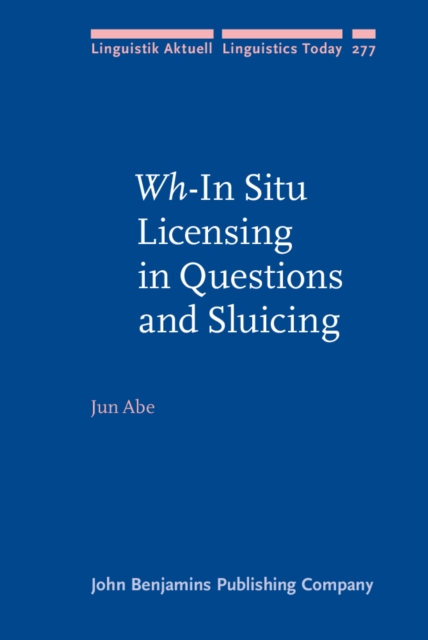
This book addresses the question of how in-situ wh-phrases are licensed from a minimalist perspective in which the basic assumptions about narrow syntax need to be reduced to the bare minimum. I propose that in-situ wh-phrases are licensed by way of either minimal Search or covert internal Merge: while in-situ wh-adjuncts are uniformly licensed by covert internal Merge, in-situ wh-arguments have a choice between the two options, depending on whether the licensing C head is overtly manifested. I also discuss sluicing, an ellipsis construction with a remnant wh-phrase, and address the question of how the remnant wh-phrase is licensed. I support the in-situ approach to sluicing, advocated in my previous book The In-Situ Approach to Sluicing (John Benjamins), according to which the remnant wh-phrase stays in situ. I argue against the more standard analysis, endorsing the main claim of this previous book that island repair by ellipsis is a myth.
eBook
Questions in discourse. Volume 2, pragmatics
The volume 'Questions in Discourse - Vol. 2 Pragmatics' collects original research on the role of questions in understanding text structure and discourse pragmatics. The in-depth studies discuss the effects of focus, questions and givenness in unalternative semantics, as well as the role of scalar particles, question-answer pairs and prosody from the perspective of Questions under Discussion. Two contributions compare the discourse-structuring potential of Questions under Discussion and rhetorical relations, whereas another adds a perspective from inquisitive semantics. Some contributions also look at understudied languages. Together, the contributions allow for a better understanding of question-related pragmatic and discourse-semantic phenomena, and they offer new perspectives on the structure of texts and discourses.
Book
Questions in Discourse
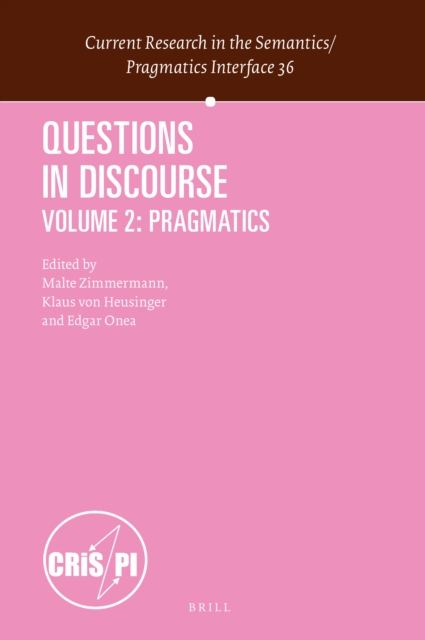
The volume Questions in Discourse - Vol. 2 Pragmatics collects original research on the role of questions in understanding text structure and discourse pragmatics. Most studies adopt the perspective of (implicit) Questions under Discussion in presenting novel analyses of various discourse-semantic phenomena.
eBook

Questions in Discourse
The volume Questions in Discourse - Semantics contains an overview of the semantic analysis and discourse-structuring role of questions, together with in-depth contributions on individual aspects of question meanings and the function of implicit questions in discourse.
eBook

The grammar of Q : Q-particles, Wh-movement, and pied-piping
This book puts forth a novel syntactic and semantic analysis of wh-questions based upon in-depth study of the Tlingit language, an endangered and under-documented language of North America. A major consequence of this new approach is that the phenomenon classically dubbed pied-piping does not actually exist. The book begins by arguing that wh-fronting in Tlingit does not involve a syntactic relationship between interrogative C and the wh-word. Rather, it involves a probe/Agree relation between C and an overt ‘Q-particle’ (or ‘Q’) c-commanding the wh-word. Fronting of the wh-word in Tlingit is thus a mere by-product of fronting the QP projected by this Q. Given the strong similarity between the wh-constructions of Tlingit and those of more widely studied languages, this ‘Q-based’ analysis is applied to a range of other languages. Regarding so-called pied-piping structures, the Q-based theory provides an analysis in which the very concept of ‘pied-piping’ is eliminated from the theory of grammar. Furthermore, the account provides an especially minimal semantics for pied-piping structures, in which no mechanisms are needed beyond those required for simple wh-questions. Finally, the Q-based theory is able to capture certain constraints on pied-piping, as well as aspects of its variation across languages. Beyond its treatment of pied-piping, the Q-based theory also yields a novel syntax and semantics for multiple wh-questions that ties the presence of Superiority Effects to the absence of Intervention Effects. Furthermore, the account predicts a previously unnoticed Intervention Effect in English pied-piping structures. Finally, the Q-based theory provides a novel account of the ill-formedness of P-stranding and left branch extractions in many of the world’s languages.
eBook
Romance interrogative syntax : formal and typological dimensions of variation
This monograph offers an innovative understanding of the mechanisms involved in Romance 'optional' wh-in situ. New supporting evidence in favour of Cable's (2010) Grammar of Q is presented, as well as novel implementations of his original theory. In particular, it is claimed that wh-in situ idioms are characterised not only by language-specific choices between QP-projection and Q-adjunction, and between overt and covert movement of Q, but also in terms of the locus where they check the features relevant to wh-questions: while some languages check both [q] and [focus] in C, others make use of the clause-internal vP-periphery to check [focus]. Thanks to the vast amount of data presented and discussed, along with the predictions and theoretical contributions made, this monograph will be of interest to a wide range of specialists in human language, from typologists to Romance specialists and formal syntacticians, but also to the many experts in languages with overt Q-particles who wonder why Romance specialists have long been so resistant to the implementation of silent Q-particles in their theoretical models.
eBook
Academic Writing and Reader Engagement
Academic Writing and Reader Engagement offers a concise linguistic description of the use and functions of questions in English, French, and Spanish and discusses their value to the teaching of academic writing. This book:
Enables a better understanding of how writers engage readers in academic writing in English, French, and Spanish and where each language behaves similarly or differently;
Explains how authors express opinions, organise discourse, and create relationships with readers via questions in their academic writing and the various functions questions perform;
Brings together research on corpus and contrastive linguistics, highlighting how these two fields can support one another;
Offers a thorough investigation of reader engagement markers from a range of linguistic perspectives and considers how knowledge of these markers could be applied to the teaching and learning of academic writing in each language;
Employs corpus data totalling approximately 1.2 million words from all three languages to illustrate the varying roles and representations of questions in each language.
Providing an invaluable resource for scholars learning to communicate successfully within their academic community, as well as teachers of English, French, and/or Spanish for academic purposes, this book is key reading for students and researchers of academic discourse, contrastive linguistics, and corpus linguistics.
eBook
The pragmatics of quoting now and then
The future of English linguistics as envisaged by the editors of Topics in English Linguistics lies in empirical studies which integrate work in English linguistics into general and theoretical linguistics on the one hand, and comparative linguistics on the other. The TiEL series features volumes that present interesting new data and analyses, and above all fresh approaches that contribute to the overall aim of the series, which is to further outstanding research in English linguistics.
eBook