
Catalogue Search | MBRL


Are you sure you want to remove the book from the shelf?

{{itemTitle}}
60
result(s) for
"Great Awakening."
Sort by:

The Awakening of Islamic pop music
Awakening -- an Islamic media company formed in London -- has created the soundtrack to many Muslim lives during the last two decades and has produced superstars like Sami Yusuf and Maher Zain, among a host of other artists. As the company celebrates its first 20 years in the industry, Jonas Otterbeck examines Awakening's rise to global success and their pop music inspired by Islam--back cover.
Book

Everyday Religion
In the early nineteenth century, antebellum America witnessed a Second Great Awakening led by evangelical Protestants who gathered in revivals and contributed to the blossoming of social movements throughout the country. Preachers and reformers promoted a Christian lifestyle, and evangelical fervor overtook entire communities. One such community in Smithfield, New York, led by activist Gerrit Smith, is the focus of Hadley Kruczek-Aaron's study.
eBook


The first great awakening
The First Great Awakening, an unprecedented surge in Protestant Christian revivalism in the Eighteenth Century, sparked enormous of controversy at the time and has been a source of scholarly debate ever since. Few historians have sought to write a synthetic history of the First Great Awakening, and in recent decades it has been challenged as having happened at all, being either an exaggeration or an \"invention.\" The First Great Awakening expands the movement's geographical, theological, and sociopolitical scope. Rather than focus exclusively on the clerical elites, as earlier studies have done, it deals with them alongside ordinary people, and includes the experiences of women, African Americans, and Indians as the observers and participants they were. It challenges prevailing scholarly opinion concerning what the revivals were and what they meant to the formation of American religious identity and culture. Cover image: NPG 131, George Whitefield by John Wollaston, oil on canvas, circa 1742. © National Portrait Gallery, London
eBook

Jonathan Edwards : writings from the Great Awakening
Draws on first editions and manuscript sources in an anthology of writings by the eighteenth-century theologian and philosopher on the revivals, including the famous sermon \"Sinners in the Hands of an Angry God.\"
BOOK
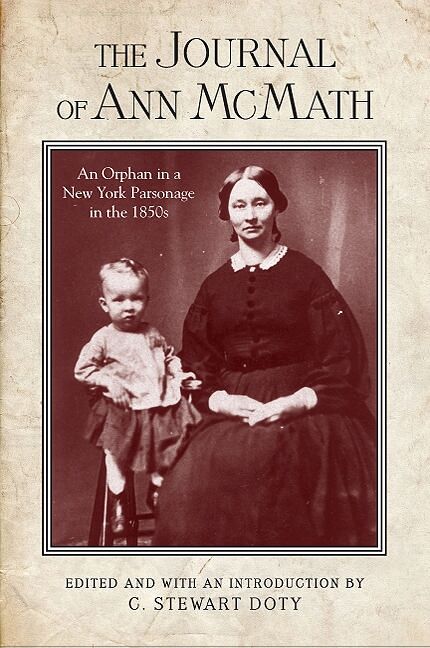
The Journal of Ann McMath
In 1851, fourteen-year-old orphan Ann McMath was sent to live with her uncle and his family in their parsonage in Horseheads, New York. Lonely and full of self doubt, anxious to establish female friendships in a new place, and questing for intellectual and moral perfection, she began keeping journal when she was seventeen and wrote in it regularly for the next five years, until she was married. A fascinating example of \"biography from below,\" McMath's journal offers a rare glimpse of of life in the 1850s as it was lived by ordinary women, told in the authentic voice of a young woman coming of age in the Burned-Over District of Western New York. In addition to the journal itself, the book includes an introduction by editor C. Stewart Doty, as well as a geneaology, notes on the text, and a section entitled \"People in the Life of Ann McMath,\" which gives brief biographies of everyone mentioned in the journal.
eBook

The first great awakening in colonial American newspapers
Gathering the attention and excitement of American colonists from Boston to Charleston, the religious revival of the 1740s traditionally known as the First Great Awakening provided colonial newspaper printers with their first story of transcolonial importance. At the time of the Awakening, American newspapers had become a vital part of the colonial information network as each major city offered at least one weekly paper. Papers printed weekly reports on revivalist preaching, eye-witness accounts of revival meetings, shocking stories of improper ordinations and church separations, as well as numerous contributed letters praising or denouncing virtually every aspect of the Awakening. No other colonial event of the 1740s, including the War of the Austrian Succession (1740-1748) and the Jacobite Rebellion (1745), came close to receiving as much newspaper coverage, making the First Great Awakening America’s first “Big Story.” In The First Great Awakening in Colonial American Newspapers: A Shifting Story, Lisa Smith offers the first scholarly work to examine in detail the printed newspaper record of the revival. This comprehensive, in-depth examination of colonial newspapers over a ten-year period uncovers information on shifts in the presentation of the revival over time, specific differences in regional reporting, and significant transformations in the newspaper personae of popular revivalists such as George Whitefield and Gilbert Tennent. Using original newspaper excerpts and graphs revealing reporting trends, this book presents an engaging, detailed picture of how colonial newspaper printers covered the experience of the First Great Awakening.
eBook
Essentials. Pivotal events, war, and conflict. Episode 71, The First Great Awakening
The First Great Awakening revived Christianity across the American colonies, introducing a new era of religious practice and community involvement.
Streaming Video
Essentials. Pivotal events, war, and conflict. Episode 349, The Second Great Awakening
Between the 1790s and the 1830s, the United States experienced a Second Great Awakening, as religious revivalists campaigned to improve the moral and spiritual character of the country.
Streaming Video

Auditing Revival: George Whitefield and Public Accounting in Colonial America
This article situates George Whitefield's accounting controversies of the 1740s in the local public accounting cultures of colonial America. It argues that Whitefield developed a novel “commercial theology” and funding strategy for his Georgia orphanage that he believed would allow God to shape every aspect of the institution. While Whitefield's published financial accounts initially provoked little commentary, his critics began to use accounting as an “impartial” tool to disprove the minister's theology. The bold theological claims and lack of institutional oversight embedded in Whitefield's accounts violated the norms of public accounting, and his critics stated that an independent audit was the only way to clear the minister's name. The audit worked, and the combination of Whitefield's experience managing a transatlantic institution and his accounting controversies caused the minister to change his commercial theology. This article uses Whitefield's accounting controversies to make two overarching arguments. First, it argues that religious institutions were key parts of the local public accounting systems that shaped the development of financial ethics in colonial America. Second, it argues that financial accounts both shaped and reflected the religious assumptions of the bookkeepers who produced them.
Journal Article