
Catalogue Search | MBRL


Are you sure you want to remove the book from the shelf?

{{itemTitle}}
573
result(s) for
"Great Britain -- Armed Forces -- Management"
Sort by:

Losing Small Wars
Partly on the strength of their apparent success in insurgencies such as Malaya and Northern Ireland, the British armed forces have long been perceived as world class, if not world beating. However, their recent performance in Iraq and Afghanistan is widely seen as-at best-disappointing; under British control Basra degenerated into a lawless city riven with internecine violence, while tactical mistakes and strategic incompetence in Helmand Province resulted in heavy civilian and military casualties and a climate of violence and insecurity. In both cases the British were eventually and humiliatingly bailed out by the US army.
In this thoughtful and compellingly readable book, Frank Ledwidge examines the British involvement in Iraq and Afghanistan, asking how and why it went so wrong. With the aid of copious research, interviews with senior officers, and his own personal experiences, he looks in detail at the failures of strategic thinking and culture that led to defeat in Britain's latest \"small wars.\" This is an eye-opening analysis of the causes of military failure, and its enormous costs.
eBook
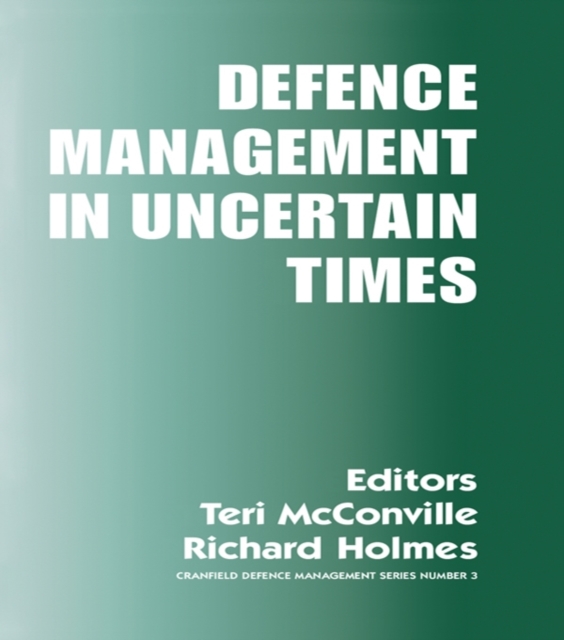
Defence Management in Uncertain Times
From the impact of the attacks on New York and Washington in 2001, to the problems of military uncertainty and the role of women in combat, this collection of essays explores the changing face of militarism from the perspective of defence management experts.
eBook

Elizabethan Naval Administration
This is the first general selection from the substantial body of surviving documents about Elizabeth's navy. It is a companion to The Navy of Edward VI and Mary I (Vol.157 in the NRS Series), where the apparatus serving both volumes was printed, and it complements the other NRS volumes that deal specifically with the Spanish Armada. This collection concentrates (though not exclusively so) on the early years of Elizabeth's reign when there was no formal war. From 1558-1585 the navy was involved in a number of small-scale campaigns, pursuit of pirates and occasional shows of force. The documents selected emphasize the financial and administrative processes that supported these operations, such as mustering, victualing, demobilisation, and ship maintenance and repair. The fleet varied in size from about 30 to 45 ships during the period and a vast amount of maintenance and repair was required. The main component of the volume is the massively detailed Navy Treasurer's account for 1562-3 which is followed by and collated with the corresponding Exchequer Account. The documents illustrate just how efficiently the dockyards functioned. They were one of the great early Elizabethan achievements.
eBook

Imperial Connections
An innovative remapping of empire, Imperial Connections offers a broad-ranging view of the workings of the British Empire in the period when the India of the Raj stood at the center of a newly globalized system of trade, investment, and migration. Thomas R. Metcalf argues that India itself became a nexus of imperial power that made possible British conquest, control, and governance across a wide arc of territory stretching from Africa to eastern Asia. His book, offering a new perspective on how imperialism operates, emphasizes transcolonial interactions and webs of influence that advanced the interests of colonial India and Britain alike. Metcalf examines such topics as law codes and administrative forms as they were shaped by Indian precedents; the Indian Army's role in securing Malaya, Africa, and Mesopotamia for the empire; the employment of Indians, especially Sikhs, in colonial policing; and the transformation of East Africa into what was almost a province of India through the construction of the Uganda railway. He concludes with a look at the decline of this Indian Ocean system after 1920 and considers how far India's participation in it opened opportunities for Indians to be a colonizing as well as a colonized people.
eBook

Exporting British Policing during the Second World War
Exporting British Policing is a comprehensive study of British military policing in liberated Europe during the Second World War. Preventing and detecting thefts, receiving and profiteering together with the maintenance of order in its broadest sense are, in the peacetime world, generally confided to the police. However, the Second World War witnessed the use of civilian police to create a detective division of the British Army’s Military Police (SIB), and the use of British civilian police, alongside American police, as Civil Affairs Officers to restore order and civil administration. Part One follows the men of the SIB from their pre-war careers to confrontations with mafiosi and their investigations into widespread organised crime and war crimes during which they were constantly hampered by being seen as a Cinderella service commanded by ‘temporary gentlemen’. Part Two focuses on the police officers who served in Civil Affairs who tended to come from higher ranks in the civilian police than those who served in SIB. During the war they occupied towns with the assault troops, and then sought to reorganise local administration; at the end of the war in the British Zones of Germany and Austria they sought to turn both new Schutzmänner and police veterans of the Third Reich into British Bobbies. Using memoirs and anecdotes, Emsley critically draws on the subjective experiences of these police personnel, assessing the successes of these wartime efforts for preventing and investigating crimes such as theft and profiteering and highlighting the importance of historical precedent, given current difficulties faced by international policing organizations in enforcing democratic police reform in post-conflict societies.
eBook

Elizabethan Naval Administration
This is the first general selection from the substantial body of surviving documents about Elizabeth's navy. It is a companion to The Navy of Edward VI and Mary I (Vol.157 in the NRS Series), where the apparatus serving both volumes was printed, and it complements the other NRS volumes that deal specifically with the Spanish Armada. This collection concentrates (though not exclusively so) on the early years of Elizabeth's reign when there was no formal war. From 1558-1585 the navy was involved in a number of small-scale campaigns, pursuit of pirates and occasional shows of force. The documents selected emphasize the financial and administrative processes that supported these operations, such as mustering, victualing, demobilisation, and ship maintenance and repair. The fleet varied in size from about 30 to 45 ships during the period and a vast amount of maintenance and repair was required. The main component of the volume is the massively detailed Navy Treasurer's account for 1562-3 which is followed by and collated with the corresponding Exchequer Account. The documents illustrate just how efficiently the dockyards functioned. They were one of the great early Elizabethan achievements.
eBook