
Catalogue Search | MBRL


Are you sure you want to remove the book from the shelf?

{{itemTitle}}
85
result(s) for
"Great Britain -- Civilization -- 18th century"
Sort by:

The Making of the Modern Self
Toward the end of the eighteenth century, a radical change occurred in notions of self and personal identity. This was a sudden transformation, says Dror Wahrman, and nothing short of a revolution in the understanding of selfhood and of identity categories including race, gender, and class. In this pathbreaking book, he offers a fundamentally new interpretation of this critical turning point in Western history.Wahrman demonstrates this transformation with a fascinating variety of cultural evidence from eighteenth-century England, from theater to beekeeping, fashion to philosophy, art to travel and translations of the classics. He discusses notions of self in the earlier 1700s-what he terms the ancien regime of identity-that seem bizarre, even incomprehensible, to present-day readers. He then examines how this peculiar world came to an abrupt end, and the far-reaching consequences of that change. This unrecognized cultural revolution, the author argues, set the scene for the array of new departures that signaled the onset of Western modernity.
eBook

The British discovery of Hinduism in the eighteenth century
After the success of British arms in the 18th-century, a number of publications appeared which reflected the intense curiosity of contemporary Europeans about strange peoples, their manners and religions. This book reprints some of the most significant English contributions to the early European understanding of Hinduism.
Book
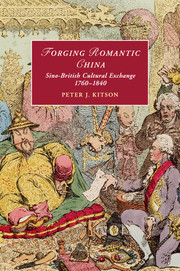
Forging Romantic China
The first major cultural study to focus exclusively on this decisive period in modern British-Chinese relations. Based on extensive archival investigations, Peter J. Kitson shows how British knowledge of China was constructed from the writings and translations of a diverse range of missionaries, diplomats, travellers, traders, and literary men and women during the Romantic period. The new perceptions of China that it gave rise to were mediated via a dynamic print culture to a diverse range of poets, novelists, essayists, dramatists and reviewers, including Jane Austen, Thomas Percy, William Jones, S. T. Coleridge, George Colman, Robert Southey, Charles Lamb, William and Dorothy Wordsworth and others, informing new British understandings and imaginings of China on the eve of the Opium War of 1839–42. Kitson aims to restore China to its true global presence in our understandings of the culture and literature of Britain in the late eighteenth and early nineteenth centuries.
eBook

Travel and the British country house : cultures, critiques and consumption in the long eighteenth century
Travel and the British country house explores the ways in which travel by owners, visitors and material objects shaped country houses during the long eighteenth century. It provides a richer and more nuanced understanding of this relationship, and how it varied according to the identity of the traveller and the geography of their journeys. The essays explore how travel on the Grand Tour, and further afield, formed an inspiration to build or remodel houses and gardens; the importance of country house visiting in shaping taste amongst British and European elites, and the practical aspects of travel, including the expenditure involved. Suitable for a scholarly audience, including postgraduate and undergraduate students, but also accessible to the general reader, Travel and the British country house offers a series of fascinating studies of the country house that serve to animate the country house with flows of people, goods and ideas.
Book

The world of Elizabeth Inchbald : essays on literature, culture, and theatre in the long eighteenth century
This collection centers on the remarkable life and career of the writer and actor Elizabeth Inchbald (1753–1821), active in Great Britain in the late eighteenth century. Inspired by the example of Inchbald’s biographer, Annibel Jenkins (1918–2013), the contributors explore the broad historical and cultural context around Inchbald’s life and work, with essays ranging from the Restoration to the nineteenth century. Ranging from visual culture, theater history, literary analyses and to historical investigations, the essays not only present a fuller picture of cultural life in Great Britain in the long eighteenth century, but also reflect a range of disciplinary perspectives. The collection concludes with the final scholarly presentation of the late Professor Jenkins, a study of the eighteenth-century English newspaper The World (1753-1756).
eBook


Historicizing the Enlightenment, Volume 2
Enlightenment critics from Dryden through Johnson and Wordsworth conceived the modern view that art and especially literature entails a double reflection: a reflection of the world, and a reflection on the process by which that reflection is accomplished. Instead \"neoclassicism\" and \"Augustanism\" have been falsely construed as involving a one-dimensional imitation of classical texts and an unselfconscious representation of the world. In fact these Enlightenment movements adopted an oblique perspective that registers the distance between past tradition and its present reenactment, between representation and presence. Two modern movements, Romanticism and modernism, have appropriated as their own these innovations, which derive from Enlightenment thought. Both of these movements ground their error in a misreading of \"imitation\" as understood by Aristotle and his Enlightenment proponents. Rightly understood, neoclassical imitation, constitutively aware of the difference between what it knows and how it knows it, is an experimental inquiry that generates a range of prefixes—\"counter-,\" \"mock-,\" \"anti-,\" \"neo-\"—that mark formal degrees of its epistemological detachment. Romantic ideology has denied the role of the imagination in Enlightenment imitation, imposing on the eighteenth century a dichotomous periodization: duplication versus imagination, the mirror versus the lamp. Structuralist ideology has dichotomized narration and description, form and content, structure and history. Poststructuralist ideology has propounded for the novel a contradictory \"novel tradition\"—realism, modernism, postmodernism, postcolonialism—whose stages both constitute a sequence and collapse it, each stage claiming the innovation of the stage that precedes it. Published by Bucknell University Press. Distributed worldwide by Rutgers University Press.
eBook

Nabobs : empire and identity in eighteenth-century Britain
Tillman Nechtman considers 'nabobs', a term used by domestic critics when referring to East India Company employees, who caused controversy in returning to Britain by bringing elements of the subcontinent's culture with them, thereby igniting the debate regarding British identity and British imperialism in the late 18th century.
Book
