
Catalogue Search | MBRL


Are you sure you want to remove the book from the shelf?

{{itemTitle}}
18
result(s) for
"Great Britain -- Civilization -- American influences"
Sort by:


Special Relations
Special Relations reevaluates Anglo-American cultural exchange by exploring metropolitan London's culture and counterculture from the 1950s to the 1970s. It challenges a tendency in cultural studies to privilege local reception and attempts to restore the concept of Americanization in this critical era of mass tourism, professional exchange, and media globalization-while acknowledging an important degree of cultural hybridity and circularity. The study begins with the influence of American modernism in the built environment and in \"Swinging London\" generally, and then moves to its central project, the re-exploration of British counterculture-the anti-war movement, student rebellion, hippies, popular music, the alternative press, and the late Sixties triad of black, feminist, and gay liberationisms-as intimately tied to American experience and to American agents of cultural change.Special Relations retrieves these phenomena as more central and enduring in British metropolitan life than the current orthodoxy allows, and subjects to sharp critical scrutiny prevalent assertions of cultural \"authenticity\" in their British variants. Finally, the book looks at aspects of the turn against modernism and the counterculture in the 1970s.
eBook


America in the British imagination : 1945 to the present
How was American culture disseminated into Britain? Why did many British citizens embrace American customs? And what picture did they form of American society and politics? This engaging and wide-ranging history explores these and other questions about the U.S.'s cultural and political influence on British society in the post-World War II period.
eBook

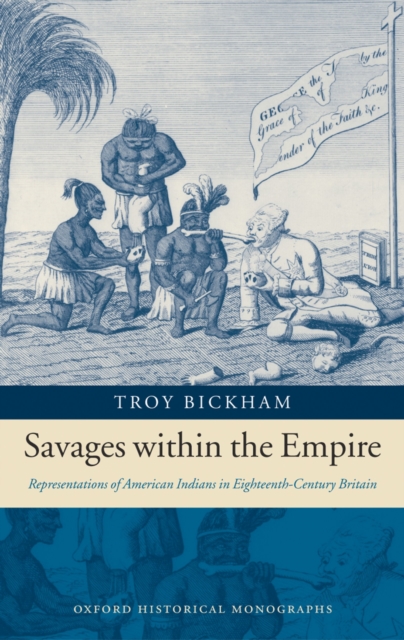
Savages within the empire : representations of American Indians in eighteenth-century Britain
In 1720s London, a well-known band of young ruffians gave themselves crescent tattoos and adorned turbans in honour of their so-called 'mohamattan [Muslim]' Indian namesakes, the Mohawk. Few Britons noticed the gang's mistaken muddling of North American and Indian subcontinent geographies and cultures. Even fewer cared in an age in which 'Indian' was a catch-all term applied to theatre characters, philosophies, and objects whose only common characteristic often was that they were not European. Yet just thirty years later, when the North American empire had entered centre stage, Londoners bought Iroquois tomahawks at auctions; provincial newspapers debated Cherokee politics; women shopkeepers read aloud newspaper accounts of frontier battles as their husbands counted the takings; church congregations listened to the sermons of American Indian converts; families toured museum exhibits of American Indian artefacts; and Oxford dons wagered their bottles of port on the outcome of American wars. Focusing on the question, 'How did the British who remained in Britain perceive American Indians, and how did these perceptions reflect and affect British culture?', Savages within the Empire explores both how Britons engaged with the peripheries of their Atlantic empire without leaving home, and, equally important, how their forged understanding significantly affected the British and their rapidly expanding world. It draws from a wide range of evidence to consider an array of eighteenth-century contexts, including material culture, print culture, imperial government policy, the Church of England's missionary endeavours, the Scottish Enlightenment, and the public outcry over the use of American Indians as allies during the American War of Independence. By chronicling and exploring discussions and representations of American Indians in these contexts, Troy Bickham reveals the proliferation of empire-related subjects in eighteenth-century British culture as well as the prevailing pragmatism with which Britons approached them.
eBook

American slaves in Victorian England : abolitionist politics in popular literature and culture
This study examines the circulation within England of the ideas of the black abolitionist campaign. It surveys the reshaping of American abolitionism by domestic Victorian debates about popular culture and the worker versus the slave.
Book

Anglicizing America
The thirteen mainland colonies of early America were arguably never more British than on the eve of their War of Independence from Britain. Though home to settlers of diverse national and cultural backgrounds, colonial America gradually became more like Britain in its political and judicial systems, material culture, economies, religious systems, and engagements with the empire. At the same time and by the same process, these politically distinct and geographically distant colonies forged a shared cultural identityone that would bind them together as a nation during the Revolution.
Anglicizing Americarevisits the theory of Anglicization, considering its application to the history of the Atlantic world, from Britain to the Caribbean to the western wildernesses, at key moments before, during, and after the American Revolution. Ten essays by senior historians trace the complex processes by which global forces, local economies, and individual motives interacted to reinforce a more centralized and unified social movement. They examine the ways English ideas about labor influenced plantation slavery, how Great Britain's imperial aspirations shaped American militarization, the influence of religious tolerance on political unity, and how Americans' relationship to Great Britain after the war impacted the early republic's naval and taxation policies. As a whole,Anglicizing Americaoffers a compelling framework for explaining the complex processes at work in the western hemisphere during the age of revolutions.
Contributors: Denver Brunsman, William Howard Carter, Ignacio Gallup-Diaz, Anthony M. Joseph, Simon P. Newman, Geoffrey Plank, Nancy L. Rhoden, Andrew Shankman, David J. Silverman, Jeremy A. Stern.
eBook

Carnegie's Model Republic
Andrew Carnegie (1835–1919) has long been known as a leading American industrialist, a man of great wealth and great philanthropy. What is not as well known is that he was actively involved in Anglo-American politics and tried to promote a closer relationship between his native Britain and the United States. To that end, Carnegie published Triumphant Democracy in 1886, in which he proposed the American federal republic as a model for solving Britain's unsettling problems. On the basis of his own experience, Carnegie argued that America was a much-improved Britain and that the British monarchy could best overcome its social and political turbulence by following the democratic American model. He expressed a growing belief that the antagonism between the two nations should be supplanted by rapprochement. A. S. Eisenstadt offers an in-depth analysis of Triumphant Democracy, illustrating its importance and illuminating the larger current of British-American politics between the American Revolution and World War I and the fascinating exchange about the virtues and defects of the two nations.
eBook