
Catalogue Search | MBRL


Are you sure you want to remove the book from the shelf?

{{itemTitle}}
8
result(s) for
"Great Britain -- Colonies -- North America -- Historiography"
Sort by:


Seasons of Misery
The stories we tell of American beginnings typically emphasize colonial triumph in the face of adversity. But the early years of English settlement in America were characterized by catastrophe: starvation, disease, extreme violence, ruinous ignorance, and serial abandonment.Seasons of Miseryoffers a provocative reexamination of the British colonies' chaotic and profoundly unstable early days, placing crisis-both experiential and existential-at the center of the story. At the outposts of a fledgling empire and disconnected from the social order of their home society, English settlers were both physically and psychologically estranged from their European identities. They could not control, or often even survive, the world they had intended to possess. According to Kathleen Donegan, it was in this cauldron of uncertainty that colonial identity was formed. Studying the English settlements at Roanoke, Jamestown, Plymouth, and Barbados, Donegan argues that catastrophe marked the threshold between an old European identity and a new colonial identity, a state of instability in which only fragments of Englishness could survive amid the upheavals of the New World. This constant state of crisis also produced the first distinctively colonial literature as settlers attempted to process events that they could neither fully absorb nor understand. Bringing a critical eye to settlers' first-person accounts, Donegan applies a unique combination of narrative history and literary analysis to trace how settlers used a language of catastrophe to describe unprecedented circumstances, witness unrecognizable selves, and report unaccountable events.Seasons of Miseryaddresses both the stories that colonists told about themselves and the stories that we have constructed in hindsight about them. In doing so, it offers a new account of the meaning of settlement history and the creation of colonial identity.
eBook


Imagining the British Atlantic after the American Revolution
Drawing on examples from different local and regional contexts,Imagining the British Atlantic after the American Revolutiondemonstrates the many remarkably local ways that revolution and empire were experienced in London, Pennsylvania, Pitcairn Island, and points in between.
eBook
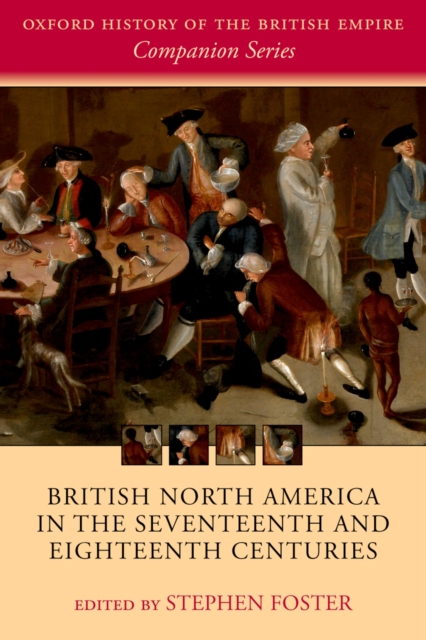
British North America in the Seventeenth and Eighteenth Centuries
Until relatively recently, the linkage between British Imperial History and the History of Early America was taken for granted. This is no longer the case. Instead, Early American historiography has suffered from a loss of coherent definition as competing manifestos demand this or that reordering of the subject to combine time periods and geographical areas in ways that would have previously seemed anomalous. Along the way, it has become a commonplace to announce that the history of America is best accounted for in America itself in a three-way melee between “settlers,” the indigenous populations, and the forcibly transported African slaves and their creole descendants. Our collection recognizes the value of the historiographic work done under this new dispensation in the last two decades or so and tries to incorporate its insights. However, we advocate a pluralistic approach to the subject generally and attempt to demonstrate that the metropolitan power was of more than secondary importance to America in the seventeenth and eighteenth centuries. Each of the contributors has been asked to address two questions: did it matter to the people who lived in the areas of Eastern North America that eventually became the United States that they were subjects of an empire and, if so, did it matter that the empire in question was British? The answer in each case is “Yes,” although not without some considerable complexity in the respective formulations. At the least, however, the combined effect is to re-validate Imperial history as one of the useful ways of describing and explaining early America.
eBook
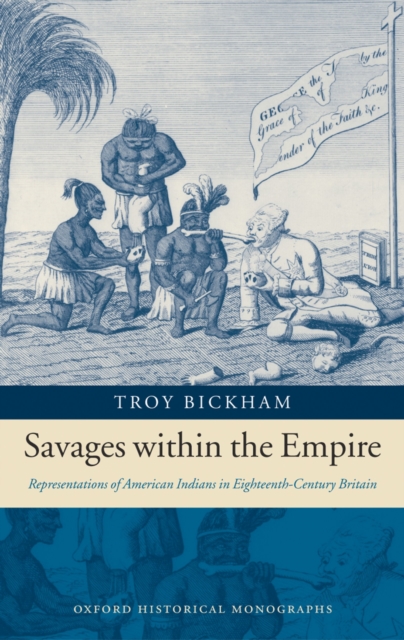
Savages within the empire : representations of American Indians in eighteenth-century Britain
In 1720s London, a well-known band of young ruffians gave themselves crescent tattoos and adorned turbans in honour of their so-called 'mohamattan [Muslim]' Indian namesakes, the Mohawk. Few Britons noticed the gang's mistaken muddling of North American and Indian subcontinent geographies and cultures. Even fewer cared in an age in which 'Indian' was a catch-all term applied to theatre characters, philosophies, and objects whose only common characteristic often was that they were not European. Yet just thirty years later, when the North American empire had entered centre stage, Londoners bought Iroquois tomahawks at auctions; provincial newspapers debated Cherokee politics; women shopkeepers read aloud newspaper accounts of frontier battles as their husbands counted the takings; church congregations listened to the sermons of American Indian converts; families toured museum exhibits of American Indian artefacts; and Oxford dons wagered their bottles of port on the outcome of American wars. Focusing on the question, 'How did the British who remained in Britain perceive American Indians, and how did these perceptions reflect and affect British culture?', Savages within the Empire explores both how Britons engaged with the peripheries of their Atlantic empire without leaving home, and, equally important, how their forged understanding significantly affected the British and their rapidly expanding world. It draws from a wide range of evidence to consider an array of eighteenth-century contexts, including material culture, print culture, imperial government policy, the Church of England's missionary endeavours, the Scottish Enlightenment, and the public outcry over the use of American Indians as allies during the American War of Independence. By chronicling and exploring discussions and representations of American Indians in these contexts, Troy Bickham reveals the proliferation of empire-related subjects in eighteenth-century British culture as well as the prevailing pragmatism with which Britons approached them.
eBook
Colonial Writing and the New World, 1583–1671
Most scholars of Anglo-American colonial history have treated colonialism either as an exclusively American phenomenon or, conversely, as a European one. Colonial Writing and the New World 1583–1671 argues for a reading of the colonial period that attempts to render an account of both the European origins of colonial expansion and its specifically American consequences. The author offers an account of the simultaneous emergence of colonialism and nationalism during the early modern period, and of the role that English interactions with native populations played in attempts to articulate a coherent English identity. He draws on a wide variety of texts ranging from travel narratives and accounts of the colony in Virginia to sermons, conversion tracts and writings about the Algonquin language.
eBook
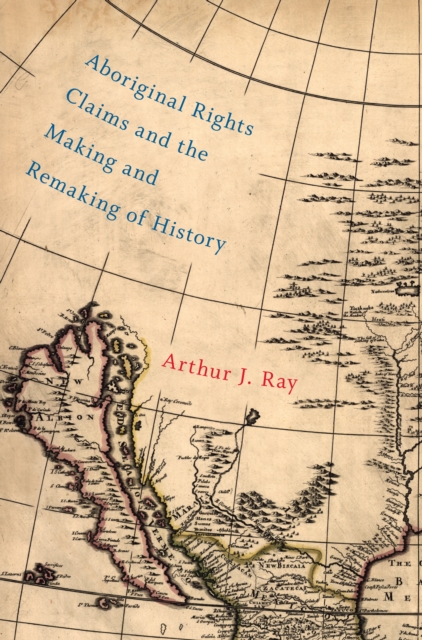
Aboriginal rights claims and the making and remaking of history
Forums such as commissions, courtroom trials, and tribunals that have been established through the second half of the twentieth century to address aboriginal land claims have consequently created a particular way of presenting aboriginal, colonial, and national histories. The history that emerges from these land-claims processes is often criticized for being \"presentist\" - inaccurately interpreting historical actions and actors through the lens of present-day values, practices, and concerns. In Aboriginal Rights Claims and the Making and Remaking of History, Arthur Ray examines how claims-oriented research is often fitted to the existing frames of indigenous rights law and claims legislation and, as a result, has influenced the development of these laws and legislation. Through a comparative study encompassing the United States, Canada, South Africa, Australia and New Zealand, Ray also explores the ways in which various procedures and settings for claims adjudication have influenced and changed the use of historical evidence, made space for indigenous voices, stimulated scholarly debates about the cultural and historical experiences of indigenous peoples at the time of initial European contact and afterward, and have provoked reactions from politicians and scholars. While giving serious consideration to the flaws and strengths of presentist histories, Aboriginal Rights Claims and the Making and Remaking of History provides communities with essential information on how history is used and how methods are adapted and changed.
eBook