
Catalogue Search | MBRL


Are you sure you want to remove the book from the shelf?

{{itemTitle}}
2,137
result(s) for
"Great Britain -- Foreign relations -- United States"
Sort by:

The lion and the eagle : the interaction of the British and American empires 1783-1972
\"Throughout modern history, British and American rivalry has gone hand in hand with common interests. In this book Kathleen Burk brilliantly examines the different kinds of power the two empires have projected, and the means they have used to do it. What the two empires have shared is a mixture of pragmatism, ruthless commercial drive, a self-righteous foreign policy and plenty of naked aggression. These have been aimed against each other more than once; yet their underlying alliance against common enemies has been historically unique and a defining force throughout the twentieth century.0This is a global and epic history of the rise and fall of empires. It ranges from America's futile attempts to conquer Canada to her success in opening up Japan but rapid loss of leadership to Britain; from Britain's success in forcing open China to her loss of the Middle East to the US; and from the American conquest of the Philippines to her destruction of the British Empire. The Pax Americana replaced the Pax Britannica, but now the American world order is fading, threatening Britain's belief in her own world role.0 In our uncertain times, this is the history we need: authoritative, measured and compelling.\"--Jacket flap.
Book

Blue and Gray Diplomacy
In this examination of Union and Confederate foreign relations
during the Civil War from both European and American perspectives,
Howard Jones demonstrates that the consequences of the conflict
between North and South reached far beyond American soil. Jones
explores a number of themes, including the international economic
and political dimensions of the war, the North's attempts to block
the South from winning foreign recognition as a nation, Napoleon
III's meddling in the war and his attempt to restore French power
in the New World, and the inability of Europeans to understand the
interrelated nature of slavery and union, resulting in their
tendency to interpret the war as a senseless struggle between a
South too large and populous to have its independence denied and a
North too obstinate to give up on the preservation of the Union.
Most of all, Jones explores the horrible nature of a war that
attracted outside involvement as much as it repelled it. Written in
a narrative style that relates the story as its participants saw it
play out around them, Blue and Gray Diplomacy depicts the
complex set of problems faced by policy makers from Richmond and
Washington to London, Paris, and St. Petersburg.
eBook


The Liberty to Take Fish
In The Liberty to Take Fish, Thomas Blake Earle offers
an incisive and nuanced history of the long American Revolution,
describing how aspirations to political freedom coupled with the
economic imperatives of commercial fishing roiled relations between
the young United States and powerful Great Britain.
The American Revolution left the United States with the \"liberty
to take fish\" from the waters of the North Atlantic. Indispensable
to the economic health of the new nation, the cod fisheries of the
Grand Banks, the Bay of Fundy, and the Gulf of St. Lawrence quickly
became symbols of American independence in an Atlantic world
dominated by Great Britain.
The fisheries issue was a near-constant concern in American
statecraft that impinged upon everything, from Anglo-American
relations, to the operation of American federalism, and even to the
nature of the marine environment. Earle explores the relationship
between the fisheries and the state through the Civil War era when
closer ties between the United States and Great Britain finally
surpassed the contentious interests of the fishing industry on the
nation's agenda.
The Liberty to Take Fish is a rich story that moves
from the staterooms of Washington and London to the decks of
fishing schooners and into the Atlantic itself to understand how
ordinary fishermen and the fish they pursued shaped and were, in
turn, shaped by those far-off political and economic forces. Earle
returns fishing to its once-central place in American history and
shows that the nation of the nineteenth century was indeed a
maritime one.
eBook


Anglo-American Relations
This book provides an examination of contemporary Anglo-American relations. Sometimes controversially referred to as the Special Relationship, Anglo-American relations constitute arguably the most important bilateral relationship of modern times. However, in recent years, there have been frequent pronouncements that this relationship has lost its 'specialness'.
This volume brings together experts from Britain, Europe and North America in a long-overdue examination of contemporary Anglo-American relations that paints a somewhat different picture. The discussion ranges widely, from an analysis of the special relationship of culture and friendship, to an examination of both traditional (e.g. nuclear relations) and more recent (e.g. environment) policies. Contemporary developments are discussed in the context of longer-term trends and contributing authors draw upon a range of different disciplines, including political science, diplomacy studies, business studies and economics. Coupled with a substantive introduction and conclusion, the result is an insightful and engaging portrayal of the complex Anglo-American relationship.
The book will be of great interest to students of US and UK foreign policy, diplomacy and international relations in general.
eBook

Lords of the desert : the battle between the United States and Great Britain for supremacy in the modern Middle East
\"Using newly declassified records and long-forgotten memoirs, including the diaries of a key British spy, James Barr tears up the conventional interpretation of this era in the Middle East, vividly portraying the tensions between London and Washington, and shedding an uncompromising light on the murkier activities of a generation of American and British diehards in the region, from the battle of El Alamein in 1942 to Britain's abandonment of Aden in 1967. Reminding us that the Middle East has always served as the arena for great power conflict, this is the tale of an internecine struggle in which Britain would discover that her most formidable rival was the ally she had assumed would be her closest friend.\" -- provided by publisher
Book

Allies at odds
Allies at Odds examines America's Vietnam policy from 1961 to 1968 in an international context by focusing on the United States' relationship with its European partners France, West Germany, and Great Britain. The European response to America's Vietnam policy provides a framework to assess this important chapter in recent American history within the wider perspective of international relations. Equally significant, the respective approaches to the \"Vietnam question\" by the Europeans and Americans reveal the ongoing challenge for nation-states of transcending narrowly defined state-centered policies for a global perspective pursuant of common goals among the trans-Atlantic allies. Blang explores the failure of France, West Germany, and Great Britain to significantly influence American policy-making.
eBook

Safe passage : the transition from British to American hegemony
History records only one peaceful transition of hegemonic power: the passage from British to American dominance of the international order. What made that transition uniquely cooperative and nonviolent? Does it offer lessons to guide policy as the United States faces its own challengers to the order it has enforced since the 1940s? To answer these questions, Kori Schake explores nine points of crisis or tension between Britain and the United States, from the Monroe Doctrine in 1823 to the establishment of the unequal \"special relationship\" during World War II. Over this period, Safe Passage shows, the United States gradually changed the rules that Britain had established at its imperial height. It was able to do so peacefully because, during the crucial years, Britain and the United States came to look alike to each other and different from other nations. Britain followed America's lead in becoming more democratic, while the United States, because of its conquest of the American West, developed an imperial cast of mind. Until the end of World War II, both countries paid more attention to their cumulative power relative to other states in the order than to their individual power relative to each other. The factors that made the Anglo-American transition peaceful, notably the convergence in their domestic ideologies, are unlikely to apply in future transitions, Schake concludes. We are much more likely to see high-stake standoffs among competing powers attempting to shape the international order to reflect the starkly different ideologies that prevail at home.-- Provided by publisher
Book
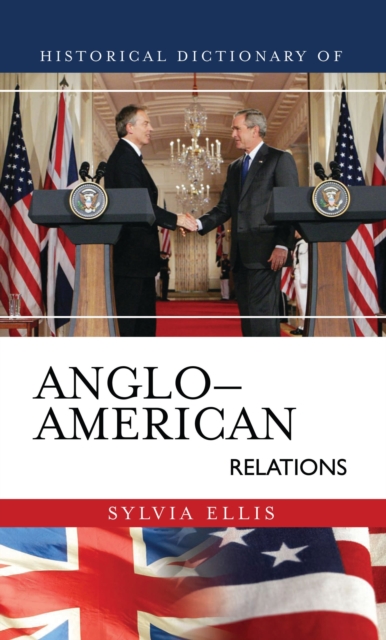
Historical dictionary of Anglo-American relations
Anglo-American relations have been a crucial factor in international relations for over two centuries. For most of that time dealings between Britain and the United States have remained co-operative, cordial, and supportive. In the beginning, however, relations were confrontational and discordant: the two nations waged war against each other twice—in the War of Independence and in the War of 1812—and have often disagreed over trade, finance, and foreign policy. This volume demonstrates the changing nature of Anglo-American relations and focuses, in particular, on the strengths and fragilities of the \"special relationship\" that developed in the aftermath of the WWII and continues to the present day. The Historical Dictionary of Anglo-American Relations surveys Anglo-American relations from 1607 to the present and covers key events, individuals, and issues that have played a part in its history. Through a chronology, an introductory essay, a bibliography, appendixes, and hundreds of cross-referenced entries—with an emphasis on the political and economic relationship between Britain and the United States but also featuring the cultural links between the two—this comprehensive and easily accessible reference tool will delight those interested in the history of these two countries.
eBook