
Catalogue Search | MBRL


Are you sure you want to remove the book from the shelf?

{{itemTitle}}
108
result(s) for
"Great Britain -- Social conditions -- 18th century"
Sort by:

Making an industrial revolution : skill, knowledge, community and innovation
'Making an Industrial Revolution' presents a fresh perspective on British industrialization. Advances in technology, commerce and science played their part, but - as this book argues - above all it was communities of shared skill, knowledge and experience which drove industrial innovation in the eighteenth century. Connections and relationships in key sectors - iron, textiles and engineering - produced transformative forces that revolutionized industrial life in Britain. Including new insights into Scotland's unique contribution, the book explores industrial change across the country, highlighting the significance of inter-regional and overseas migration and connection.
BOOK

Luxury and Pleasure in Eighteenth-Century Britain
This book explores the invention, making, and buying of new, semi-luxury, and fashionable consumer goods during the 18th century. It follows these goods, from china tea ware to all sorts of metal ornaments such as candlesticks, cutlery, buckles, and buttons, as they were made and shopped for, then displayed in the private domestic settings of Britain's urban middling classes. It tells the stories and analyses the developments that led from a global trade in Eastern luxuries beginning in the sixteenth century to the new global trade in British-made consumer goods by the end of the 18th century. These new products, regarded as luxuries by the rapidly growing urban and middling-class people of the 18th century, played an important part in helping to proclaim personal identities and guide social interaction. Customers enjoyed shopping for them; they took pleasure in their beauty, ingenuity or convenience. All manner of new products appeared in shop windows; sophisticated mixed-media advertising seduced customers and created new desires. This unparalleled ‘product revolution’ provoked philosophers and pundits to proclaim a ‘new luxury’, one that reached out to the middling and trading classes, unlike the elite and corrupt luxury of old. This book is built on a fresh empirical base drawn directly from customs accounts, advertising material, company papers, and contemporary correspondence. The book traces how this new consumer society of the 18th century and the products first traded, then invented to satisfy it, stimulated industrialisation itself.
eBook

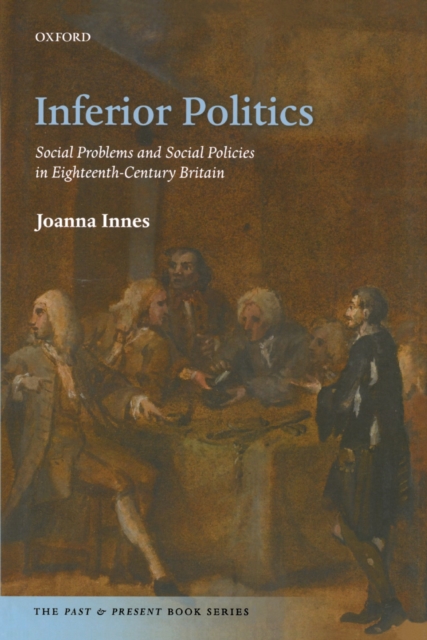
Inferior politics : social problems and social policies in eighteenth-century Britain
This book explores how social policy was created in Britain in a period when central government was not active in making it. Parliament proved capable of generating national legislation nonetheless — and provided a forum for debate even when it was impossible to mobilise consensus behind any particular plan. In this setting, there was a lively, and surprisingly inclusive, ‘politics’ of social policy-making, in which ‘inferior’ officers of government (what we might call ‘local authorities’) figured prominently. The book explores the institutional structures which shaped these debates and their outcomes, and supplies several case studies of policy-making: one focussing on some of the less well-known activities of William Wilberforce, as he attempted to promote a national ‘reformation of manners’; others featuring such apparently marginal figures as imprisoned debtors and a lowly (and bigoted) London constable. A central chapter explores the history of social and economic empirical enquiry from the invention of ‘political arithmetic’ in the later 17th century through to the first census of 1801, detailing similar interaction between government and private enthusiasts.
eBook

Heroes of invention : technology, liberalism and British identity, 1750-1914
This is an innovative study of why inventors rose to heroic stature and popular acclaim in Victorian Britain.
Book

The Archaeology of Improvement in Britain, 1750–1850
In this innovative 2007 study, Sarah Tarlow shows how the archaeology of this period manifests a widespread and cross-cutting ethic of improvement. Theoretically informed and drawn from primary and secondary sources in a range of disciplines, the author considers agriculture and the rural environment, towns, and buildings such as working-class housing and institutions of reform. From bleach baths to window glass, rubbish pits to tea wares, the material culture of the period reflects a particular set of values and aspirations. Tarlow examines the philosophical and historical background to the notion of improvement and demonstrates how this concept is a useful lens through which to examine the material culture of later historical Britain.
eBook


Politics of hunger
The 1840s witnessed widespread hunger and malnutrition at home and mass starvation in Ireland. And yet the aptly named ‘Hungry 40s’ came amidst claims that, notwithstanding Malthusian prophecies, absolute biological want had been eliminated in England. The eighteenth and early nineteenth centuries were supposedly the period in which the threat of famine lifted for the peoples of England. But hunger remained, in the words of Marx, an ‘unremitted pressure’. The politics of hunger offers the first systematic analysis of the ways in which hunger continued to be experienced and feared, both as a lived and constant spectral presence. It also examines how hunger was increasingly used as a disciplining device in new modes of governing the population. Drawing upon a rich archive, this innovative and conceptually-sophisticated study throws new light on how hunger persisted as a political and biological force.
eBook


Riotous assemblies : popular protest in Hanoverian England
This book examines 18th- and early 19th-century England through the lens of popular disorder. The more closely-studied forms of protest are discussed, such as food riots, industrial disorders, and political disturbances, along with much less well understood occasions of popular disorder including tax riots, turnpike riots, riots against the establishment of the militia, and religious riots. This book re-engages the study of riot within a wider interpretation of the forces—social, economic, and political—which were transforming society. Special emphasis is given on disturbances in the years between 1795 and 1812, such as how far they indicated the major discontinuities discerned by earlier histories of protest, or whether they retained much of the character of earlier upheaval. Based on detailed case studies and the most recent research, the book extends the focus of earlier studies of protest. It locates the origins of disorder within the concepts of constitutionalism and the free-born Englishman, and argues that older attitudes proved far more tenacious than many have allowed.
eBook