
Catalogue Search | MBRL


Are you sure you want to remove the book from the shelf?

{{itemTitle}}
190
result(s) for
"Great Britain Colonies India."
Sort by:


Selling Empire
Linking four continents over three centuries,Selling Empiredemonstrates the centrality of India--both as an idea and a place--to the making of a global British imperial system. In the seventeenth century, Britain was economically, politically, and militarily weaker than India, but Britons increasingly made use of India's strengths to build their own empire in both America and Asia. Early English colonial promoters first envisioned America as a potential India, hoping that the nascent Atlantic colonies could produce Asian raw materials. When this vision failed to materialize, Britain's circulation of Indian manufactured goods--from umbrellas to cottons--to Africa, Europe, and America then established an empire of goods and the supposed good of empire.Eacott recasts the British empire's chronology and geography by situating the development of consumer culture, the American Revolution, and British industrialization in the commercial intersections linking the Atlantic and Indian Oceans. From the seventeenth into the nineteenth century and beyond, the evolving networks, ideas, and fashions that bound India, Britain, and America shaped persisting global structures of economic and cultural interdependence.
eBook


Dowry murder : the imperial origins of a cultural crime
The Hindu custom of dowry has long been blamed for the murder of wives and female infants in India. In this highly provocative book, Veena Oldenburg argues that these killings are neither about dowry nor reflective of an Indian culture or caste system that encourages violence against women. Rather, such killings can be traced directly to the influences of the British colonial era. In the precolonial period, dowry was an institution managed by women, for women, to enable them to establish their status and have recourse in an emergency. As a consequence of the massive economic and societal upheaval brought on by British rule, women's entitlements to the precious resources obtained from land were erased and their control of the system diminished, ultimately resulting in a devaluing of their very lives. Taking us on a journey into the colonial Punjab, Veena Oldenburg skillfully follows the paper trail left by British bureaucrats to indict them for interpreting these crimes against women as the inherent defects of Hindu caste culture. The British, Oldenburg claims, publicized their \"civilizing mission\" and blamed the caste system in order to cover up the devastation their own agrarian policies had wrought on the Indian countryside. A forceful demystification of contemporary bride burning concludes this remarkably original book. Deploying her own experiences and memories and her research at a women's shelter with \"dowry cases\" for almost a year in the mid-eighties, the author looks at the contemporary violence against wives and daughters-in-law in modern India. Oldenburg seamlessly weaves the contemporary with the historical, the personal with the political, and strips the layers of exoticism off an ancient practice to show how an invaluable safety net was twisted into a deadly noose. She brings us startlingly close to the worsening treatment of modern
Indian women as she challenges us to rethink basic assumptions about womens human and economic rights. Combining rigorous research with impassioned analysis and a nuanced treatment of a complex, deeply controversial subject, this book critiques colonialism while holding a mirror to gender discrimination in modern India.
eBook

Memory, identity and the colonial encounter in India : essays in honour of Peter Robb
\"This book sheds new light on the dynamics of the colonial encounter between Britain and India. It highlights how various analytical approaches to this encounter can be creatively mobilised to re-think entanglements of memory and identity emerging from British rule in the subcontinent. The volume re-evaluates central, long-standing debates about the historical impact of the British Raj by deviating from hegemonic and top-down civilizational perspectives. It focuses on interactions, relations and underlying meanings of the colonial experience. The narratives of memory, identity, and the legacy of the colonial encounter are woven together in a diverse range of essays on subjects such as colonial and nationalist memorials; British, Eurasian, Dalit and Adivasi identities; regional political configurations; and state initiatives and patterns of control. By drawing on empirically rich, regional and chronological historical studies, this book will be essential reading for students and researchers of history, political science, colonial studies, cultural studies and South Asian studies.\"--Provided by publisher.
Book


Ascent and decline of native and colonial trading : tale of four Indian cities
\"Ascent and Decline of Native and Colonial Trading: Tale of Four Indian Cities presents a vivid picture of how the British political regime reorganized the structure of the Indian economy to suit its own objectives. While doing so, the regime also affected the geographical distribution of economic activities. This resulted in the decline of native cities and prosperity of colonial cities. To reveal how the British colonial power brought about such changes in the Indian subcontinent, the book narrates the account of two pairs of native and colonial cities--Dacca and Calcutta from the eastern coast; and Surat and Bombay from the western coast. These were major centres of manufacturing, shared a common history and experienced the consequences of three different political dispensations--the Mughal Empire, the East India Company and the British Raj. It describes in detail how mutually beneficial relationships and interregional variations between these cities developed because of colonial restructuring. Due to its extensive coverage and analysis of the underlying phenomena, this book will prove indispensable for developing a deep understanding of Indian colonial and economic history.\"--Provided by publisher.
Book

Sovereignty and Social Reform in India
The British prohibition of sati (the funeral practice of widow immolation) in 1829 has been considered an archetypal example of colonial social reform. It was not the end of the story, however, as between 1830 and 1860, British East India Company officials engaged in a debate with the Indian rulers of the Rajput and Maratha princely states of North West India about the pro- hibition and suppression of sati in their territories. This book examines the debates that brought about legislation in these areas, arguing that they were instrumental in setting the terms of post-colonial debates about sati and, more generally, in defining the parameters of British involvement in Indian social and religious issues.
This book provides a reinterpretation of the major themes of sovereignty, authority and social reform in colonial South Asian history by examining the shifting pragmatic, political, moral and ideological forces which underpinned British policies on and attitudes to sati. The author illuminates the complex ways in which East India Company officials negotiated the limits of their own authority in India, their conceptions of the nature and extent of Indian princely sovereignty, and argues that the so-called ‘civilising mission’ was often dependent on local circumstances and political expediencies rather than overarching imperial principles; the book also evaluates Indian responses to the supposed modernising Enlightenment discourse.
This book will be of great interest to students and scholars of South Asian history as well as British colonial studies.
eBook

Irish imperial networks
\"This is an innovative study of the role of Ireland and the Irish in the British Empire which examines the intellectual, cultural and political interconnections between nineteenth-century British imperial, Irish and Indian history. Barry Crosbie argues that Ireland was a crucial sub-imperial centre for the British Empire in South Asia that provided a significant amount of the manpower, intellectual and financial capital that fuelled Britain's drive into Asia from the 1750s onwards. He shows the important role that Ireland played as a centre for recruitment for the armed forces, the medical and civil services and the many missionary and scientific bodies established in South Asia during the colonial period. In doing so, the book also reveals the important part that the Empire played in shaping Ireland's domestic institutions, family life and identity in equally significant ways\"-- Provided by publisher.
Book
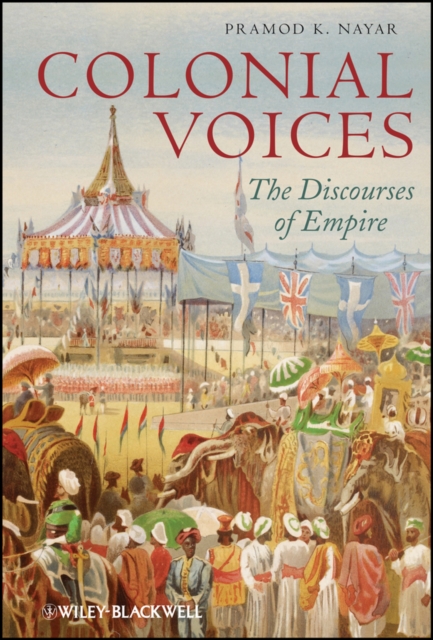
Colonial voices
This accessible cultural history explores 400 years of British imperial adventure in India, developing a coherent narrative through a wide range of colonial documents, from exhibition catalogues to memoirs and travelogues.
eBook