
Catalogue Search | MBRL


Are you sure you want to remove the book from the shelf?

{{itemTitle}}
39
result(s) for
"Great Britain Colonies Intellectual life."
Sort by:


Britain and its empire in the shadow of Rome : the reception of Rome in socio-political debate from the 1850s to the 1920s
Drawing on new primary source evidence, this volume evaluates ancient Rome's influence on an English intellectual tradition from the 1850s to the 1920s as politicians, scientists, economists and social reformers addressed three fundamental debates of the period - Empire, Nation and City.These debates emerged as a result of political, economic and.
eBook

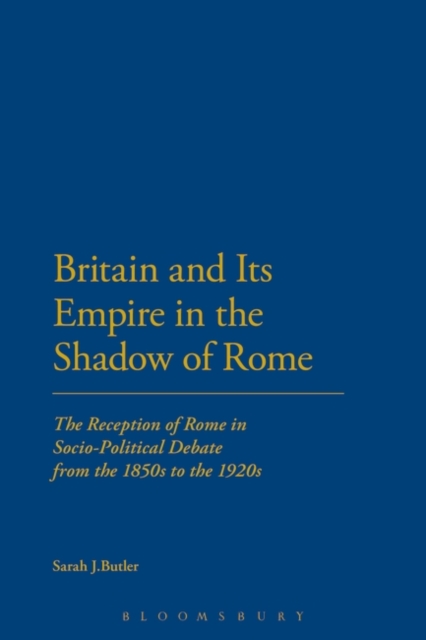
Britain and its empire in the shadow of Rome : the reception of Rome in socio-political debate, 1850-1920
Drawing on new primary source evidence, this volume evaluates ancient Rome's influence on an English intellectual tradition from the 1850s to the 1920s as politicians, scientists, economists and social reformers addressed three fundamental debates of the period - Empire, Nation and City.These debates emerged as a result of political, economic and social change both in the Empire and Britain, and coalesced around issues of degeneracy, morality and community. As ideas of political freedom were subsumed by ideas of civilization, best preserved by technocratic governance, the political and historical focus on Republican Rome was gradually displaced by interest in the Imperial period of the Roman emperors. Moreover, as the spectre of the British Empire and Nation in decline increased towards the turn of the nineteenth century, the reception of Imperial Rome itself was transformed. By the 1920s, following the end of World War I, Imperial Rome was conjured into a new framework echoing that of the British Empire and appealing to the surging nationalistic mood.
eBook

Empire and science in the making : Dutch colonial scholarship in comparative global perspective, 1760-1830
Drawing on extensive new research, and bringing much new scholarship before English readers for the first time, this wide-ranging volume examines how knowledge was created and circulated throughout the Dutch Empire, and how these processes compared with those of the Imperial Britain, Spain, and Russia.
eBook


American Curiosity
Colonial America presented a new world of natural curiosities for
settlers as well as the London-based scientific community. In
American Curiosity , Susan Scott Parrish examines how
various peoples in the British colonies understood and represented
the natural world around them from the late sixteenth century
through the eighteenth. Parrish shows how scientific knowledge
about America, rather than flowing strictly from metropole to
colony, emerged from a horizontal exchange of information across
the Atlantic. Delving into an understudied archive of letters,
Parrish uncovers early descriptions of American natural phenomena
as well as clues to how people in the colonies construed their own
identities through the natural world. Although hierarchies of
gender, class, institutional learning, place of birth or residence,
and race persisted within the natural history community, the
contributions of any participant were considered valuable as long
as they supplied novel data or specimens from the American side of
the Atlantic. Thus Anglo-American nonelites, women, Indians, and
enslaved Africans all played crucial roles in gathering and
relaying new information to Europe. Recognizing a significant
tradition of nature writing and representation in North America
well before the Transcendentalists, American Curiosity
also enlarges our notions of the scientific Enlightenment by
looking beyond European centers to find a socially inclusive
American base to a true transatlantic expansion of knowledge.
eBook


Humanism and America
Humanism and America provides a major study of the impact of the Renaissance and Renaissance humanism upon the English colonization of America. The analysis is conducted through an interdisciplinary examination of a broad spectrum of writings on colonization, ranging from the works of Thomas More to those of the Virginia Company. Andrew Fitzmaurice shows that English expansion was profoundly neo-classical in inspiration, and he excavates the distinctively humanist tradition that informed some central issues of colonization: the motivations of wealth and profit, honour and glory; the nature of and possibilities for liberty; and the problems of just title, including the dispossession of native Americans. Dr Fitzmaurice presents a colonial tradition which, counter to received wisdom, is often hostile to profit, nervous of dispossession and desirous of liberty. Only in the final chapters does he chart the rise of an aggressive, acquisitive and possessive colonial ideology.
eBook