
Catalogue Search | MBRL


Are you sure you want to remove the book from the shelf?

{{itemTitle}}
1,582
result(s) for
"Great Britain Economic conditions."
Sort by:


Managing the Economy, Managing the People
The volume provides a distinctive new account of British economic life since the Second World War, focusing upon the ways in which successive governments, in seeking to manage the economy, have sought simultaneously to ‘manage the people’: to try and manage popular understanding of economic issues. In doing so, governments have sought not only to shape expectations for electoral purposes but to construct broader narratives about how ‘the economy’ should be understood. The starting point is to ask what goals have been focused upon; how these have been constructed to appeal to the population; and how far the population has accepted these narratives. In its first part, the volume analyses the development of the major narratives from the 1940s onwards. This part covers the notion of ‘austerity’ and its particular meaning in the 1940s; the rise of a narrative of ‘economic decline’ from the late 1950s, and the subsequent attempts to ‘modernize’ the economy; the attempts to ‘roll back the state’ from the 1970s; the impact of ideas of ‘globalization’ in the 1980s and 1990s; and, finally, the way the crisis of 2008/9 onwards was constructed as a problem of ‘debts and deficits’. The second part of the volume then focuses in on four key issues in attempts to ‘manage the people’: productivity, the balance of payments, inflation, and unemployment. It shows how in each case governments have sought to get the populace to understand these issues in a particular light, and have shaped strategies to that end.
eBook

The industrial revolution : the state, knowledge and global trade
\"The British Industrial Revolution has long been seen as the spark for modern, global industrialization and sustained economic growth. Indeed the origins of economic history, as a discipline, lie in 19th-century European and North American attempts to understand the foundation of this process. In this book, William J. Ashworth questions some of the orthodoxies concerning the history of the industrial revolution and offers a deep and detailed reassessment of the subject that focuses on the State and its role in the development of key British manufactures. In particular, he explores the role of State regulation and protectionism in nurturing Britain's negligible early manufacturing base. Taking a long view, from the mid 17th century through to the 19th century, the analysis weaves together a vast range of factors to provide one of the fullest analyses of the industrial revolution, and one that places it firmly within a global context, showing that the Industrial Revolution was merely a short moment within a much larger and longer global trajectory. This book is an important intervention in the debates surrounding modern industrial history will be essential reading for anyone interested in global and comparative economic history and the history of globalization.\"--Cover page 4
Book
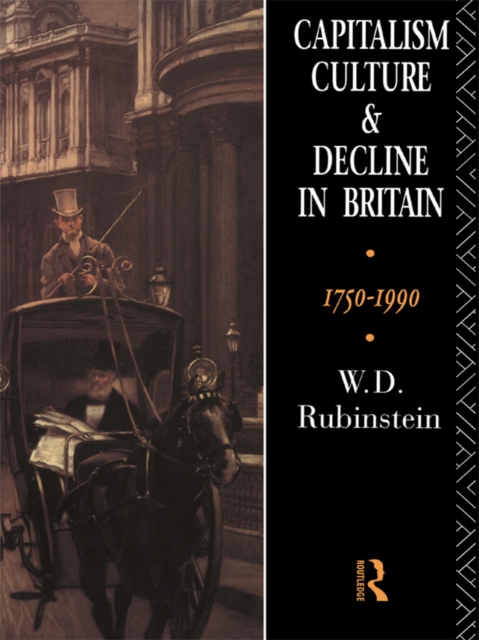
Capitalism, culture, and decline in Britain, 1750-1990
This is an original and controversial contribution to the topical debate on Britain's alleged economic decline. Rubinstein presents a critique of the thesis, made familiar by Wiener, Sampson, Barnett and others, that Britain has failed in economic terms because of its anti-industrial and pre-modern cultural values and class system. He argues that Britain was never an industrial economy, rather a commercial and financial one whose comparative advantage always lay in that area. He examines Britain's cultural values, class system and elite structure to demonstrate that these were unusually rational and modern by comparison with the more newly industrialised powers, and that features of the class system, such as the public schools, were actually instrumental in enhancing this competitive advantage. Emphasising the importance of the City of London and addressing socialism, Keynsianism and Thatcherism, Rubinstein provides an energetic and challenging contribution to this debate.
eBook


Industrialisation and Society
Indusrialisation and Society provides an essential introduction to the effects of industrialisation on British society, from Queen Victoria's reign to the birth of the welfare state in the 1940s.This book deals with the remarkable social consequences of the industrial revolution, as Britain changed into an urban society based on industry. As the first nation to undergo an industrial revolution, Britain was also the first to deal with the unprecedented social problems of rapid urbanisation combined with an unparalleled growth in population.Industrialisation and Society looks at contemporary ways in which the government and ordinary people tried to cope with these new pressures, and studies their reactions to the unforseen consequences of the steam revolution. In particular, this indispensable book considers:* the Victorian inheritance* Edwardian England and the Liberal reforms* the two world wars* the Welfare State.
eBook


The labour market in winter : the state of working Britain
This book provides an overview of the key issues concerning the performance of the labour market, and the policy issues surrounding it, with a focus on the recent recession and its aftermath. The book contains assessments of the effects of many policies introduced over the last ten years in employment, education, and welfare. The result is a comprehensive analysis of the economic downturn and the Labour government's record in the field of employment, spanning its time in office.
eBook


The Memoirs of Walter Bagehot
Walter Bagehot (1826-1877) was a prominent English journalist, banker, and man of letters. For many years he was editor ofThe Economist, and to this day the magazine includes a weekly \"Bagehot\" column. His analyses of politics, economics, and public affairs were nothing short of brilliant. Sadly, he left no memoir.
How, then, does this book bear the title,The Memoirs of Walter Bagehot? Frank Prochaska explains, \"Given my longstanding interest in Bagehot's life and times, I decided to compose a memoir on his behalf.\" And so, in this imaginative reconstruction of the memoir Bagehot might have written, Prochaska assumes his subject's voice, draws on his extensive writings (Bagehot'sCollected Worksfill 15 volumes), and scrupulously avoids what Bagehot considered that most unpardonable of faults-dullness.
A faux autobiography allows for considerable license, but Prochaska remains true to Bagehot's character and is accurate in his depiction of the times. The memoir immerses us in the spirit of the Victorian era and makes us wish to have known Walter Bagehot. He is, Prochaska observes, the Victorian with whom we would most want to have dinner.
eBook