
Catalogue Search | MBRL


Are you sure you want to remove the book from the shelf?

{{itemTitle}}
962
result(s) for
"Great Britain Influence."
Sort by:


Governors, Politics and the Colonial Office
This book explores the making of public policy for Hong Kong between 1918 and 1958. During much of this period, the Hong Kong government had limited policymaking capabilities. Many new policies followed initiatives either from the Colonial Office or from politicians in Hong Kong. This book examines the balance of political power influencing how such decisions were reached and who wielded the most influence—the Hong Kong or British governments or the politicians. Gradually, the Hong Kong government, through implementing new policies, improved its own policy-making capabilities and gained the ability to exercise greater autonomy.
eBook

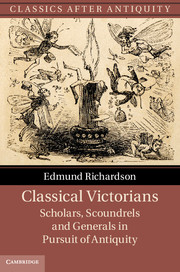
Classical Victorians
Victorian Britain set out to make the ancient world its own. This is the story of how it failed. It is the story of the headmaster who bludgeoned his wife to death, then calmly sat down to his Latin. It is the story of the embittered classical prodigy who turned to gin and opium – and the virtuoso forger who fooled the greatest scholars of the age. It is a history of hope: a general who longed to be an Homeric hero, a bankrupt poet who longed to start a revolution. Victorian classicism was defined by hope – but shaped by uncertainty. Packed with forgotten characters and texts, with the roar of the burlesque-stage and the mud of the battlefield, this book offers a rich insight into nineteenth-century culture and society. It explores just how difficult it is to stake a claim on the past.
eBook


Veteran MPs and Conservative Politics in the Aftermath of the Great War
Between 1918 and 1939, 448 men who performed uniformed service in the First World War became Conservative MPs. This relatively high-profile cohort have been under-explored as a distinct body, yet a study of their experiences of the war and the ways in which they - and the Conservative Party - represented those experiences to the voting public reveals much about the political culture of Interwar Britain and the use of the Great War as political capital. Radicalised ex-servicemen have, thus far, been considered a rather continental phenomenon historiographically. And whilst attitudes to Hitler and Mussolini form part of this analysis, the study also explores why there were fewer such types in Britain. The Conservative Party, it will be shown, played a crucial part in such a process - with British politics serving as a contested space for survivors' interpretations of what the war should mean.
eBook

Making Thatcher's Britain
\"Margaret Thatcher was one of the most controversial figures of modern times. Her governments inspired hatred and veneration in equal measure and her legacy remains fiercely contested. Yet assessments of the Thatcher era are often divorced from any larger historical perspective. This book draws together leading historians to locate Thatcher and Thatcherism within the political, social, cultural and economic history of modern Britain. It explores the social and economic crises of the 1970s; Britain's relationships with Europe, the Commonwealth and the United States; and the different experiences of Thatcherism in Scotland, Wales and Northern Ireland. The book assesses the impact of the Thatcher era on class and gender and situates Thatcherism within the Cold War, the end of Empire and the rise of an Anglo-American 'New Right'. Drawing on the latest available sources, it opens a wide-ranging debate about the Thatcher era and its place in modern British history\"-- Provided by publisher.
BOOK

Britain and World War One
The First World War appears as a fault line in Britain's twentieth-century history. Between August 1914 and November 1918 the titanic struggle against Imperial Germany and her allies consumed more people, more money and more resources than any other conflict that Britain had hitherto experienced. For the first time, it opened up a Home Front that stretched into all parts of the British polity, society and culture, touching the lives of every citizen regardless of age, gender and class: vegetables were even grown in the gardens of Buckingham Palace. Britain and World War One throws attention on these civilians who fought the war on the Home Front. Harnessing recent scholarship, and drawing on original documents, oral testimony and historical texts, this book casts a fresh look over different aspects of British society during the four long years of war. It revisits the early war enthusiasm and the making of Kitchener's new armies; the emotive debates over conscription; the relationships between politics, government and popular opinion; women working in wartime industries; the popular experience of war and the question of social change. This book also explores areas of wartime Britain overlooked by recent histories, including the impact of the war on rural society; the mobilization of industry and the importance of technology; responses to air raids and food and housing shortages; and the challenges to traditional social and sexual mores and wartime culture. Britain and World War One is essential reading for all students and interested lay readers of the First World War.
eBook


Traces of Another Time
Is the historical novel the outmoded genre that some people imagine--form inseparable from romanticism, nationalism, and the nineteenth century? In this stimulating volume, Margaret Scanlan answers a convincing \"no,\" as she demonstrates the relevance of historical novels by well-known figures such as Anthony Burgess, John le Carr, Graham Greene, Doris Lessing, Iris Murdoch, and Paul Scott, as well as by less well established writers such as Joseph Hone and Thomas Kilroy. Scanlan shows what a skeptical, experimental approach to the relationship between history and fiction these writers adopt and how radically they depart from the mimetic conventions usually associated with historical novels. Drawing on contemporary historiography and literary theory, Scanlan defines the problem of writing historical fiction at a time when people see the subject of history as fragmentary and uncertain. The writers she discusses avoid the great events of history to concentrate on its margins: what interests them is history as it is experienced, usually reluctantly, by human beings who would rather be doing something else. The first section of the book looks at fictional representations of England's difficult history in Ireland; the second examines spies, aliens, and the loss of public confidence; and the third probes the theme of Apocalypse, nuclear or otherwise, and depicts the collapse of the British Empire as an instance of the greatly diminished importance of Western culture in the world.
Originally published in 1990.
ThePrinceton Legacy Libraryuses the latest print-on-demand technology to again make available previously out-of-print books from the distinguished backlist of Princeton University Press. These paperback editions preserve the original texts of these important books while presenting them in durable paperback editions. The goal of the Princeton Legacy Library is to vastly increase access to the rich scholarly heritage found in the thousands of books published by Princeton University Press since its founding in 1905.
eBook