
Catalogue Search | MBRL


Are you sure you want to remove the book from the shelf?

{{itemTitle}}
13
result(s) for
"Great Britain. Royal Air Force History World War, 1914-1918."
Sort by:


Hero of the Angry Sky
Hero of the Angry Sky draws on the unpublished diaries, correspondence, informal memoir, and other personal documents of the U.S. Navy's only flying \"ace\" of World War I to tell his unique story. David S. Ingalls was a prolific writer, and virtually all of his World War I aviation career is covered, from the teenager's early, informal training in Palm Beach, Florida, to his exhilarating and terrifying missions over the Western Front. This edited collection of Ingalls's writing details the career of the U.S. Navy's most successful combat flyer from that conflict. While Ingalls's wartime experiences are compelling at a personal level, they also illuminate the larger, but still relatively unexplored, realm of early U.S. naval aviation. Ingalls's engaging correspondence offers a rare personal view of the evolution of naval aviation during the war, both at home and abroad. There are no published biographies of navy combat flyers from this period, and just a handful of diaries and letters in print, the last appearing more than twenty years ago. Ingalls's extensive letters and diaries add significantly to historians' store of available material.
eBook

Reckless fellows : the gentlemen of the Royal Flying Corps
The Royal Flying Corps, later the Royal Air Force, was formed in 1912 and went to war in 1914. here it played a vital role in reconaissance, supporting the British Expeditionary Force as \"air cavalry,\" and also in combat, establishing air superiority over the Imperial German Air Force, including the legendary Fokker E-type monoplane. In this book Edward Bujak has combined the narrative of the air war, including details of strategy, tactics, technical issues and combat, with a social and cultural history.
Book

Airpower over Gallipoli, 1915-1916
Based on extensive archival research, Sterling Michael Pavelec recounts the adventures of the handful of aviators and their aircraft during the Gallipoli Campaign. As the contest for the Dardanelles Straits and the Gallipoli Peninsula raged, three Allied seaplane tenders and three land-based squadrons (two UK and one French) flew and fought against two mixed German and Ottoman squadrons (one land-based, one seaplane) against each other, the elements, and the fledgling technology. The contest was marked by experimentation, bravado, and airborne carnage as the men and machines plied the air to gain a strategic advantage in the new medium. The nine-month aerial contest did not determine the outcome; but the bravery of the pilots and new tactics employed predicted the importance of airpower in battles to come. Airpower Over Gallipoli, 1915-1916 focuses on the men and machines in the skies over the Gallipoli Peninsula, their contributions to the campaign, and the ultimate outcomes of the role of airpower in the early stages of World War I.
eBook

Airway to the East 1918-1920 : and the collapse of No. 1 Aerial Route RAF
The origins of what became officially known as No 1 Aerial Route lay in the newly formed Royal Air Force's desire to move several squadrons of the then recently designed first heavy bomber to enter service - the Handley Page O/400 - to the war in the Middle-East. In summer 1919, a fleet of fifty-one bombers left England and France to fly to Cairo. Seventeen of these aircraft were destroyed or crashed en-route. Eight airmen were killed. A Court of Enquiry was held at the Air Ministry to investigate; however, the findings were suppressed by the Secretary of State for Air, Winston Churchill.
Book
Airfields & Airmen: Somme
The latest volume in the Airfields and Airmen series covers the Arras area. It includes a visit to the grave of Albert Ball VC and the graves of Waterfall and Bayly, the first British fliers killed in action. There is a visit to the aerodrome from which Alan McLeod took off from to earn his VC and to the grave of Viscount Glentworth, killed while flying with 32 Squadron. The German side is well covered with visits to their cemeteries and aerodromes. This well researched book relives the deadly thrills of war in the air over the battlefields of the Western Front.
eBook

Churchill and his airmen
Winston Churchill probably had more impact on 20th Century British military history than any other person and especially during World War II. Yet of all the many volumes since that war which deal with his relationships with generals and admirals, most surprisingly, there seems not to be a single book devoted to Churchill as a would-be pilot, and, more importantly, to the relations he had with a host of airmen between 1914 and 1945. Exceptional air marshals of his time included Dowding, Park, Portal, Freeman, Tedder, Coningham and Harris. Such men had years of professional expertise behind them and those who had reached the top by 1943 were such strong characters that not even the prime minister could dominate them in policy-making. Crucially, Churchill had supported the independence of the RAF from other services, and whilst he did bully and cajole, even abuse his airmen, he also listened to them and their plans, and inspired them. With his expert eye, respected historian and professor, Vincent Orange, has carefully studied and evaluated every detail of Churchill's relationships with his closest officers to produce a masterful analysis of a neglected subject.
Book

The Sky on Fire
A fascinating examination of the strategies and uses of air power in the First World War, Sky on Fire covers not only developments in military hardware and tactics but also how public policy and political considerations shaped the ways air power was deployed. Providing an excellent balance of data and statistics as well as human insights, Fredette’s book is essential reading for readers interested in the air power, both historically and in contemporary conflicts.
eBook

Recollections of an Airman
This candid WWI memoir takes readers inside the cockpit with an RAF officer on the Western Front from the outbreak the Great War until its end in 1918. Louis Arbon Strange was at the Royal Air Force's Central Flying School when war broke out in 1914.He immediately reported to Royal Flying Corps headquarters and joined No. 5 Squadron.
eBook
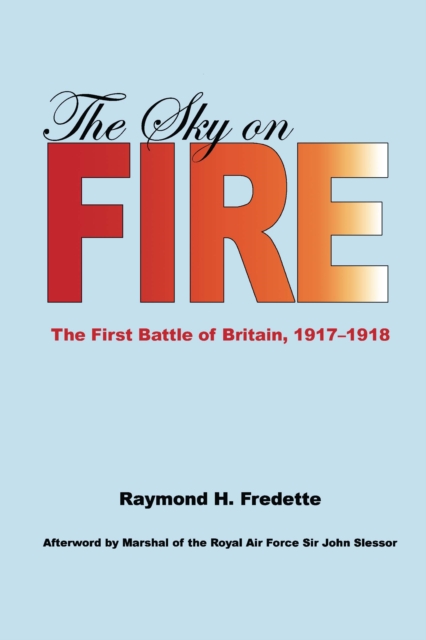
Sky on Fire: The First Battle of Britain, 1917-1918
A fascinating examination of the strategies and uses of air power in the First World War, Sky on Fire covers not only developments in military hardware and tactics but also how public policy and political considerations shaped the ways air power was deployed. Providing an excellent balance of data and statistics as well as human insights, Fredette' s book is essential reading for readers interested in the air power, both historically and in contemporary conflicts.
eBook