
Catalogue Search | MBRL


Are you sure you want to remove the book from the shelf?

{{itemTitle}}
963
result(s) for
"Great Lakes Region."
Sort by:

Plants and animals of the Great Lakes
The importance of biodiversity in the Great Lakes watershed cannot be overemphasized. The thousands of kinds of plants and animals that live in the lakes habitats affect the health of the lakes, just as the lakes health affects the wildlife. Readers learn about the many habitats of the Great Lakes region and conservation efforts that continue to restore and protect them. Full-color photographs accompany in-depth profiles of plants and animals, such as the Canada goose and brook trout, in the region. Sidebars introduce even more wildlife information, which augments the social studies and science curriculum students learn in the classroom. Conservation Themes, Detailed Table of Contents, For Further Information Section, Glossary, Index, Maps, Science Content, Sidebars, Social Studies Content.
Book

The Dynamics of Violence in Central Africa
Endowed with natural resources, majestic bodies of fresh water, and a relatively mild climate, the Great Lakes region of Central Africa has also been the site of some of the world's bloodiest atrocities. In Rwanda, Burundi, and the Congo-Kinshasa, decades of colonial subjugation-most infamously under Belgium's Leopold II-were followed by decades of civil warfare that spilled into neighboring countries. When these conflicts lead to horrors such as the 1994 Rwandan genocide, ethnic difference and postcolonial legacies are commonly blamed, but, with so much at stake, such simple explanations cannot take the place of detailed, dispassionate analysis.The Dynamics of Violence in Central Africaprovides a thorough exploration of the contemporary crises in the region. By focusing on the historical and social forces behind the cycles of bloodshed in Rwanda, Burundi, and the Congo-Kinshasa, René Lemarchand challenges much of the conventional wisdom about the roots of civil strife in former Belgian Africa. He offers telling insights into the appalling cycle of genocidal violence, ethnic strife, and civil war that has made the Great Lakes region of Central Africa the most violent on the continent, and he sheds new light on the dynamics of conflict in the region. Building on a full career of scholarship and fieldwork, Lemarchand's analysis breaks new ground in our understanding of the complex historical forces that continue to shape the destinies of one of Africa's most important regions.
eBook


The Once and Future Great Lakes Country
North America's Great Lakes country has experienced centuries of upheaval. Its landscapes are utterly changed from what they were five hundred years ago. The region's superabundant fish and wildlife and its magnificent forests and prairies astonished European newcomers who called it an earthly paradise but then ushered in an era of disease, warfare, resource depletion, and land development that transformed it forever. The Once and Future Great Lakes Country is a history of environmental change in the Great Lakes region, looking as far back as the last ice age, and also reflecting on modern trajectories of change, many of them positive. John Riley chronicles how the region serves as a continental crossroads, one that experienced massive declines in its wildlife and native plants in the centuries after European contact, and has begun to see increased nature protection and re-wilding in recent decades. Yet climate change, globalization, invasive species, and urban sprawl are today exerting new pressures on the region’s ecology. Covering a vast geography encompassing two Canadian provinces and nine American states, The Once and Future Great Lakes Country provides both a detailed ecological history and a broad panorama of this vast region. It blends the voices of early visitors with the hopes of citizens now.
eBook

The nature of empires and the empires of nature : Indigenous peoples and the Great Lakes environment
Explores the power of Nature and the attempts by Empires (United States, Canada, and Britain) to control it from Indigenous or Indigenous influenced perspectives. This title hopes to inspire ways of looking at the Great Lakes watershed and the people and empires contained within it.
Book
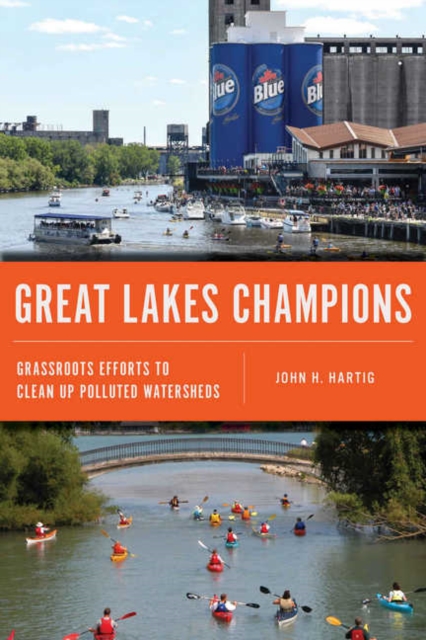
Great Lakes Champions
The Great Lakes-containing one-fifth of the standing freshwater on earth, covering some 94,250 square miles with a combined 10,210 miles of shoreline-have suffered greatly from human use and abuse since the advent of the commercial fur trade in the late 1600s. Logging destroys or degrades habitats, urbanization and industrialization pour human and industrial wastes into the water, fertilizers flowing off farm fields feed algae that suffocate other creatures, and ships bring in exotic species that decimate the lakes' biodiversity. In 1985 when the International Joint Commission identified more than forty pollution hotspots around the lakes, few people had faith the Areas of Concern would be cleaned up in their lifetime. Indeed, aquatic ecosystem restoration is extremely difficult: only nine of these hotspots have been removed from the infamous list. But progress is being made, and at the helm are local champions, people with a profound love of the region who lead by example and build broad, diverse coalitions in order to realize a common vision. The stories of fourteen of these champions are told here to inspire necessary action to care for the place they call home, so it may be a home to many living creatures for ages yet to come.
eBook

The middle ground : Indians, empires, and republics in the Great Lakes region, 1650-1815
\"An acclaimed book and widely acknowledged classic, The Middle Ground steps outside the simple stories of Indian-white relations - stories of conquest and assimilation and stories of cultural persistence. It is, instead, about a search for accommodation and common meaning. It tells how Europeans and Indians met, regarding each other as alien, as other, as virtually nonhuman, and how between 1650 and 1815 they constructed a common, mutually comprehensible world in the region around the Great Lakes that the French called pays d'en haut. Here the older worlds of the Algonquians and of various Europeans overlapped, and their mixture created new systems of meaning and of exchange. Finally, the book tells of the breakdown of accommodation and common meanings and the re-creation of the Indians as alien and exotic. First published in 1991, the 20th anniversary edition includes a new preface by the author examining the impact and legacy of this study\"-- Provided by publisher.
Book

Conflict and Peacebuilding in the African Great Lakes Region
Driven by genocide, civil war, political instabilities, ethnic and pastoral hostilities, the African Great Lakes Region, primarily Uganda, Rwanda, Democratic Republic of the Congo, and Burundi, has been overwhelmingly defined by conflict. Kenneth Omeje, Tricia Redeker Hepner, and an international group of scholars, many from the Great Lakes region, focus on the interlocking conflicts and efforts toward peace in this multidisciplinary volume. These essays present a range of debates and perspectives on the history and politics of conflict, highlighting the complex internal and external sources of both persistent tension and creative peacebuilding. Taken together, the essays illustrate that no single perspective or approach can adequately capture the dynamics of conflict or offer successful strategies for sustainable peace in the region.
eBook

The Great Lakes : our freshwater treasure
\"A picture book about the five largest lakes in North America - how they formed, the importance of these waters, and how they've become a national treasure\"-- Provided by publisher.
Book

Performing Trauma in Central Africa
What are the stakes of performance in a time of war? How is artistic expression prone to manipulation by the state and international humanitarian organizations? From the standpoint of empire, Laura Edmondson explores cultural production that responds to the 1994 genocide in Rwanda, the twenty-year civil war in northern Uganda, and regional conflict in the eastern part of the Democratic Republic of the Congo. She examines memorial ceremonies, plays, indigenous performance, NGO media campaigns, and contemporary dance to reveal how artists and cultural workers challenge state and humanitarian narratives in the shadow of empire and how empire, in turn, infiltrates creative capacities. Carefully contextualizing these narratives within the charged political terrain of the Great Lakes Region, Edmondson deepens our understanding of the role of creative expression and cultural agency in conflict and postconflict zones.
eBook