
Catalogue Search | MBRL


Are you sure you want to remove the book from the shelf?

{{itemTitle}}
76
result(s) for
"Greece Civilization Influence."
Sort by:


Greece and the Augustan Cultural Revolution
This book examines the impact of the Roman cultural revolution under Augustus on the Roman province of Greece. It argues that the transformation of Roman Greece into a classicizing 'museum' was a specific response of the provincial Greek elites to the cultural politics of the Roman imperial monarchy. Against a background of Roman debates about Greek culture and Roman decadence, Augustus promoted the ideal of a Roman debt to a 'classical' Greece rooted in Europe and morally opposed to a stereotyped Asia. In Greece the regime signalled its admiration for Athens, Sparta, Olympia and Plataea as symbols of these past Greek glories. Cued by the Augustan monarchy, provincial Greek notables expressed their Roman orientation by competitive cultural work (revival of ritual; restoration of buildings) aimed at further emphasising Greece's 'classical' legacy. Reprised by Hadrian, the Augustan construction of 'classical' Greece helped to promote the archaism typifying Greek culture under the principate.
eBook


Byron's War
Roderick Beaton re-examines Lord Byron's life and writing through the long trajectory of his relationship with Greece. Beginning with the poet's youthful travels in 1809–1811, Beaton traces his years of fame in London and self-imposed exile in Italy, that culminated in the decision to devote himself to the cause of Greek independence. Then comes Byron's dramatic self-transformation, while in Cephalonia, from Romantic rebel to 'new statesman', subordinating himself for the first time to a defined, political cause, in order to begin laying the foundations, during his 'hundred days' at Missolonghi, for a new kind of polity in Europe – that of the nation-state as we know it today. Byron's War draws extensively on Greek historical sources and other unpublished documents to tell an individual story that also offers a new understanding of the significance that Greece had for Byron, and of Byron's contribution to the origin of the present-day Greek state.
eBook

Greece and the Augustan cultural revolution
\"This book examines the impact of the Roman cultural revolution under Augustus on the Roman province of Greece. It argues that the transformation of Roman Greece into a classicizing 'museum' was a specific response of the provincial Greek elites to the cultural politics of the Roman imperial monarchy. Against a background of Roman debates about Greek culture and Roman decadence, Augustus promoted the ideal of a Roman debt to a 'classical' Greece rooted in Europe and morally opposed to a stereotyped Asia. In Greece the regime signalled its admiration for Athens, Sparta, Olympia and Plataea as symbols of these past Greek glories. Cued by the Augustan monarchy, provincial-Greek notables expressed their Roman orientation by competitive cultural work (revival of ritual; restoration of buildings) aimed at further emphasising Greece's 'classical' legacy. Reprised by Hadrian, the Augustan construction of 'classical' Greece helped to promote the archaism typifying Greek culture under the principate\"-- Provided by publisher.
BOOK


Egypt and the Limits of Hellenism
In a series of studies, Ian Moyer explores the ancient history and modern historiography of relations between Egypt and Greece from the fifth century BCE to the early Roman empire. Beginning with Herodotus, he analyzes key encounters between Greeks and Egyptian priests, the bearers of Egypt's ancient traditions. Four moments unfold as rich micro-histories of cross-cultural interaction: Herodotus' interviews with priests at Thebes; Manetho's composition of an Egyptian history in Greek; the struggles of Egyptian priests on Delos; and a Greek physician's quest for magic in Egypt. In writing these histories, the author moves beyond Orientalizing representations of the Other and colonial metanarratives of the civilizing process to reveal interactions between Greeks and Egyptians as transactional processes in which the traditions, discourses and pragmatic interests of both sides shaped the outcome. The result is a dialogical history of cultural and intellectual exchanges between the great civilizations of Greece and Egypt.
eBook


Black Athena
Could Greek philosophy be rooted in Egyptian thought? Is it possible that the Pythagorean theory was conceived on the shores of the Nile and the Euphrates rather than in ancient Greece? Could it be that much of Western civilization was formed on the \"Dark Continent\"? For almost two centuries, Western scholars have given little credence to the possibility of such scenarios.
InBlack Athena,an audacious three-volume series that strikes at the heart of today's most heated culture wars, Martin Bernal challenges Eurocentric attitudes by calling into question two of the longest-established explanations for the origins of classical civilization. To use his terms, the Aryan Model, which is current today, claims that Greek culture arose as the result of the conquest from the north by Indo-European speakers, or \"Aryans,\" of the native \"pre-Hellenes.\" The Ancient Model, which was maintained in Classical Greece, held that the native population of Greece had initially been civilized by Egyptian and Phoenician colonists and that additional Near Eastern culture had been introduced to Greece by Greeks studying in Egypt and Southwest Asia. Moving beyond these prevailing models, Bernal proposes a Revised Ancient Model, which suggests that classical civilization in fact had deep roots in Afroasiatic cultures.
This long-awaited third and final volume of the series is concerned with the linguistic evidence that contradicts the Aryan Model of ancient Greece. Bernal shows how nearly 40 percent of the Greek vocabulary has been plausibly derived from two Afroasiatic languages-Ancient Egyptian and West Semitic. He also reveals how these derivations are not limited to matters of trade, but extended to the sophisticated language of politics, religion, and philosophy. This evidence, according to Bernal, greatly strengthens the hypothesis that in Greece an Indo-European-speaking population was culturally dominated by Ancient Egyptian and West Semitic speakersProvocative, passionate, and colossal in scope, this volume caps a thoughtful rewriting of history that has been stirring academic and political controversy since the publication of the first volume.
eBook
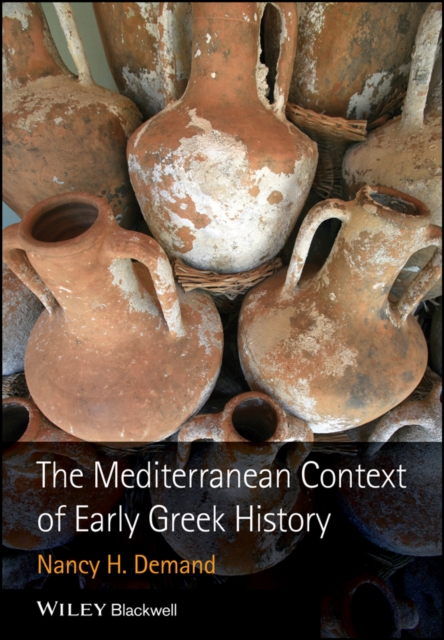
The Mediterranean context of early Greek history
Noted historian Nancy H. Demand joins the growing group of scholars who have abandoned traditional isolationist models of the development of the Greek polis and cast their gaze seaward, to the sparkling waters of the Mediterranean.
eBook