
Catalogue Search | MBRL


Are you sure you want to remove the book from the shelf?

{{itemTitle}}
27
result(s) for
"Greece Civilization Roman influences."
Sort by:

Egypt and the limits of Hellenism
\"In a series of studies, Ian Moyer explores the ancient history and modern historiography of relations between Egypt and Greece from the fifth century BCE to the early Roman Empire. Beginning with Herodotus, he analyzes key encounters between Greeks and Egyptian priests, the bearers of Egypt's ancient traditions. Four moments unfold as rich micro-histories of cross-cultural interaction: Herodotus' interviews with priests at Thebes; Manetho's composition of an Egyptian history in Greek; the struggles of Egyptian priests on Delos; and a Greek physician's quest for magic in Egypt. In writing these histories, the author moves beyond Orientalizing representations of the Other and colonial metanarratives of the civilizing process to reveal interactions between Greeks and Egyptians as transactional processes in which the traditions, discourses and pragmatic interests of both sides shaped the outcome. The result is a dialogical history of cultural and intellectual exchanges between the great civilizations of Greece and Egypt\"-- Provided by publisher.
Book

Greece and the Augustan Cultural Revolution
This book examines the impact of the Roman cultural revolution under Augustus on the Roman province of Greece. It argues that the transformation of Roman Greece into a classicizing 'museum' was a specific response of the provincial Greek elites to the cultural politics of the Roman imperial monarchy. Against a background of Roman debates about Greek culture and Roman decadence, Augustus promoted the ideal of a Roman debt to a 'classical' Greece rooted in Europe and morally opposed to a stereotyped Asia. In Greece the regime signalled its admiration for Athens, Sparta, Olympia and Plataea as symbols of these past Greek glories. Cued by the Augustan monarchy, provincial Greek notables expressed their Roman orientation by competitive cultural work (revival of ritual; restoration of buildings) aimed at further emphasising Greece's 'classical' legacy. Reprised by Hadrian, the Augustan construction of 'classical' Greece helped to promote the archaism typifying Greek culture under the principate.
eBook

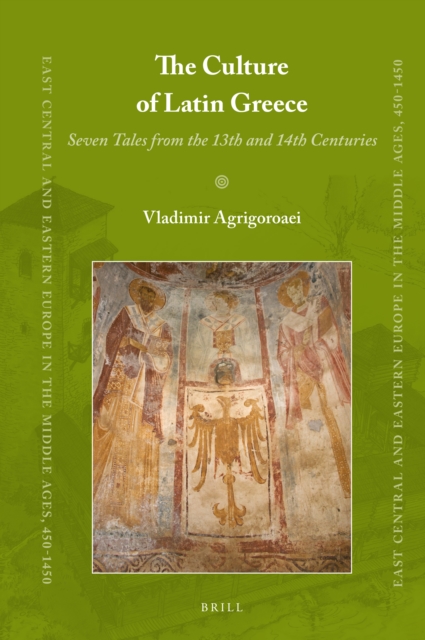
The Culture of Latin Greece
The author and six historical characters of his own choosing tell tales and guide you through the artistic and literary maze of Latin-occupied Greece. They show you patterns, influences, and dissimilar evolutions in what appears to be a 13th-14th century cultural conundrum.
eBook

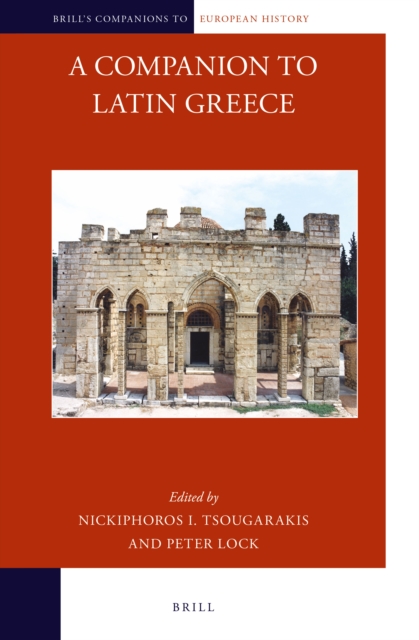
A Companion to Latin Greece
The Companion to Latin Greece offers an overview of the history of the Latin states that were founded on former lands of the Byzantine Empire following the conquest of Byzantium by the armies of the Fourth Crusade.
eBook

Student commentary on Pausanias Book 1
\"Patrick Paul Hogan's A Student Commentary on Pausanias Book 1 introduces the first book of Pausanias' 'Description of Greece' to students of Classical Greek. Pausanias' second century CE work is the only surviving ancient description of the monuments and artwork of mainland Greece. Book 1 of the 'Description' covers Athens, its demes, and Megara--that is, Attica, the heart of the ancient Greek world. It offers not only a walking description of buildings, statues, and artwork by an ancient traveler but also insight into the mindset of an educated Greek of the Roman imperial age: his reaction to Roman domination and Classical Greek history and culture, his deeply felt religious beliefs, and his ideas regarding Hellenism and Hellenic identity. This textbook, the first on Pausanias aimed at students in almost a century, brings Pausanias back into the classroom for a new generation of readers. It is based on the Greek text edited by M.H. Rocha-Pereira and includes philological and historical commentary by Hogan. This volume elucidates difficult syntax and helps the reader with the immense number of names and places Pausanias mentions. It is suitable for students of Classical Greek at the graduate and undergraduate levels, whether Classical philologists or Classical archaeologists and art historians. Professors of archaeology will find this textbook an excellent starting point for any course on Pausanias and easily supplemented by their own knowledge of material remains and modern finds\" -- Provided by publisher.
BOOK

Rethinking the Other in Antiquity
Prevalent among classicists today is the notion that Greeks, Romans, and Jews enhanced their own self-perception by contrasting themselves with the so-called Other--Egyptians, Phoenicians, Ethiopians, Gauls, and other foreigners--frequently through hostile stereotypes, distortions, and caricature. In this provocative book, Erich Gruen demonstrates how the ancients found connections rather than contrasts, how they expressed admiration for the achievements and principles of other societies, and how they discerned--and even invented--kinship relations and shared roots with diverse peoples.
Gruen shows how the ancients incorporated the traditions of foreign nations, and imagined blood ties and associations with distant cultures through myth, legend, and fictive histories. He looks at a host of creative tales, including those describing the founding of Thebes by the Phoenician Cadmus, Rome's embrace of Trojan and Arcadian origins, and Abraham as ancestor to the Spartans. Gruen gives in-depth readings of major texts by Aeschylus, Herodotus, Xenophon, Plutarch, Julius Caesar, Tacitus, and others, in addition to portions of the Hebrew Bible, revealing how they offer richly nuanced portraits of the alien that go well beyond stereotypes and caricature.
Providing extraordinary insight into the ancient world, this controversial book explores how ancient attitudes toward the Other often expressed mutuality and connection, and not simply contrast and alienation.
eBook

Greece and the Augustan cultural revolution
\"This book examines the impact of the Roman cultural revolution under Augustus on the Roman province of Greece. It argues that the transformation of Roman Greece into a classicizing 'museum' was a specific response of the provincial Greek elites to the cultural politics of the Roman imperial monarchy. Against a background of Roman debates about Greek culture and Roman decadence, Augustus promoted the ideal of a Roman debt to a 'classical' Greece rooted in Europe and morally opposed to a stereotyped Asia. In Greece the regime signalled its admiration for Athens, Sparta, Olympia and Plataea as symbols of these past Greek glories. Cued by the Augustan monarchy, provincial-Greek notables expressed their Roman orientation by competitive cultural work (revival of ritual; restoration of buildings) aimed at further emphasising Greece's 'classical' legacy. Reprised by Hadrian, the Augustan construction of 'classical' Greece helped to promote the archaism typifying Greek culture under the principate\"-- Provided by publisher.
BOOK

Egypt and the Limits of Hellenism
In a series of studies, Ian Moyer explores the ancient history and modern historiography of relations between Egypt and Greece from the fifth century BCE to the early Roman empire. Beginning with Herodotus, he analyzes key encounters between Greeks and Egyptian priests, the bearers of Egypt's ancient traditions. Four moments unfold as rich micro-histories of cross-cultural interaction: Herodotus' interviews with priests at Thebes; Manetho's composition of an Egyptian history in Greek; the struggles of Egyptian priests on Delos; and a Greek physician's quest for magic in Egypt. In writing these histories, the author moves beyond Orientalizing representations of the Other and colonial metanarratives of the civilizing process to reveal interactions between Greeks and Egyptians as transactional processes in which the traditions, discourses and pragmatic interests of both sides shaped the outcome. The result is a dialogical history of cultural and intellectual exchanges between the great civilizations of Greece and Egypt.
eBook