
Catalogue Search | MBRL


Are you sure you want to remove the book from the shelf?

{{itemTitle}}
162
result(s) for
"Greece Civilization To 146 B.C."
Sort by:

The Greek News
Presents a \"special edition\" of a Greek newspaper which spans the years 1500 to 146 B.C. and contains articles about history, politics, feasts, fashions, theater, gods, and wars.
Book

Rethinking the Other in Antiquity
Prevalent among classicists today is the notion that Greeks, Romans, and Jews enhanced their own self-perception by contrasting themselves with the so-called Other--Egyptians, Phoenicians, Ethiopians, Gauls, and other foreigners--frequently through hostile stereotypes, distortions, and caricature. In this provocative book, Erich Gruen demonstrates how the ancients found connections rather than contrasts, how they expressed admiration for the achievements and principles of other societies, and how they discerned--and even invented--kinship relations and shared roots with diverse peoples.
Gruen shows how the ancients incorporated the traditions of foreign nations, and imagined blood ties and associations with distant cultures through myth, legend, and fictive histories. He looks at a host of creative tales, including those describing the founding of Thebes by the Phoenician Cadmus, Rome's embrace of Trojan and Arcadian origins, and Abraham as ancestor to the Spartans. Gruen gives in-depth readings of major texts by Aeschylus, Herodotus, Xenophon, Plutarch, Julius Caesar, Tacitus, and others, in addition to portions of the Hebrew Bible, revealing how they offer richly nuanced portraits of the alien that go well beyond stereotypes and caricature.
Providing extraordinary insight into the ancient world, this controversial book explores how ancient attitudes toward the Other often expressed mutuality and connection, and not simply contrast and alienation.
eBook

A brief history of ancient Greece : politics, society and culture
Combining research from the fields of social history, archaeology, and comparative anthropology, this work covers the entire span of Greek history from the Bronze Age to the Hellenistic Era and details coverage of women and family life, religion, and athletics in Greek life, as well as male homosexuality.
Book

Wandering Greeks
Most classical authors and modern historians depict the ancient Greek world as essentially stable and even static, once the so-called colonization movement came to an end. But Robert Garland argues that the Greeks were highly mobile, that their movement was essential to the survival, success, and sheer sustainability of their society, and that this wandering became a defining characteristic of their culture. Addressing a neglected but essential subject,Wandering Greeksfocuses on the diaspora of tens of thousands of people between about 700 and 325 BCE, demonstrating the degree to which Greeks were liable to be forced to leave their homes due to political upheaval, oppression, poverty, warfare, or simply a desire to better themselves.
Attempting to enter into the mind-set of these wanderers, the book provides an insightful and sympathetic account of what it meant for ancient Greeks to part from everyone and everything they held dear, to start a new life elsewhere-or even to become homeless, living on the open road or on the high seas with no end to their journey in sight. Each chapter identifies a specific kind of \"wanderer,\" including the overseas settler, the deportee, the evacuee, the asylum-seeker, the fugitive, the economic migrant, and the itinerant, and the book also addresses repatriation and the idea of the \"portable polis.\" The result is a vivid and unique portrait of ancient Greece as a culture of displaced persons.
eBook

Blast back! : ancient Greece
\"When people talk about ancient Greece, things like myths and the Olympics may come to mind. But what was ancient Greece really like? This engaging nonfiction book, complete with black and white interior illustrations, will make readers feel like they've traveled back in time. It covers everything from what ancient Greeks did for fun to the gods and goddesses they worshipped, and more.\"--Amazon.com.
Book

The Rise and Fall of Classical Greece
Lord Byron described Greece as great, fallen, and immortal, a characterization more apt than he knew. Through most of its long history, Greece was poor. But in the classical era, Greece was densely populated and highly urbanized. Many surprisingly healthy Greeks lived in remarkably big houses and worked for high wages at specialized occupations. Middle-class spending drove sustained economic growth and classical wealth produced a stunning cultural efflorescence lasting hundreds of years.
Why did Greece reach such heights in the classical period-and why only then? And how, after \"the Greek miracle\" had endured for centuries, did the Macedonians defeat the Greeks, seemingly bringing an end to their glory? Drawing on a massive body of newly available data and employing novel approaches to evidence, Josiah Ober offers a major new history of classical Greece and an unprecedented account of its rise and fall.
Ober argues that Greece's rise was no miracle but rather the result of political breakthroughs and economic development. The extraordinary emergence of citizen-centered city-states transformed Greece into a society that defeated the mighty Persian Empire. Yet Philip and Alexander of Macedon were able to beat the Greeks in the Battle of Chaeronea in 338 BCE, a victory made possible by the Macedonians' appropriation of Greek innovations. After Alexander's death, battle-hardened warlords fought ruthlessly over the remnants of his empire. But Greek cities remained populous and wealthy, their economy and culture surviving to be passed on to the Romans-and to us.
A compelling narrative filled with uncanny modern parallels, this is a book for anyone interested in how great civilizations are born and die.
This book is based on evidence available on a new interactive website. To learn more, please visit: http://polis.stanford.edu/.
eBook

Hail! Ancient Greeks
Presented in the style of a tabloid newspaper, this book describes some of the interesting history, culture, and facts about ancient Greece.
Book
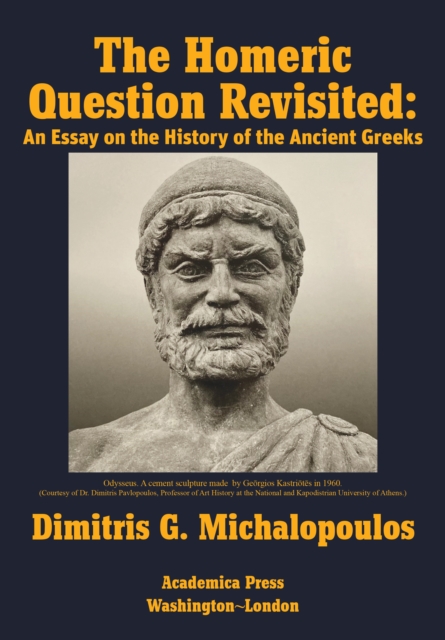
The Homeric Question Revisited
How did Socrates and Plato know that our planet is shaped like a ball? How were they aware that the earth has twelve tectonic plates? Were the Persians conquered at the naval battle of Salamis thanks to missiles launched from the nearby Thriasion Plain? How can Theocritus' accurate knowledge of the American continent and Plutarch's awareness of the Sargasso Sea be explained? Who was the real victor of the Trojan War, the Greeks or the Trojans? Can the aftermath of that legendary war in Anatolia be regarded as proof that the Greeks were conquered by the Trojans and not vice-versa? In point of fact, almost the whole of ancient Greek civilization is still an enigma. This book, taking as its starting point the assurance of Strabo, the famous geographer of the age of Pax Romana, that Odysseus's peregrinations took place in the Atlantic Ocean, provides evidence for the veracity of this statement.
eBook

Empire of ancient Greece
This volume chronicles the legacy of the Greeks, as well as the diversity of their societies--from the thriving democracy of Athens to the militarism of Sparta to the oligarchy of Thrace. It explores the conditions that made it possible for the ancient Greeks to develop a culture that set the foundation for our intellectual lives today, and explains why Greek power eventually declined.
Book

The Hellenistic Age
The three centuries following the conquests of Alexander were perhaps the most thrilling of all periods of ancient history. Culture, ideas, and individuals travelled freely over vast areas from the Rhone to the Indus, whilst dynasts battled for dominion over Alexander's great empire. Thonemann presents a brief history of this globalized world.
eBook