
Catalogue Search | MBRL


Are you sure you want to remove the book from the shelf?

{{itemTitle}}
1,708
result(s) for
"Greece Civilization."
Sort by:

Creators, conquerors, and citizens : a history of ancient Greece
\"We Greeks are one in blood and one in language; we have temples to the gods and religious rites in common, and a common way of life.\" So the fifth-century historian Herodotus has some Athenians declare, in explanation of why they would never betray their fellow Greeks to the enemy, the \"barbarian\" Persians. And he might have added further common features, such as clothing, foodways, and political institutions. But if the Greeks knew that they were kin, why did many of them side with the Persians against fellow Greeks, and why, more generally, is ancient Greek history so often the history of internecine wars and other forms of competition with one another? This is the question acclaimed historian Robin Waterfield sets out to explore in this magisterial history of ancient Greece. With more information, more engagingly presented, than any similar work, this is the best single-volume account of ancient Greece in more than a generation. Waterfield gives a comprehensive narrative of seven hundred years of history, from the emergence of the Greeks around 750 BCE to the Roman conquest of the last of the Greco-Macedonian kingdoms in 30 BCE. Equal weight is given to all phases of Greek history -- the Archaic, Classical, and Hellenistic periods. But history is not just facts; it is also a matter of how we interpret the evidence. Without compromising the readability of the book, Waterfield incorporates the most recent scholarship by classical historians and archaeologists and asks his readers to think critically about Greek history. A brilliant, up-to-date account of ancient Greece, suitable for history buffs and university students alike, Creators, Conquerors, and Citizens presents a compelling and comprehensive story of this remarkable civilization's disunity, underlying cultural solidarity, and eventual political unification. \"-- Provided by publisher.
Book

Greece and the Augustan Cultural Revolution
This book examines the impact of the Roman cultural revolution under Augustus on the Roman province of Greece. It argues that the transformation of Roman Greece into a classicizing 'museum' was a specific response of the provincial Greek elites to the cultural politics of the Roman imperial monarchy. Against a background of Roman debates about Greek culture and Roman decadence, Augustus promoted the ideal of a Roman debt to a 'classical' Greece rooted in Europe and morally opposed to a stereotyped Asia. In Greece the regime signalled its admiration for Athens, Sparta, Olympia and Plataea as symbols of these past Greek glories. Cued by the Augustan monarchy, provincial Greek notables expressed their Roman orientation by competitive cultural work (revival of ritual; restoration of buildings) aimed at further emphasising Greece's 'classical' legacy. Reprised by Hadrian, the Augustan construction of 'classical' Greece helped to promote the archaism typifying Greek culture under the principate.
eBook

The Greek News
Presents a \"special edition\" of a Greek newspaper which spans the years 1500 to 146 B.C. and contains articles about history, politics, feasts, fashions, theater, gods, and wars.
Book

The Rise and Fall of Classical Greece
Lord Byron described Greece as great, fallen, and immortal, a characterization more apt than he knew. Through most of its long history, Greece was poor. But in the classical era, Greece was densely populated and highly urbanized. Many surprisingly healthy Greeks lived in remarkably big houses and worked for high wages at specialized occupations. Middle-class spending drove sustained economic growth and classical wealth produced a stunning cultural efflorescence lasting hundreds of years.
Why did Greece reach such heights in the classical period-and why only then? And how, after \"the Greek miracle\" had endured for centuries, did the Macedonians defeat the Greeks, seemingly bringing an end to their glory? Drawing on a massive body of newly available data and employing novel approaches to evidence, Josiah Ober offers a major new history of classical Greece and an unprecedented account of its rise and fall.
Ober argues that Greece's rise was no miracle but rather the result of political breakthroughs and economic development. The extraordinary emergence of citizen-centered city-states transformed Greece into a society that defeated the mighty Persian Empire. Yet Philip and Alexander of Macedon were able to beat the Greeks in the Battle of Chaeronea in 338 BCE, a victory made possible by the Macedonians' appropriation of Greek innovations. After Alexander's death, battle-hardened warlords fought ruthlessly over the remnants of his empire. But Greek cities remained populous and wealthy, their economy and culture surviving to be passed on to the Romans-and to us.
A compelling narrative filled with uncanny modern parallels, this is a book for anyone interested in how great civilizations are born and die.
This book is based on evidence available on a new interactive website. To learn more, please visit: http://polis.stanford.edu/.
eBook

A history of Greece
Drawing on the latest research into ancient, medieval, and modern history, this single-volume traces the history of Greek culture and societies from the Bronze Age to the present. Written for the general reader and undergraduate student, it examines the continuities and changes across the entirety of Greek history --Provided by publisher.
Book

Rethinking the Other in Antiquity
Prevalent among classicists today is the notion that Greeks, Romans, and Jews enhanced their own self-perception by contrasting themselves with the so-called Other--Egyptians, Phoenicians, Ethiopians, Gauls, and other foreigners--frequently through hostile stereotypes, distortions, and caricature. In this provocative book, Erich Gruen demonstrates how the ancients found connections rather than contrasts, how they expressed admiration for the achievements and principles of other societies, and how they discerned--and even invented--kinship relations and shared roots with diverse peoples.
Gruen shows how the ancients incorporated the traditions of foreign nations, and imagined blood ties and associations with distant cultures through myth, legend, and fictive histories. He looks at a host of creative tales, including those describing the founding of Thebes by the Phoenician Cadmus, Rome's embrace of Trojan and Arcadian origins, and Abraham as ancestor to the Spartans. Gruen gives in-depth readings of major texts by Aeschylus, Herodotus, Xenophon, Plutarch, Julius Caesar, Tacitus, and others, in addition to portions of the Hebrew Bible, revealing how they offer richly nuanced portraits of the alien that go well beyond stereotypes and caricature.
Providing extraordinary insight into the ancient world, this controversial book explores how ancient attitudes toward the Other often expressed mutuality and connection, and not simply contrast and alienation.
eBook

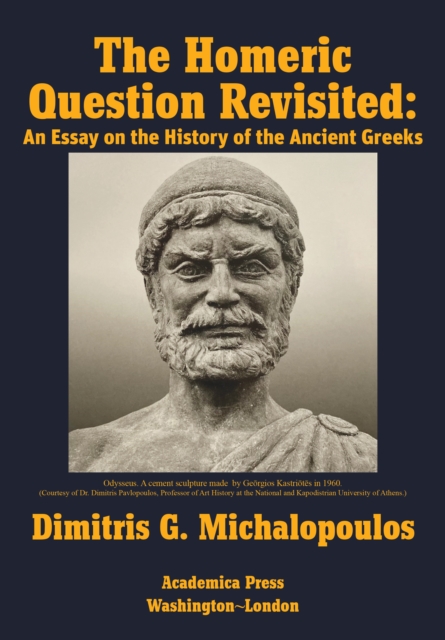
The Homeric Question Revisited
How did Socrates and Plato know that our planet is shaped like a ball? How were they aware that the earth has twelve tectonic plates? Were the Persians conquered at the naval battle of Salamis thanks to missiles launched from the nearby Thriasion Plain? How can Theocritus accurate knowledge of the American continent and Plutarchs awareness of the Sargasso Sea be explained? Who was the real victor of the Trojan War, the Greeks or the Trojans? Can the aftermath of that legendary war in Anatolia be regarded as proof that the Greeks were conquered by the Trojans and not vice-versa? In point of fact, almost the whole of ancient Greek civilization is still an enigma. This book, taking as its starting point the assurance of Strabo, the famous geographer of the age of Pax Romana, that Odysseuss peregrinations took place in the Atlantic Ocean, provides evidence for the veracity of this statement.
eBook


City and empire in the age of the successors
In the chaotic decades after the death of Alexander the Great, the world of the Greek city-state became deeply embroiled in the political struggles and unremitting violence of his successors’ contest for supremacy. As these presumptive rulers turned to the practical reality of administering the disparate territories under their control, they increasingly developed new cities by merging smaller settlements into large urban agglomerations. This practice of synoikism gave rise to many of the most important cities of the age, initiated major shifts in patterns of settlement, and consolidated numerous previously independent polities. The result was the increasing transformation of the fragmented world of the small Greek polis into an urbanized network of cities. Drawing on a wide array of archaeological, epigraphic, and textual evidence, City and Empire in the Age of the Successors reinterprets the role of urbanization in the creation of the Hellenistic kingdoms and argues for the agency of local actors in the formation of these new imperial cities.
eBook